



.jpg)
There is an ancestral Chinese stool beneath us and rather too much history above.
Ai Weiwei has arranged hundreds of the small folding seats across the floor of Aviva Studios, asking those assembled for the first view of his vast new exhibition to sit close to the ground. The design can be traced back centuries, he explains: portable furniture for people travelling on horseback. These particular stools were made by the artist. They are objects of usefulness, inheritance and hospitality.
They are also a kindly gesture. Because almost everything else inside Button Up! is enormous.
Above and around us, history has been inflated, reconstructed, cast in bronze, assembled from antique timber, blown in black Murano glass and fixed together with several million plastic bricks and buttons. The exhibition occupies the great Warehouse at Aviva Studios with sufficient confidence to make even that extraordinary room feel briefly containable.
A 49-metre black inflatable boat carries hundreds of faceless human figures. A Ming dynasty ancestral hall, dismantled and rebuilt from around 1,500 wooden components, occupies the space like an improbable visitation. Twelve monumental bronze animal heads revisit the looting of Beijing’s Old Summer Palace by British and French troops. An immense chandelier - beautiful, funereal and almost grotesque - turns death into something that glitters.
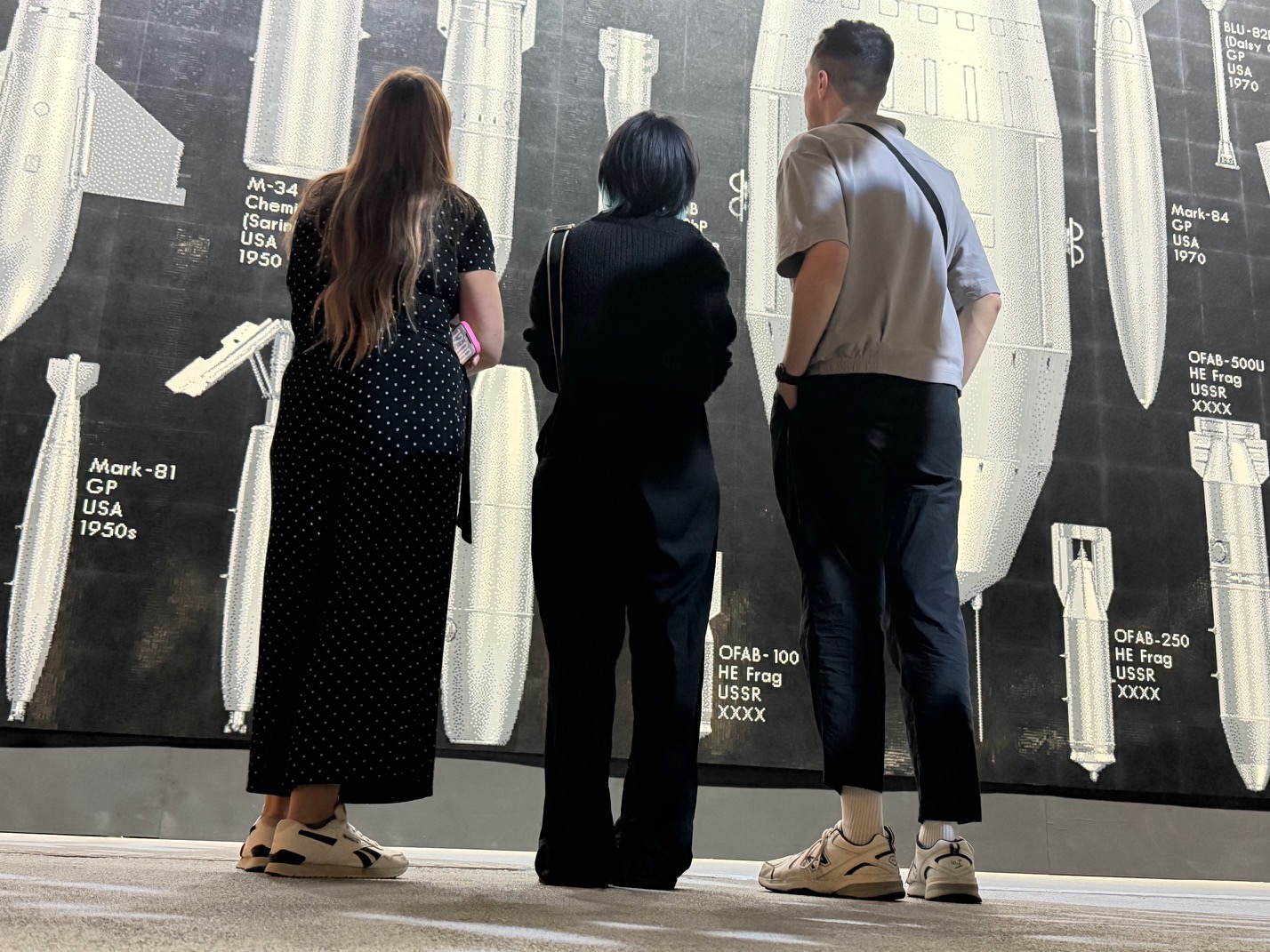
On one wall, the technologies of human destruction are laid out with the clarity of an industrial inventory.
Elsewhere, eight flags have been painstakingly constructed from approximately four million buttons.
The exhibition ranges across more than 200 years of encounter between China, Britain, Europe and the United States. It encompasses industrialisation, empire, slavery, war, trade, forced migration, censorship and the political uses of memory. Yet its emotional and intellectual key is something almost absurdly small.
A button fell from a prisoner’s trousers.
.jpg)
In April 2011, Ai Weiwei was seized by the Chinese authorities and secretly detained for 81 days. He had no access to a lawyer and could not tell his family where he was being held.
He was watched continually by young military guards. He slept, ate, washed and was interrogated beneath unbroken surveillance. He was required to walk for hours in a cell so small that movement became repetition rather than travel.
During his detention, Ai lost around ten kilograms. His trousers became loose. Eventually, their only button fell off.
At the press preview in Manchester, he tells the story with the comic timing of someone refusing to surrender the memory entirely to solemnity.
As he walked back and forth across the few tiles available to him, his trousers threatened to fall. The guards beside him were barely more than teenagers, trained to maintain an almost theatrical seriousness while accompanying a supposedly dangerous political criminal.
Ai discovered that allowing his trousers to drop could make them laugh.
For a moment, discipline failed. The absurd entered the room. The guards could not help themselves.
Ai asked his interrogators to have the button sewn back on.
It was, as he recalled, the only practical thing he required: the most minimal human request imaginable. Yet even this needed to move through an authoritarian architecture of permission and suspicion. A needle could not simply be carried into the room. The guards themselves were searched whenever they left, lest they convey information about him to the world outside.
Ai repeated the request. Eventually, two soldiers arrived and repaired the trousers beneath the CCTV cameras, making sure the surveillance system could see that they were doing only what had been authorised.
They did not sew the button particularly well. It was not even placed correctly.
But it held.
The story contains almost everything this exhibition wants us to consider.
A button is ordinary, industrially produced and usually unnoticed until it is missing. It separates dignity from exposure. It fastens the public self together. It is insignificant right up to the moment when a human being is denied the power to replace it.
It also gives the exhibition its title.
Button Up! is playful, but the play has teeth. It is an instruction to fasten one’s clothing and an order to stop speaking. It evokes the factory, the garment, Manchester’s textile history and the policing of expression. It moves between material and metaphor, humour and threat.
The button from Ai’s detention is not preserved here as a holy relic. Instead, its meaning expands until it becomes the organising principle for an exhibition about systems: the systems that manufacture objects, accumulate wealth, enforce borders, produce obedience and decide which human requests may be granted.
There is a danger, with any exhibition of this size and profile, that the city hosting it becomes little more than a location in the listings. That is emphatically not the case here.
Button Up! could not simply have been transferred to Manchester from elsewhere. Manchester is one of its subjects. Its factories, warehouses, trading history and role in the creation of industrial capitalism provide the exhibition with both its material language and its moral complication.
Ai first visited what would become Aviva Studios in 2022, while the building was still approaching completion. For Low Kee Hong, Factory International’s Creative Director, the four years that followed became a process of considering how an artist accustomed to working at great scale might respond to a building whose central Warehouse appears to resist ordinary limitation.
The result is described as Ai’s largest site-specific exhibition to date. The claim is believable not merely because the objects are huge, but because their relationships depend upon this particular city and this particular room.
Ai has exhibited in many of the world’s most important cultural institutions. In Manchester, however, he encountered a space capable of holding together monumental existing works and ambitious new commissions without reducing either to spectacle alone.
“The show would never, even till now, have the same kind of facility,” he told the assembled press, praising not only the building but the curators, technicians and exhibition staff required to deliver works moving simultaneously across sculpture, architecture, film, installation and performance.
But the architecture is only the beginning. To understand why Manchester matters, we must return to the buttons.
In 2019, Ai responded to news that A. Brown & Co Buttons, a London wholesaler that had traded for more than a century, was closing. Rather than allow the remaining stock to enter landfill, he purchased it - approximately 30 tonnes in all.
The acquisition was entirely characteristic of an artist alert to the memory carried by discarded material. But possession did not immediately produce meaning.
There were thousands of different kinds of button, accumulated across decades: objects designed for clothes, uniforms, classes, fashions and purposes that might already have disappeared. Ai has said the collection could have formed a museum of buttons in its own right.
Yet he refused to use them merely because there were millions available.
“Meaning is the usage,” he told us, invoking Wittgenstein. A vast quantity of material did not justify a vast artwork. The buttons needed a reason to exist again. Manchester gave him that reason.
The city’s industrial revolution was, in considerable part, a cotton revolution. Its mills, warehouses, canals and commercial institutions stood at the centre of an international system joining Lancashire to the plantations of the American South, the colonised markets and cotton fields of India, and the expanding reach of British finance and maritime power.
The story often told about Manchester is one of invention, labour, municipal ambition and technological transformation. All of that is true. It is also incomplete.
The city’s astonishing growth was entangled with slavery, extraction, colonial rule and the enforced movement of goods and people. Manchester did not simply manufacture cloth. It participated in a world system whose benefits and injuries were distributed with spectacular inequality.
Ai’s flags gather that history into material form.
Each represents one member of the Eight-Nation Alliance - Britain, France, the United States, Germany, Japan, Russia, Italy and the Austro-Hungarian Empire - whose forces intervened in China during the Boxer uprising at the beginning of the 20th century.
The work is visually seductive. From a distance, the surfaces appear almost textile-like. Move closer and they fracture into hundreds of thousands of individual buttons: some plain, some decorative, some already carrying the faint residue of another economic and social life.
The beauty is deliberate. And so is the discomfort.
Asked whether the flags constitute an accusation, Ai refuses the easy formulation. These things happened, he says. They are facts. The task is to keep memory alive.
History, in his telling, is not a tribunal in which the living inherit uncomplicated guilt for the actions of the dead. It is a set of forces that continue to shape relations between nations, economies and people. Britain’s military and commercial encounters with China belong to the past, but the contest between East and West, and particularly between China and the United States, remains active in the present.
The exhibition does not ask Manchester to perform repentance as cultural theatre. It asks the city to recognise itself as part of the story.
The sheer size of Button Up! will dominate many accounts of it.
That is understandable. The first bodily experience of entering the space is one of scale. Ai has placed major works together that are rarely, if ever, encountered in the same exhibition. They do not sit obediently within a sequence of white rooms. They coexist like competing historical events.
Yet monumentality can be misleading.
Ai says he is not interested in making large things simply for the sake of it. Size, in this exhibition, is a consequence of the subject.
History of Bombs occupies a wall approximately 25 metres wide and ten metres high. Constructed from 3.5 million toy bricks, it depicts conventional weapons and weapons of mass destruction in the manner of an immense diagram or visual checklist.
The material is associated with childhood, imagination and play. The images it produces catalogue the machinery built to obliterate childhoods, homes, cities and nations.
The contradiction is direct rather than subtle. It is also difficult to escape.
The first version of the work was presented at the Imperial War Museum. Here, expanded and rebuilt with the help of volunteers in Manchester and craftspeople in China, the chronology of weapons becomes part of the broader exhibition argument: modern warfare is inseparable from industrial capacity.
The factory does not only produce textiles, domestic goods or the conveniences of civilisation. It standardises, accelerates and multiplies destruction.
That point is made with even greater force by the relationship between History of Bombs and the flags. The nations represented in the Eight-Nation Alliance Flags are also nations deeply implicated in industrial warfare, imperial expansion and the global trade in weapons.
Manchester’s history as a centre of production therefore becomes part of a much larger question.
What do societies manufacture - and who is required to live with the consequences?
Beneath and around these works are objects carrying different registers of history.
The Wang Family Ancestral Hall dates from the late Ming dynasty. Reconstructed without nails from hundreds of pieces of timber, it brings an architecture of family, ethics and ancestral continuity into the industrial vastness of Aviva Studios.
Nearby, compressed blocks of Chinese tea appear almost minimal in form. But tea is not neutral here. It was a commodity desired by Britain and central to the imbalance of trade that helped precipitate the Opium Wars. An apparently modest domestic ritual opens onto military coercion, addiction, empire and the forced opening of Chinese markets.
The bronze heads of Circle of Animals/Zodiac Heads revisit another imperial wound: the looting of zodiac fountainheads from the Old Summer Palace by British and French troops in 1860.
Ai does not simply reconstruct the lost originals. He reimagines them at monumental scale, making restitution, authenticity, ownership and cultural memory impossible to separate.
Then there is La Commedia Umana.
The black Murano glass chandelier contains more than 2,000 hand-moulded pieces and weighs close to three tonnes. Begun before the pandemic and completed afterwards, it incorporates forms associated with death and bodily ruin. Its beauty is inseparable from menace.
It turns catastrophe into ornament and ornament back into catastrophe.
Like much of Ai’s work, it refuses the comfort of a single response. We may be astonished by the craftsmanship and repelled by what it depicts. The two reactions are permitted to remain together.
.jpg)
No object in the exhibition makes the body feel smaller than Law of the Journey.
The enormous inflatable boat, made from the material used in refugee vessels, contains hundreds of equally black, anonymous figures. Their lack of individual features is not an argument that refugees are interchangeable. It is an indictment of the political language through which individual lives are converted into a mass.
A “flow.” A “wave.” A “crisis.” A number arriving, waiting or being returned.
Ai has spent years documenting forced migration. For Human Flow, his feature-length film, he and his team visited refugee camps across more than 20 countries and conducted hundreds of interviews.
The boat in Manchester is not a representation of one journey. It holds the accumulated image of many.
Its scale makes it impossible to overlook, just as the people it evokes are routinely made invisible through repetition. We have seen so many photographs of overcrowded vessels and emergency blankets that horror risks becoming visual convention.
Ai enlarges the image until convention fails.
Still, the real force of the work lies not in the size of the boat, but in the distance between the object and the human realities it cannot fully contain. Every figure stands for someone with a name, a history and relationships that existed before they were described primarily as a migrant.
That idea quietly echoes elsewhere in the exhibition through Nian Nian, an audio installation in which the names of 5,197 schoolchildren killed in the 2008 Sichuan earthquake are read aloud in a loop.
Ai’s investigation into the disaster began when the Chinese state failed to provide a complete and transparent account of the children who died, many beneath inadequately constructed school buildings.
To speak the names is an act of documentation, mourning and resistance.
The state may prefer a total. Art returns the individual.
The same movement - from abstraction back to the person - runs through Button Up!.
Empire is made from transactions, laws, ships, factories and invasions. War is made from weapons. Censorship is made from procedures. Detention is made from cells, timetables, searches and guards.
But all are ultimately experienced by bodies.
A person boards the boat.
A child dies beneath a building.
A family waits without knowing where a father has been taken.
A prisoner’s trousers will not stay up.
.jpg)
From 5pm on 3 July until 5pm the following day, Ai will return voluntarily to the conditions of his detention.
Sewing a Button is his first live durational performance and perhaps the most perilous element of the entire project. Not physically, necessarily, but artistically and emotionally.
A recreation of his cell has been built inside the Hall at Aviva Studios. Across 24 hours, Ai will sleep, eat, wash, exercise, write and undergo interrogation. Actors will portray the guards and doctors. Journalists and broadcasters will question him. Cameras will reproduce the continual observation under which he once lived.
The performance compresses 81 days into one. Approximately every 17 minutes will represent a day of detention.
This is not the theatrical recreation of a dramatic escape or confrontation. The essence of secret detention is repetition, uncertainty and administrative control.
Its violence lies partly in the removal of ordinary variation. A timetable governs the body. The room does not change. The guards remain. The prisoner does not know what will happen, how long confinement will last or whether the people outside know he is alive.
By performing the routine rather than merely describing it, Ai places duration itself before an audience.
To observe for 20 minutes will be one experience. To stay through the night will be another. To watch online from elsewhere in the world will be different again.
Nobody watching will be imprisoned. Everyone will retain the power to leave. That difference is fundamental, and the work does not pretend otherwise.
What it can do is expose the machinery surrounding an imprisoned person: the routines through which the abnormal becomes normal, the intimate humiliations hidden inside political language, and the strange relationship that forms between the detained and those employed to watch them.
Ai speaks of his young guards without simplifying them into monsters.
They were part of the system, but they were also trapped within its discipline. They had to remain with him, follow him and suppress their own reactions. Their involuntary laughter when his trousers fell was a moment in which the assigned identities - dangerous criminal, impassive guard - briefly collapsed.
Humanity entered through farce.
That is why the sewing of the button becomes something larger than a prison anecdote.
The authoritarian system had to approve a tiny act of repair. It had to control the needle, the thread, the guards and the camera. Yet it could not prevent the event from becoming absurd, intimate and memorable.
Power granted the request. Ai retained the meaning.
There is another story within the ancestral hall.
At one corner of the structure, a small piece of writing is preserved inside a clear block. It was made by Ai’s son, Ai Lao, when he was around four years old, in the aftermath of his father’s detention.
The four Chinese characters are not, Low Kee Hong explains, a conventional idiom. Their approximate meaning is:
If your heart is calm, all will be well.
During Ai’s disappearance, police repeatedly questioned and harassed members of his family and studio. The punishment radiated outward. Detention did not end at the wall of the cell.
Ai’s partner and son are expected to attend Sewing a Button. Their presence gives the performance an additional weight he does not attempt to disguise.
During detention, interrogators told him that he might be sentenced to 13 years. His son was then two. By the time Ai emerged, they suggested, the child might no longer recognise or remember him.
This possibility pierced the defiance with which he met other accusations.
“My crime certainly should not affect my son,” he told the room in Manchester, recalling that he was almost brought to tears.
There is an important refusal in that sentence.
Ai is willing to accept responsibility for opposition, dissent and the political consequences of his own speech. He jokes that the authorities were correct to consider him dangerous because he genuinely wanted their power overthrown. But he rejects the extension of punishment to those he loves.
This distinction is important because political repression thrives on contamination. The accused person is not isolated only physically. Their family, colleagues and friends are made vulnerable. Fear is distributed through proximity.
The threat is not merely: We can imprison you. It is: Your choices can injure everyone around you.
To reconstruct the cell in Manchester with his family nearby is therefore not an act of individual catharsis. Ai is uneasy about requiring them to revisit a period that altered their lives. They have, as he puts it, their own destiny to complete.
The ancestral hall holds that complexity. It is an object concerned with lineage, continuity and the structures through which one generation lives in relation to another. Within it sits the writing of a child attempting to steady a family while the state withheld his father.
The grand histories in Button Up! repeatedly arrive at this point.
Politics becomes intimate.
Empire enters the house.
The state reaches the child.
It would be easy to construct a familiar account of Ai Weiwei: the fearless dissident artist, injured by an authoritarian state and transformed through suffering into a symbol of free expression.
There is obviously truth in that description. There is also a danger that it turns a complicated living artist into a moral exhibit.
Ai resists the reduction.
Asked what it means to revisit the detention 15 years later, he moves away from himself. He speaks about Julian Assange, whom he visited in prison, and about the behaviour of states that claim the right to confine, seize or silence people in the name of law, order or national interest.
He insists that the problem cannot be contained within his own experience. “I don’t lick my own scars,” he says. The scars are on the human face.
That is one of the most important statements available to us in Manchester.
It refuses both self-pity and exceptionalism. Ai’s detention is key, but not because famous artists deserve rights more urgently than people whose names are unknown.
His experience becomes useful only when it illuminates the systems operating elsewhere.
He is equally unwilling to present authoritarianism as something belonging exclusively to China. Rules, disciplines and procedures exist in every society, including democratic ones. Institutions create principles to regulate behaviour, and those principles can become so rigid that even a reasonable human adjustment appears subversive.
The comparison should not be flattened. Britain is not China; an administrative frustration is not secret imprisonment.
But democracies are not immune to the habits of surveillance, dehumanisation and procedural cruelty. Nor are they entitled to discuss freedom as though their own histories were clean.
This is where Button Up! becomes more challenging than a celebration of artistic courage.
It asks British audiences to admire Ai’s resistance while standing inside work about British imperialism, global inequality, refugee exclusion and industrialised violence.
The safe response would be to condemn censorship elsewhere. The exhibition makes safety difficult.
Aviva Studios has often been discussed through the language of scale: the scale of its investment, ambition, architecture and intended cultural impact.
Button Up! provides one answer to the question of what such a building is actually for.
It can accommodate objects that few other institutions could physically present together. That matters. Artists change their thinking when a venue permits possibilities that would otherwise remain drawings, fragments or proposals.
But capacity should not be confused with purpose. A major cultural building earns its place not simply by hosting the spectacular, but by making space for difficult encounters between a city and the world. This exhibition does precisely that.
It treats Manchester neither as a triumphant post-industrial brand nor as a place requiring simplistic moral condemnation. It recognises the city as a location where extraordinary human ingenuity, working-class struggle, international commerce, colonial exploitation and political radicalism have long existed alongside one another.
The Warehouse becomes a room large enough to hold contradiction.
There is civic confidence in presenting an exhibition of this ambition. There is greater confidence in allowing the artist to interrogate the very history from which the city’s power emerged.
Manchester once helped manufacture the modern world. Ai Weiwei asks what that world manufactured in return.
At the beginning of the preview, Ai worries aloud about the intimidation produced by a monumental exhibition. The subjects are heavy. The histories are immense. The works arrive from different directions and demand different forms of attention.
Hence the stools.
Sit down, he seems to suggest. Take your time.
There is humour throughout his conversation: dry, mischievous and occasionally disruptive. He claims to have a bad memory and says he may need to invent an answer. He notes that he now prefers zips to buttons because they are an upgrade. At the end of a serious discussion about detention, family and political violence, he mischievously reminds Low Kee Hong of an alleged promise that they would pose nude together.
The jokes do not undermine the work. They prevent power from controlling its tone.
Authoritarianism depends upon imposed seriousness. The state names the criminal, defines the offence, sets the timetable and determines which questions may be asked. Humour creates an alternative relationship to the scene. It refuses the complete authority of the script.
That principle survives across the exhibition.
The title is a joke and a warning. Toy bricks depict bombs. Buttons become imperial flags. A folding stool becomes a way of meeting monumental history without being crushed by it.
Ai Weiwei says that no work here is without meaning. He does not believe in total abstraction because human life is not abstract. We become hungry, tired, frightened and cold. We need food, shelter, sleep - and sometimes a button to hold our trousers together.
This is not a rejection of beauty or imagination. It is a demand that art remain connected to the conditions in which people live.
Inside Aviva Studios, those conditions stretch across centuries.
They include the poet father denounced and exiled by the state; the child growing up amid political punishment; the artist imprisoned without charge; the schoolchildren whose names officials failed to publish; the refugees compressed into statistics; the workers producing goods within global systems they did not control; and the anonymous people beneath every flag who experience the decisions made in its name.
The exhibition is vast because the machinery is vast.
Its meaning remains human.
Button Up! does not ask Manchester to apologise for having made the modern world. It asks whether a city shaped by that history is willing to look directly at what the modern world has cost.
And amid the flags, boats, bombs, bronze, timber and glass, Ai Weiwei leaves us with a stubbornly ordinary truth.
Sometimes the entire system reveals itself through the smallest thing it will not allow a person to do.
Sometimes history hangs by a thread.
Ai Weiwei: Button Up!
2 July–6 September 2026
The Warehouse, Aviva Studios, Water Street, Manchester
Closed Mondays
Tickets from £15
Sewing a Button
5pm, 3 July–5pm, 4 July 2026
The Hall, Aviva Studios
Tickets from £15; 24-hour tickets available





