



.jpg)
On a bright day split between Dorset walks and London meetings, conductor Enyi Okpara is talking about two things that, at first glance, shouldn’t quite fit together: orchestras and football.
But listen to him for more than a few minutes, and the connection becomes not only logical - but urgent.
On 24 April, Okpara will step onto the “pitch” at the National Football Museum with Manchester Camerata for a concert that fuses terrace chants, classical repertoire and the shared rituals of fandom. It’s a project that celebrates football’s sonic culture - but also quietly asks a bigger question: who gets to feel that classical music belongs to them?
As Okpara puts it, simply: “It’s about enjoyment…that shared sense of enjoyment is what connects everything.”

Okpara didn’t begin at the front.
“I spent a lot of time at the back,” he tells us, recalling his early years as a percussionist. “You’re not always playing - but you’re always listening.”
That vantage point - observing rehearsals, watching conductors shape sound, understanding how individual parts form a whole - sparked something deeper than performance. It was about structure, colour, collaboration. A “jigsaw,” as he describes it.
That instinct stayed with him through a law degree at the University of Bristol, and into a conducting master’s at the Royal Academy of Music. Since then, his rise has been, in his words, “serendipitous” - from assistant conductor roles to major appointments, including work with the Bournemouth Symphony Orchestra and the London Philharmonic Orchestra.
But the technical journey is only half the story. What really drives him sits elsewhere.
Ask Okpara about widening participation, and the answer is immediate - and personal. “I was very fortunate with my music service,” he says. “I had inspirational teachers. And I feel really passionate about trying to pass that on.”
His thinking is clear-eyed and refreshingly pragmatic. For him, the future of music isn’t just about producing professionals - it’s about building an ecosystem:
“You need all three,” he says. “That’s how the whole thing survives.”
It’s a perspective shaped not just by his own experience, but by time spent working in a South London state school after the pandemic - teaching, mentoring, and, crucially, listening.
“That’s where it really clicked,” he confirms. “Trying to find what sparks something in someone - and helping them realise that connection.”
But he’s also candid about the challenges. Music services, he notes, remain under pressure. Funding is fragile. Messaging around the value of arts education is inconsistent. And perhaps most critically, classical music still carries an image problem.
“People feel like it’s not for them,” he says. “And that’s something we have to change.”
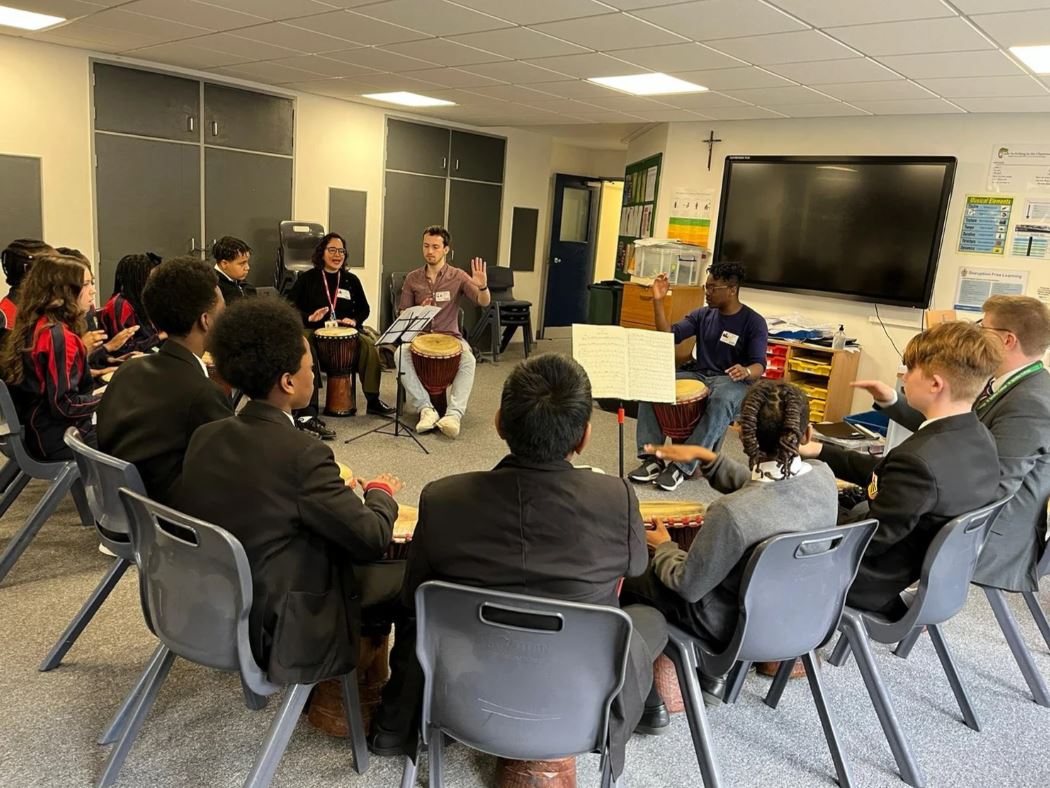
For Okpara, the biggest barrier isn’t just cost or access. It’s distance - literal and psychological.
“As orchestras got bigger, the gap between performers and audience got bigger,” he explains. “And we haven’t fully addressed that.”
The solution isn’t radical reinvention, but something deceptively simple: connection.
He talks about presenting concerts, speaking directly to audiences, breaking down formality. He points to jazz artists - like Ezra Collective - as models for building atmosphere and inclusion.
“They create a ‘temple of joy’,” he says. “People feel like they belong in that space.”
Classical music, he argues, needs more of that mindset.
“It’s not about dumbing anything down,” he adds. “It’s about bringing people into your world.”
That philosophy is exactly why working with Manchester Camerata feels like a natural fit.
“They’ve tapped into something,” Okpara says. “It’s about community. It’s about people.”
Camerata’s work - whether in concert halls, care settings, or community spaces - has long centred on participation and inclusion. Their projects blur boundaries: between performer and audience, between art and everyday life.
For Okpara, the proof is in how easy it is to talk about the upcoming concert. “I’m bringing about eight people - and none of them are musicians,” he says. “That’s the thing I love.”
It’s not just accessibility in theory - it’s accessibility in practice.
“They’re a beacon,” he adds. “For what classical music could look like.”

And then, of course, there’s football.
Okpara is, by his own admission, a “massive” Arsenal FC fan. That passion isn’t incidental to the project - it’s central.
The upcoming concert -The Beautiful Game - leans into the deep, often overlooked relationship between football and music: chants, anthems, shared rhythms of collective emotion.
But for Okpara, the connection runs deeper than sound. “Both are about playing,” he tells us. “About enjoyment.”
He draws parallels between orchestras and teams: shared goals, collective responsibility, emotional highs and lows.
“Your wins are your wins, your losses are your losses,” he says. “It’s exactly the same.”
At the heart of the programme is Eleven by James MacMillan - a piece structured around eleven notes, mirroring the eleven players on a pitch.
“It’s about teasing out the detail,” Okpara explains. “Helping people hear the story.”
And that’s key: storytelling. Making connections visible. Showing audiences that classical music isn’t distant - it’s already woven into culture, into sport, into everyday life.
And the setting matters too.
Staging the performance at the National Football Museum isn’t just a novelty - it’s a statement. “You’ll get people who wouldn’t normally come to a concert,” Okpara says. “Football fans. Different audiences.”
That, ultimately, is the goal. Not just to entertain - but to invite.
“If someone comes who’s never experienced an orchestra before,” he says, “I hope they have a good time. I hope they learn something. And I hope they want to come back.”
It’s a modest ambition, on the surface. But in a sector still grappling with relevance, access, and identity, it’s also massively important.

Back in the conversation, the talk drifts - inevitably - towards football allegiances, local clubs, and the meaning of support.
And that word - support - lingers.
Because whether it’s a small-town team or a city orchestra, the principle is the same: people showing up, feeling part of something, sharing in a collective experience.
“That sense of belonging,” Okpara says, “that’s what it’s about.”
In April, in a museum dedicated to the world’s most popular sport, an orchestra will play to an audience that might not usually be there.
Some will come for the football. Some for the music. Some out of curiosity.
If Okpara - and Camerata - get it right, they’ll leave with something else entirely.
The feeling that this world, too, belongs to them.
The Beautiful Game kicks off at 6.30 and 8.00pm on 24 April at the National Football Museum in Manchester. For tickets and info CLICK HERE





