



Sometimes, the days feel like they bob along, don’t they? The autumn sun shines and the daylight has a Polaroid warmth. On those days, I reach for my Telecaster and play the intro to Plug In Baby, note perfect. Another guitar amplifier has found a new home, and for one glorious moment I start to think I might actually know what I’m doing.
Yeah, life is great.
Then there are other days.
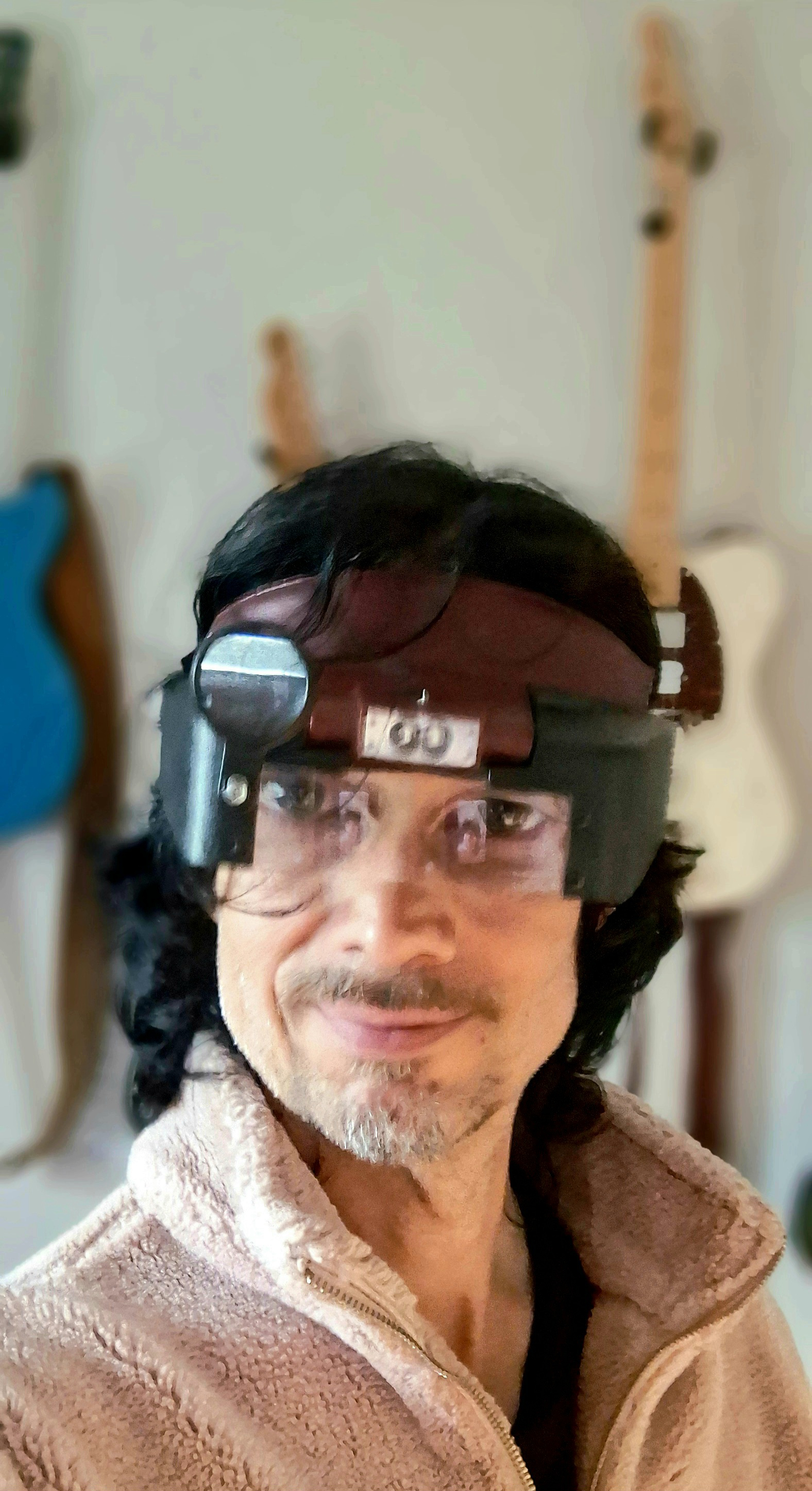
Days when I’m locked in battle with mathematical equations, a soldering iron in one hand and some kind of Doc Brown-esque magnifying contraption strapped to my head. My other hand is a fist, seriously considering punching a hole in something. Anything.
All this because a circuit board I've spent hundreds of hours designing, calculating, assembling and convincing myself is a work of genius has decided to produce an ear-splitting, high-pitched squeal. It won't shut up, even when I unplug the guitar.
Welcome to the next chapter of Colson of York, my small workshop on the outskirts of York where I build analogue guitar amplifiers by hand. Because, for some reason, I'm now designing my own circuitry from scratch.
When Colin of MagNorth last came over to chat about the launch of my workshop, I'd just finished the Three Sisters of Ainsty. One-off boutique guitar amplifiers, designed and built from Yorkshire hardwoods, a world away from the traditional black vinyl-covered boxes you usually see.
Since then, two of the sisters have found new homes and I've finished Clear Evening Sky. That’s the first of my Veils of York amplifier collection, made from English sweet chestnut and Yorkshire sycamore.
I'm happy with them. Really happy. But something's been nagging at me.
The cabinets are mine. Conceived, designed and crafted by me. The speakers and overall soundscape are my choices. Yet the electrical heart of each amplifier is based on someone else's analogue technology. I've adapted it, made circuit modifications and changed the tone, but a tiny voice kept telling me that I’m building on someone else's work.
That’s why I decided to design my own preamplifier.
So, here’s a very quick amplifier lesson.
While the power amplifier section mostly provides the muscle, the preamp is central to shaping the sound. It’s a huge part of a guitar amplifier's personality, whether that’s clean or crunchy, warm or glassy, gentle or aggressive.
I wanted a preamp circuit that would let the guitar and effects pedals breathe and sing out, but also add its own natural voice. Something that reacts subtly to each player’s individuality. And, if successful, it might even become a signature sound for Colson of York.
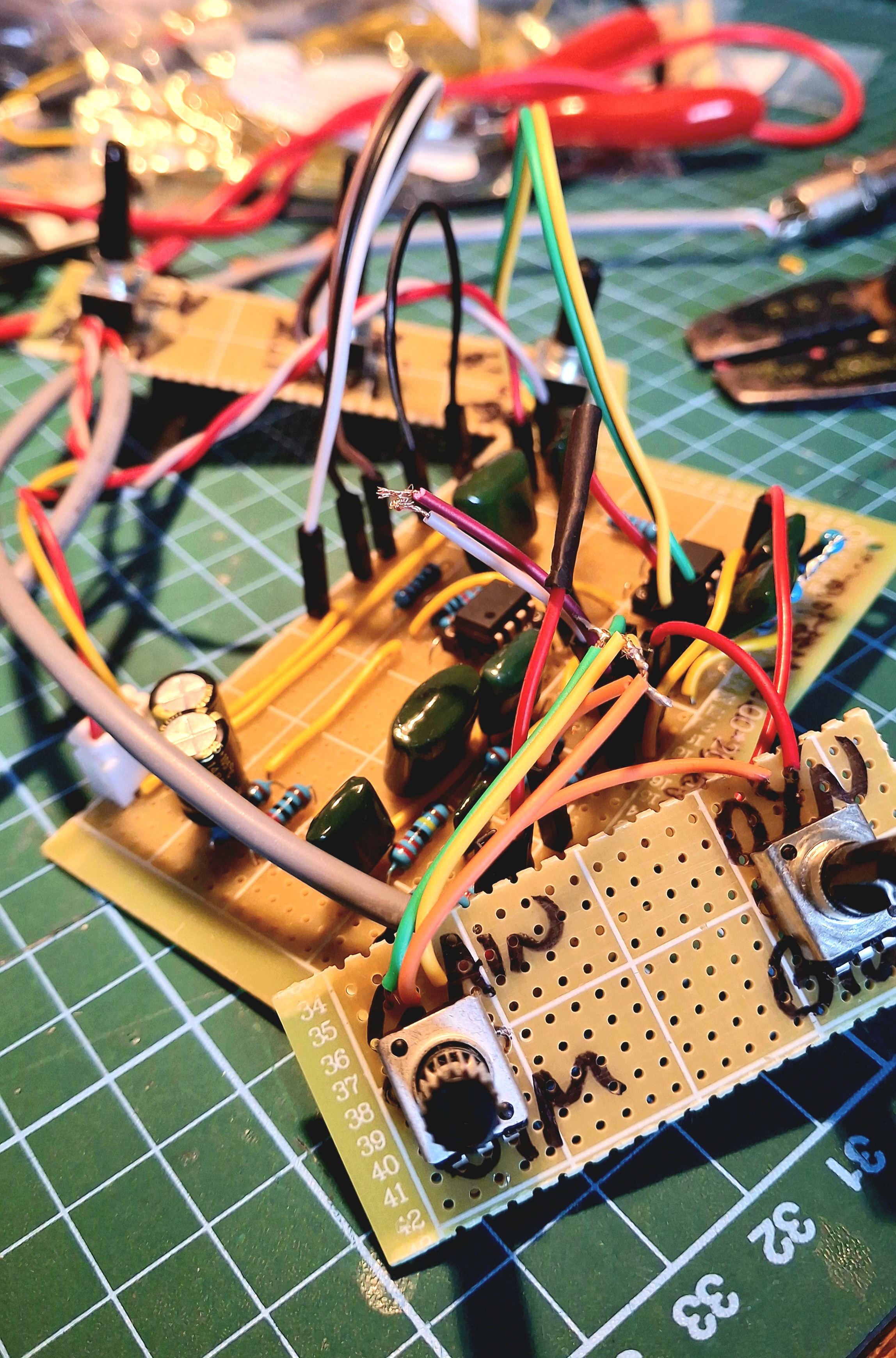
But knowing how amplifiers work and being able to modify them isn't the same as designing something new from scratch. It turns out there are quite a few sensible ways to build an audio circuit, and an almost limitless number of stupid ones. Knowing the difference between stupid and spectacular has occupied a massive amount of my time recently.
My prototype took me weeks. I could test electrical connections and work out the values of resistors and capacitors, but to actually hear whether the thing worked at all, I needed to build the entire circuit. There were no convenient points along the way where I could plug in a guitar and check my progress.
Finally, with the spaghetti contraption sprawled across my workbench, I connected it to a speaker, plugged in my Telecaster and played.
It made sounds. Actual music.
It wasn't going to change the course of history, and Marvin Berry wasn't about to call his cousin Chuck. But it sounded pretty sweet. Most of all, I was relieved.
That was before the screaming started.
When I turned up the treble on the guitar it sent the circuit into a frenzy. Adding a capacitor and resistor calmed it down. Problem solved, I thought. Except once I'd installed everything into its cabinet, I discovered it could sometimes still scream with no guitar connected.
I needed to build in a whole new buffer circuit to stabilise the input. I designed it, fitted it, wired everything up, switched on...and got nothing. Total silence.
Three hours of troubleshooting later, I discovered the culprit was a millimetre of resistor leg bridging two copper tracks.
One millimetre. Seriously.
And now?
The prototype lives and sings. Its battle-scarred circuitry sits inside a guitar amplifier cabinet that I built a few years ago, from pieces of my 1815 house, including a slice of kitchen worktop, internal door and an old oak bedroom shelf.
And I intend to gig it.
Solving those problems has given me a springboard. I've been improving my design and working out how to give the midrange more presence. That’s where most of a guitar's voice lives. One eye-opener, literally, was waking up in the night and realising I could make those mid frequencies sparkle by easing back the bass and the treble instead. That involves far fewer components than boosting the mids.
My latest design has eight controls. Each is meant to offer tonal choice, not just another knob to twiddle. Well, that’s the plan on paper. But this refined circuit is still nothing more than scribbles, diagrams and component positions. I haven't heard it. I won’t, either, until I’ve soldered in nearly one hundred resistors and capacitors, and picked up my Telecaster again. More checking, more head-scratching and quite possibly more wanting to punch stuff.

The first two future amplifiers already have names. The Tuxedo Twins. I have enough sweet chestnut to make two more cabinets. There's a long, lazy crack running through the timber, which developed as it dried, and I'll secure it with butterfly-shaped wooden inlays known as bow ties. Bow ties became tuxedos, and the Twins were born.
As they'll be my sixth and seventh builds, their serial numbers will carry 006 and 007.
There's a more personal reason for all this design foolishness. Alongside gigging in a covers band, I write copy for tech companies. Much of my life involves turning complicated ideas into words, often credited to someone else. I enjoy it, but there’s something strange about work you can’t point to and say, “I made that”.
In the workshop, I can.
My idea becomes a drawing, a set of calculations, a piece of timber on the bench, a cacophony of components and, eventually, something that makes music. My ‘thinks’ become ‘things’.
I still don't know whether the Tuxedo Twins will sound magnificent or send me straight back to the drawing board. But I do know why I'm doing it.
I want to hear what a noise of my own sounds like. Something analogue, natural, and built to last.


