



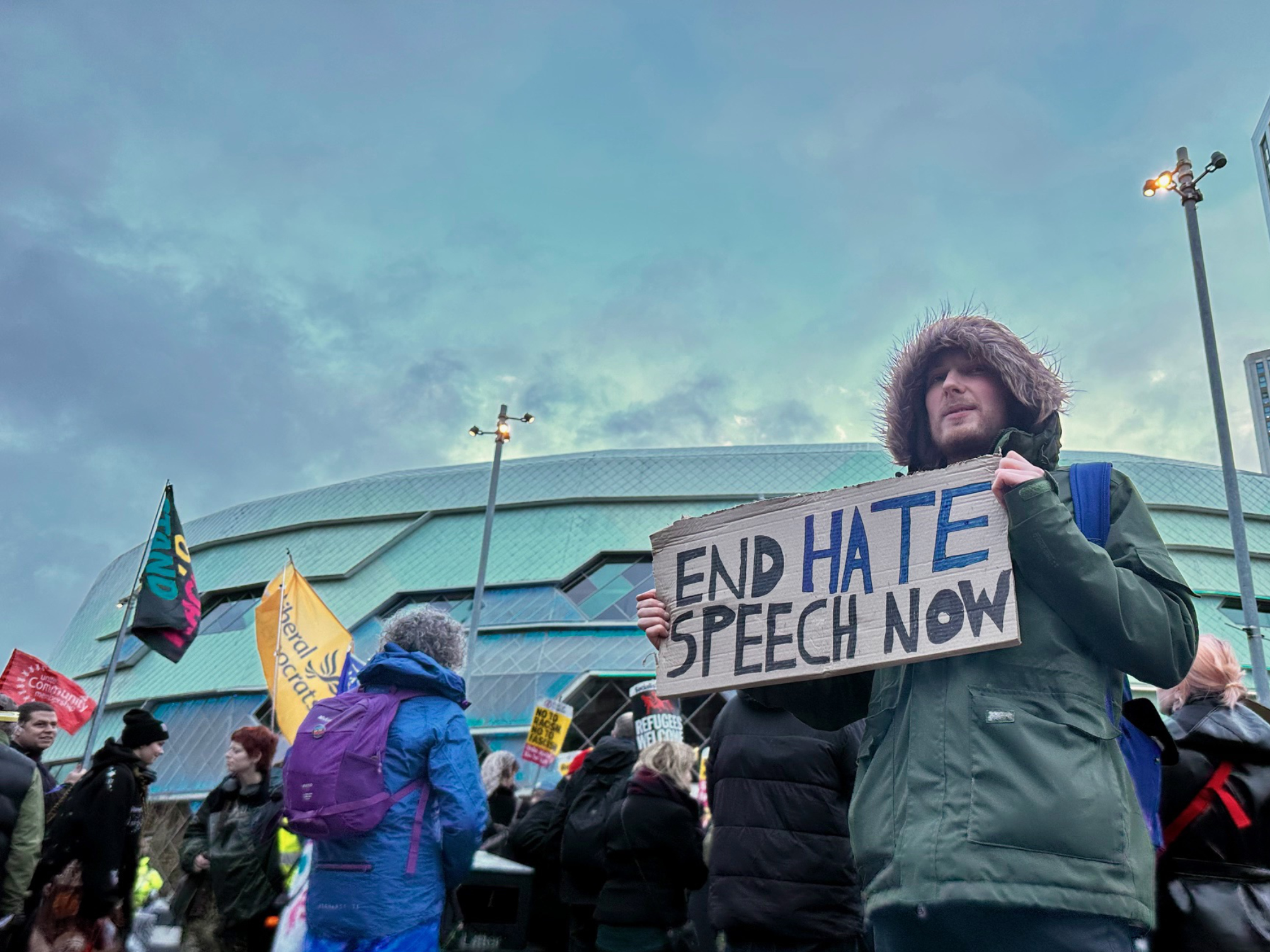
On Tuesday evening, outside the First Direct Arena, two visions of England faced each other across a line of police.
Inside: a Reform UK rally, built on energy, grievance, and the promise of rupture.
Outside: a “Say No to Racism” demonstration - smaller, less coordinated, but rooted in a longer political memory.
The distance between the two was minimal. The divide was not.
“Reform is the future,” said Chris, gesturing toward the counter-protest. “Look at that lot. They couldn’t run the country.”
It was a remark less about policy than perception: competence, ownership, control.
The idea of the North as politically settled - predictable, Labour, static - is over.
Polling now consistently places Reform UK at or near the top of British politics. By late 2025, YouGov had the party on 27%, ahead of both Labour and the Conservatives. Aggregated polling in early 2026 suggests that position has held - hovering in the high twenties, and in some projections translating into a parliamentary majority.
Reform has, in effect, doubled its support since the 2024 general election.
This is not a protest vote in the traditional sense. It is a realignment.
And it is being built, in part, in places like Leeds.
Reform’s rise is not evenly distributed. It is strongest in places shaped by:
These are not abstract conditions. They are lived realities across much of the North.
But what is striking is how those realities are interpreted.
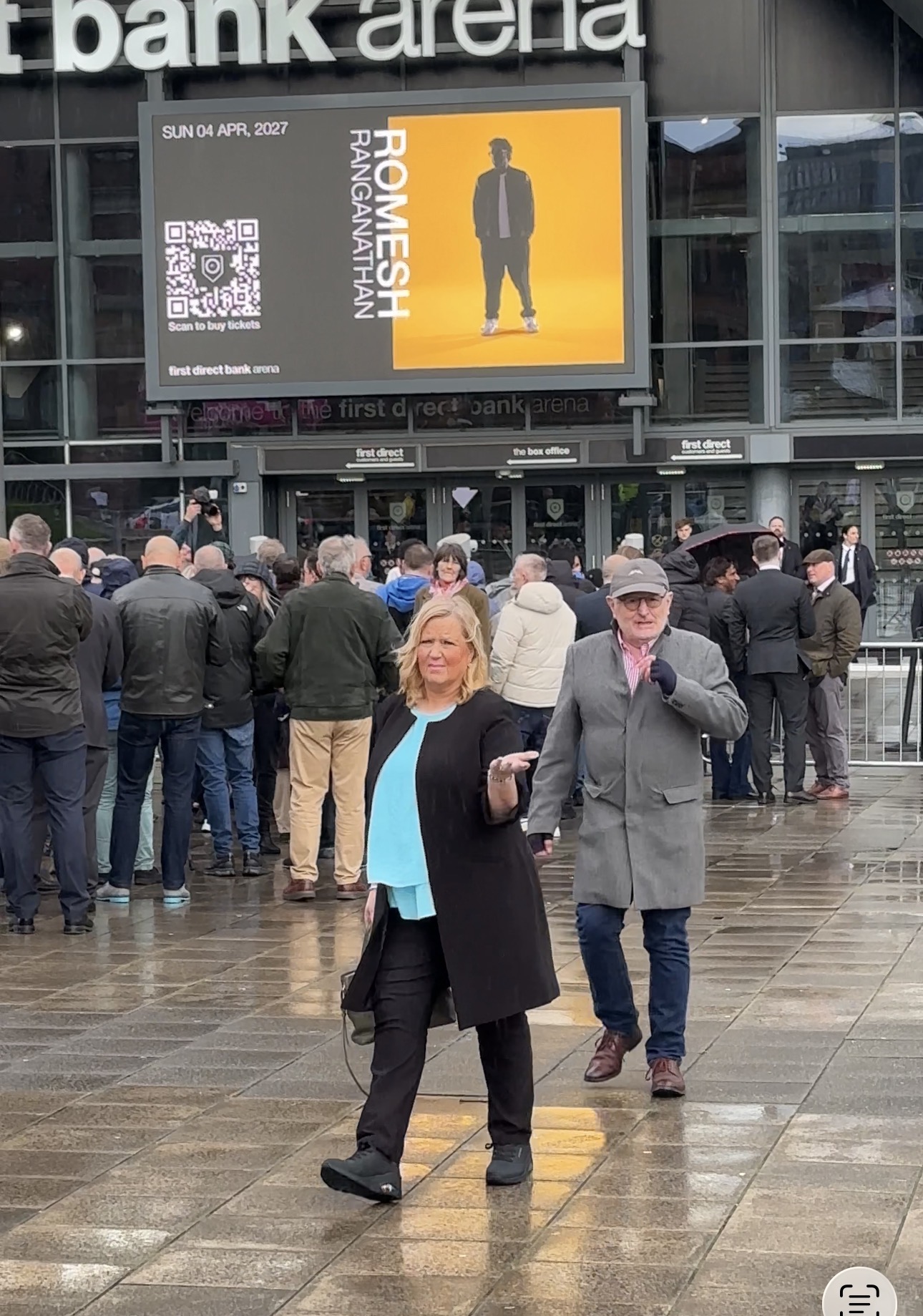
Speaking outside the arena, one couple - immaculately dressed, coordinated with the party’s pale blue - framed Britain’s global role in starkly different terms. “This country has always brought stability to the world,” the husband said. “People coming here now aren’t running from what we do - they want what we’ve got.”
His wife was more direct. “Our daughter isn’t safe to walk the streets on her own.”
Here, global politics collapses into local anxiety. Foreign policy, migration, and personal safety become part of a single narrative - emotionally coherent, even if analytically unstable.
Populism thrives where trust breaks down.
By the end of 2025, the UK government’s approval ratings had fallen deep into negative territory. Party loyalty has weakened. Voters are more volatile, more fragmented, less attached.
In that space, explanation becomes as important as policy.
“It’s not fascism,” said Baz, a Reform supporter. “It’s about taking our country back. I do 60 hours a week and I’m paying for young lads from Africa who shouldn’t be here.”
The clarity is the point.
Complex systems - tax, labour markets, migration policy - are reduced to a direct moral economy: effort, fairness, entitlement.
It is a powerful framing. And a politically effective one.
Reform’s offer is built on three things:
It tells a story in which decline has identifiable causes and reversible solutions.
But the North’s challenges - regional inequality, low productivity, underfunded services - are structural. They cannot be resolved through narrative alone.
There is growing evidence that material change matters here. Areas that have seen tangible public investment show lower levels of support for Reform, suggesting that where economic progress is visible, populist appeal weakens.
Grievance, in other words, fills a vacuum.
There was another presence on Tuesday night - one that speaks to a more recent and less understood shift in British political culture.
On the edges of the anti-racism protest, groups of self-styled “independent journalists” positioned themselves deliberately: cameras raised, microphones ready, waiting not to document events, but to manufacture them.
They moved through the crowd targeting individuals - often younger protesters - with an absence of meaningful engagement, persistent filming, and escalating pressure. The intention was not neutral observation. It was extraction: of reactions, of mistakes, of moments that could be repurposed as content.
The tone was frequently aggressive. At times, it was overtly intimidating.
.jpg)
The presence of accredited media did little to temper this. Wearing an NUJ press card did not signal shared professional ground - it marked a point of friction. In this emerging ecosystem, journalism is not a set of standards; it is a contested identity.
What is taking shape is not citizen journalism in any meaningful democratic sense. It is performative media, driven by platform logic:
Protests are no longer simply political events. They are raw material.
Footage captured at the margins can be edited, reframed, and circulated to reinforce pre-existing narratives: of chaos, of extremism, of illegitimacy. In doing so, it feeds directly into the same emotional economy that sustains populist politics.
This is not incidental. It is structural.
The periphery is now part of the machinery.
There is another history here.
In 1936, tens of thousands gathered at Holbeck Moor to oppose Oswald Mosley. Leeds has long been a site of political resistance - organised, collective, outward-looking.
That tradition was visible on Tuesday night, though less assured.
Asked about a claim on her banner - that 20% of Reform MPs have assault convictions - a protester hesitated. “I think so… it’s something like that.”
It was a small moment, but a telling one.
If populism simplifies, parts of its opposition risk doing the same - sacrificing precision for urgency, and in doing so, weakening their own credibility.
.jpg)
One of the defining features of the demonstration was its unevenness:
Both matter. But neither, alone, is sufficient.
Because if Reform’s rise is rooted in disillusionment, then counter-politics must do more than reject it. It must replace it - with:
Without that, the imbalance remains: one side offering clarity, the other complexity without traction.
Leeds was not an anomaly. It was a signal.
Not just in the confrontation between rally and counter-protest, but in the wider ecosystem surrounding it: the cameras at the margins, the search for provocation, the conversion of politics into content.
Across the North, politics is being reorganised - not simply along left–right lines, but around deeper tensions:
Reform UK’s rise is real, data-driven, and rooted in lived conditions.
But it is not inevitable.
The same forces driving disillusionment - economic insecurity, political distance, uneven development - can also produce renewal, if they are addressed seriously.
Until they are, the atmosphere like that outside the arena last night will not dissipate.
It will return - louder, sharper, and increasingly mediated each time.





