



For six hours at a time, Angela Locke lay still on the Cumbrian fells so that search dogs could practise finding her. Nearly forty years after Search Dog first appeared, she tells MagNorth how a Labrador named Sam brought her north, what she learned from the people who go out looking, and where the mountains took her next.
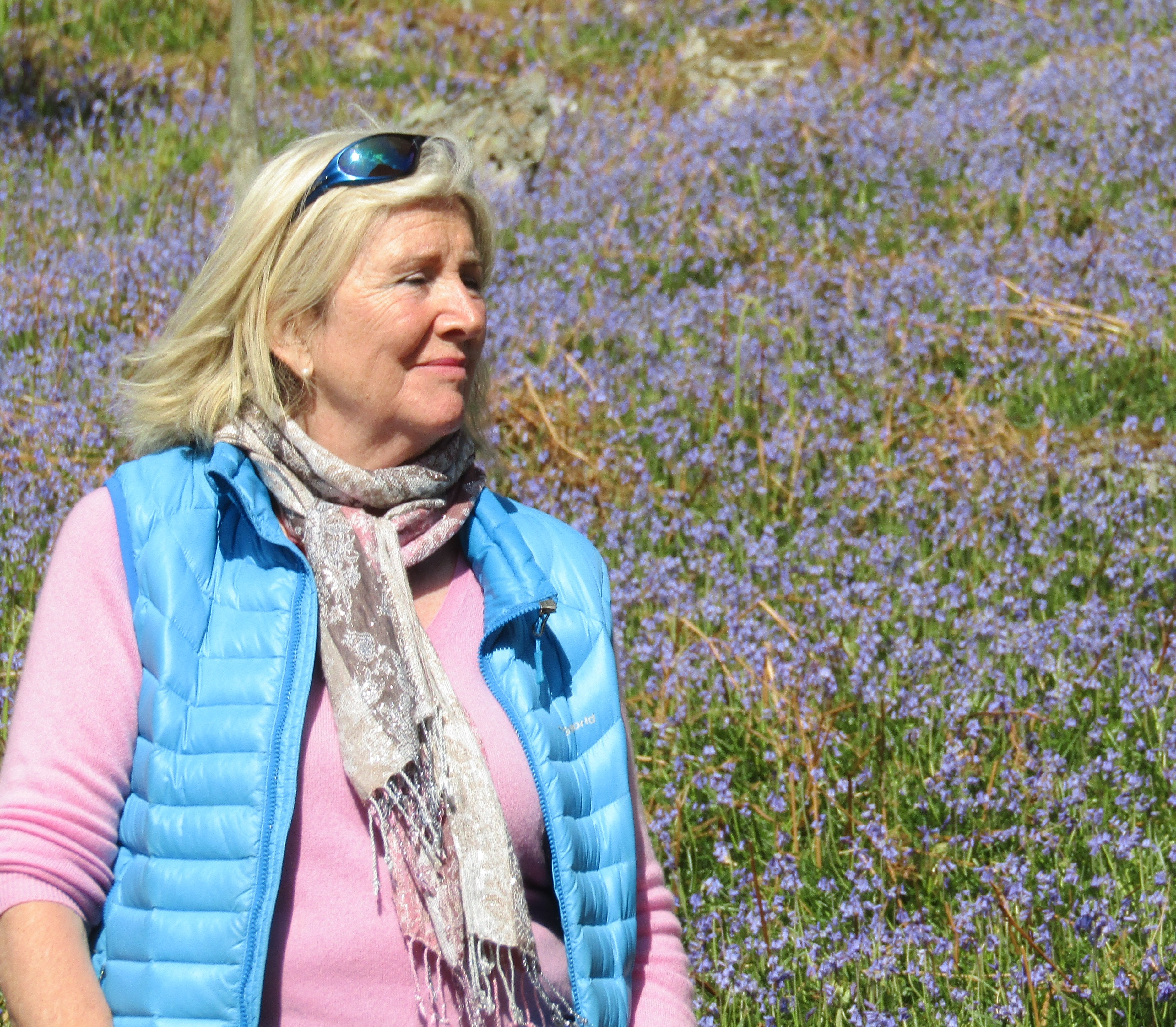
By eleven in the morning, on the Annual course in February one year, Angela Locke had eaten her sandwiches. There were hours still to go. On one winter exercise above Littletown, in the Cumbrian fells, water trickled into the heavy-duty plastic bag she’d been given in place of a bivvy sack. When she came out after hours crouched in the bag, she found she was completely covered in snow. Someone took a photo of her as she came down the fellside, through the snow, dragging the bag and a camouflage net. It went up on the noticeboard that night. The people watching from the valley in the Land Rover teased her they had to open a window in the Land Rover, and someone had got snow on his sleeve! Angela says: "I think they thought I had done well, after all!"
And six hours is a long time to lie in one place. Once you’d taken up your position, the dogs and handlers had to find you there. “Then you go into a sort of state of meditation, really,” Angela tells me, “which is not easy if it’s raining or if it’s snowing.” In a plantation on Whinlatter she must have dozed. When she opened her eyes, there was a deer browsing around her ankles.
This was how a writer from Sussex came to know the Lake District. She’d gone north to write about a dog. Over roughly a decade of winter courses she became one of the volunteer ‘bodies’ that search dogs train to find. Sometimes she lay out on frost so deep she could feel the ground changing beneath her as the morning warmed. Sometimes the dog never came.
Search Dog, first published in 1987 and now reissued by Juniper Press with a new introduction, follows Sam, a Labrador with Penrith Mountain Rescue, and his handler, John Brown. The first time round Angela wrote it as a tribute to Sam. Revisiting it has made her think about how much of the experience she left on the fell.
Angela was already deep in the research for a wartime novel when she saw the words ‘Search Dog’ in the back of a little red car. She was visiting her sister, who lived next door to John Brown. Her sister told her that Sam had that morning been barking on Radio Cumbria. He’d found two boys alive at Angle Tarn overnight and had become something of a local celebrity.
“I said, ‘I’m going to write a book about that dog.’ Just literally. I mean, it was the weirdest thing.”
Her sister rang John Brown. That afternoon Angela knocked on his door and announced that she wanted to write a book about his dog. He offered her a cup of tea and asked her to tell him about it. As they talked, she felt her ankle getting wet. She looked down. Sam was standing beside her, holding a watering can.
“Whether that was his trick normally or whether he just thought it was funny, he tipped it over my foot,” she says. “And that just was Sam. You never knew when he was going to get up to something.”
On an early exercise near Ambleside, she saw a different side of him. The party went straight up the fell into fog. In a craggy stretch of ground, an exercise casualty was hidden under a large rock. Sam worked back and forth across the fell, disappeared, came back and gave his unmistakable call. Then he led John to the rock. As they reached it, Angela remembers the fog lifting and the stunning vista of the fells opening out around them. Sam, very pleased with himself, wagged his whole body.
Angela had spent years around Labradors. She’d never seen one do anything quite like that. She’d also never had to go straight up a Cumbrian fell in the yellow sailing gear she’d brought with her. John had already had to tie her laces because she was wearing so many layers she couldn’t bend down. On the ascent she got so hot she had to strip off layers and start again. At the station down south, a friend had told her she was completely insane to go. Standing on a platform in Cumbria, she had briefly wondered if he had a point.
“I was very careful not to be a nuisance and to learn,” she says. “And, you know, they got me in as a ‘body’, once I got more experienced.”

Angela worried every year that they might remember some terrible thing she’d done and decide against asking her back. At first they put her high on the crag. After about ten years she noticed she’d been moved nearer the footpath.
By then she had invested in a proper bivvy sack and knew how to settle in. The volunteers had radios, and the people in the valley knew where they were. Even so, a good hiding place could turn on you. On one occasion in a little cave on Langstrath, the wind changed and drove rain straight in. Angela was soaked and beginning to feel ill. She called in on the radio. A handler came up to bring her down while the two talked about Philip Larkin. Four decades later they’re still friends.
On another exercise, across from Helvellyn, Angela braced her feet against a sapling. The tree gave way and she began sliding downhill. “Permission to move,” she said into the radio. “My tree has just fallen over.” She could hear the laughter at the other end.
There was one occasion in the Pennines when she describes becoming mildly hypothermic. The team got her warm. There were also places she would happily have stayed longer. In a gully on Helvellyn she lay beneath a waterfall and watched rainbows in the spray. No dog found her there. She thinks the rising air carried her scent up with it. Years later she put something of that view into her novel, Dreams of the Blue Poppy, when a character looks up and sees the flower in Himalayan shale.
Sometimes Sam found her and appeared to recognise her as a person likely to have something in her pockets. His alert, when he gave it, was quite his own. Angela makes the sound for me, four low bursts, somewhere between a bark and a chomp.
What makes a good body? Some ability to manage steep ground in the fells, she reckons, and enough common sense to know when to call it a day. She disqualifies herself on most counts, then comes back to the one that matters to her. “You’ve got to have a real ability to stay still and be able to be in that quiet place.”
She’d come back south on the train in her battered gear and get in just in time to pick up the children from school. “I’d think, ‘I’ve been in a different place.’ That’s all I could say, really.” It was hard to tell the other parents at the school gate where she’d been. It was hard, sometimes, to come back at all.
A dog working on air scent can pick up a person’s scent carried on the wind, including from ground a handler may be unable to reach. Angela talks about a dog quartering a broad stretch of hillside, then indicating a find that allows the team to concentrate its people and time. The shape of the land and the movement of air matter. She’d learned that under the waterfall.
Labradors and collies worked differently, she remembers. There were other breeds on the courses, too. For Sam & Co, the sequel, she followed the work of Dave Riley, a police detective in Windermere, and his collie, Loch. As Angela tells it, the dog helped find a man alive under a collapsed building after an earthquake in El Salvador. She also saw how widely canine search work extended, from the fells to lowland searches for people missing from home. She remembers a colleague whose dog could indicate the location of a body underwater.
There’s the comfort of a dog arriving when you’ve been lying injured for hours, too. Then there’s what the dog means to the person going out in the first place. Late one night a handler told Angela who he thought was the senior partner when they were out in a blizzard. “It’s not me, it’s the dog. Without the dog, I’d be scared.”
Angela describes a triangle between the dog, the handler and the mountain. “The mountain doesn’t care if you fall off something,” she says. One of her favourite photographs shows Sam with a rucksack at night. She thinks a storm is just breaking. The image brings to mind what handlers told her, once they knew her well enough, about how much safer they felt with the dog there.
Britain’s search dog associations trace their history to Glencoe, where mountain rescuer Hamish MacInnes organised a training course in 1964 after seeing avalanche dogs at work in Switzerland. The Search and Rescue Dog Association, SARDA, was formed in 1965. Angela read MacInnes’s technical writing closely to understand what she was seeing in Cumbria. In Keswick, on the Annual Course, originally at the Crow Park Hotel and then the Keswick Hotel, she remembers welcoming visitors from Norway and the United States to the winter course. These days Lake District Mountain Rescue Search Dogs is one of several associations in England and Wales. Its handlers are already operational members of mountain rescue teams.

The people who taught Angela were reserved about the work. She got teased, listened and learned when to stay out of the way. On live callouts she stayed at headquarters. On course nights she would stay up listening to singing and music, sometimes until two or three in the morning, with everyone due back on the hill at nine. That was often when people began to tell her about their own experiences. She remembers SARDA handlers Neil Powell and the late Phil Haig among the folk singers in those late-night gatherings.
Writing about rescues meant being careful with the lives of people who’d never asked to appear in a book. For Search Dog she changed place names at the teams’ request. By the sequel they were comfortable with her using real locations, trusting her to disguise the details that would identify casualties. A reader once told her she recognised an incident anyway. Angela still remembers the moment. You can work hard at protecting somebody’s privacy and discover how much a person close to the story can recognise.
Search Dog became a bestseller, appeared in translation and also reached readers through Reader’s Digest and the paperback edition. Angela says it raised money for SARDA. For the sequel, Sam & Co., she wanted to show how the dogs’ work fitted with the work of the police, mountain rescue teams and the RAF. John had a younger dog, Tyan, coming through. The RAF gave her five hours in a Sea King. Over Haweswater she played the casualty and a winchman hauled her up. She was convinced the helicopter was going to fall out of the sky. “I spent the whole time being terrified and excited at the same time.”
By the time she was finishing the sequel, Sam & Co. Sam had grown old and very ill. A newspaper photographer had been out to take pictures and the dog who always played up for the camera had kept his head hanging down. Angela rang John on 21st December as she was nearing the end of the manuscript. He said he had to leave and couldn’t talk. There had been a crash near the Scottish borders and he was being called out. It was Lockerbie. John went as part of mountain rescue. Sam stayed in his basket.
Angela recalls being asked to write an additional chapter about the many organisations involved, from the emergency services to the Samaritans. Years later, the BBC contacted her for photographs to help restore the coat of one of Neil Powell’s heroic search dogs, Pepper, who had tragically died after Lockerbie. The dog had been working in the crater and, along with other Search Dogs who sadly died after the search, his bloodstream was shown to have absorbed contaminants from the plane, which may have contributed to liver failure. Angela went straight to the album in her crowded house and found the pictures they needed to get the colour right - emerald green for Irish SARDA. She says the restored coat and collar are now displayed at the Irish North SARDA headquarters.
Many of the inspiring handlers from SARDA Angela knew have also died in the last few years. She remembers the late Dave Riley, whose story Angela featured in the second book Sam & Co after his collie Loch found someone still alive under a building in El Salvador after the earthquake. He was someone too who could stay up half the night with everyone else and still be there on the hill in the morning. He was a tower of strength and an inspiration. So many others too, treasured friends with whom she had kept in contact. Among the SARDA Scotland 60th anniversary gathering in Pitlochry she met someone who could still remember her, landing in a Sea King coming down on a sports field at Cockermouth on exercise, and other familiar faces too. The search dog teams she had got to know were helping to establish routines that have become part of how mountain rescue operates in Cumbria. Being made an honorary member of SARDA meant as much to her as any qualification she’d earned.
Angela and her family moved north while she was writing Sam & Co. The friendships were here by then, and so were the places she’d learned by spending hours lying in them. Today she can see Skiddaw from her back window and watch it change hour by hour.
The fells also led her towards the Himalayas. She began researching the mountains for her fiction and travelled to Nepal. The Juniper Trust grew out of that first visit. Founded in 1994 by volunteers inspired by Angela, the Trust works with communities on projects they identify as priorities, with a particular focus on children. Its work now reaches well beyond Nepal.
There is a measure of what sustained volunteer work can do in the Trust’s account of the 2015 Nepal earthquake. It helped rebuild 20 schools, a programme that continued for years after the immediate emergency. Its work has since included equipping schools and helping families recover after flooding in the Bhote Koshi area. When we spoke, Angela said a second load of emergency aid was being delivered to a flood-affected area. The Trust is volunteer-run and that 98 per cent of donations go to projects.
On one Himalayan trek, Angela remembers the juxtaposition of being both an adventurer and a parent hitting home; reaching about 16,000 feet and finding a telephone at a hotel on the way down. She rang home to announce she was back. “Do you mind, Mum? We’re watching Neighbours,” said her daughter.
There was another dog book, Hearing Dog, written with a profoundly deaf woman who had run a pub in Cumbria, The Snooty Fox. Angela went to see the training and watched another kind of partnership take shape.
She still teaches writers and says she gets at least as much pleasure from teaching as she does from writing. Seven weeks after a bad fall and a new shoulder this summer, a friend drove her to Iona to lead a course for writers who had travelled from as far away as the US and Australia. Coming round from the anaesthetic, her first question had apparently been whether she could go to Iona! Once there, she made it down to the sea and walked about half a mile. That determination possibly tells us all we need to know about this incredible woman.
The fall hadn't taken place on a windswept, isolated crag. It happened on the lane near home, walking her dog. She’d badly injured her shoulder and arm and had no phone. Her neighbours heard her calling from up the hill and got an ambulance. “All those things I did in the mountain rescue,” she says. “Just walking my dog, you know...”

I ask whether the work is harder now. “It’s harder,” she says. The teams have better radios, GPS and drones. There are also many more people going into the fells, relying on mobile phones if they get into trouble. In her observation, some underestimate how quickly a grassy path can turn into exposed mountain ground. Angela is glad so many people want to walk. She also thinks of the volunteers who get up in the night and still have jobs to go to the next morning.
On one exercise she remembers seeing a group of children coming down through heavy snow in trainers and thin coats. The team went up to bring them down. What stayed with her over the years was how careful MRT volunteers were about the way they spoke to people who needed help. There might be an injury, a complicated situation or somebody close to the casualty who needed looking after too. “They care so much about protecting people,” she says.
Asked what she’d want weekend walkers to think about, Angela starts with footwear and the speed with which conditions can change. She talks about warm layers, waterproofs, a torch, a hot drink and something to eat. She mentions the Oxfam shop in Keswick, where she has picked up good second-hand outdoor gear herself. Above all, she asks people to think through the question she always asked herself before going high. “What if?”
The reissue comes with a hope that the book can raise money for the search dogs again. Angela also hopes readers will see how much goes into getting a dog ready to work. I now understand it can take years. A dog has to be safe around sheep as well as capable of searching the hill. She remembers taking Sam into schools and getting into a casualty bag ( ‘casbag’) so the children could see what he did. They loved the dog, and it gave her a way to talk to them about being on the fells.
After decades involved in the most important work, last year Angela's impact and her writing was shown to be as relevant now as it was in the 80's. Having lunch with friends at a local tearoom, a man introduced himself and asked if she was Angela Locke. He had his dog with him.
“This is a search dog,” he told her. “And I’ve trained my dog because I read your book.”
She was, she tells me, “absolutely beside myself”. At the time she wrote it, she’d thought she was saying thank you to Sam. The book's reach and importance to a new generation of those seeking something in wild places cannot be overstated.
Angela organises an annual Arts and Literature Festival in Maryport’s Senhouse Roman Museum, where she is Writer-in-Residence. In March 2027 she will be talking about writing the new edition of Search Dog at the Festival. And appearing at Words by the Water, the annual Book Festival at Theatre by the Lake in Keswick, also in March 2027.
Search Dog by Angela Locke is published by Juniper Press, ISBN 9781918770025.


