



.jpg)
There are loads of ways to talk about the climate emergency. Some are technical. Some are political. Some are so thick with acronyms and policy language that even people who care deeply begin to feel themselves quietly leaving the room.
At Bradford City’s Valley Parade stadium, where the North East & Yorkshire Net Zero Hub under the expert baton of John Hart, gathered policy makers, community leaders, businesses, charities, schools and climate practitioners for Energising Britain North East & Yorkshire 2026, the most powerful language of the day was much simpler.
Solar panels on a cathedral roof.
A football club powered by electricity.
A fish and chip shop trying to do the right thing.
Empty houses in Leeds becoming warm homes.
A school orchard.
A child explaining particulate pollution.
The event brought together people working across the region’s net zero transition, from heritage and housing to agriculture, sport, community energy and education. Katie White MP, speaking as Climate Minister and as MP for Leeds North West, opened the day by acknowledging the scale of the crisis without losing sight of the practical and human work already happening across Yorkshire and the North East.
“We are in the middle of a climate crisis,” she said. “The heatwaves that we’ve had are completely unprecedented and they’re absolutely hideous. Not just for people trying to sleep, but also for the NHS, for farmers, for parents, for our way of being.”
But White’s keynote didn't remain in the register of warning. It moved quickly towards the reason the room had got together.
“What people really care about is what’s happening in their community,” she confirmed. “It’s when they drive, walk, cycle around. It’s what they see in their community. It’s whether they see solar panels on the roof. It’s whether they see their neighbours having an upgraded house. It’s whether they see somebody with a new electric vehicle. Those are the things that genuinely matter most.”
For MagNorth, that became the theme of the day. Not net zero as a distant national target, but as a visible change in places people already know and love.
White put it plainly: “People, communities and stories are what is going to make it happen.”
.jpeg)
The day’s first panel took that idea and ran with it. Introduced under the banner of “everything we love is powered by electricity”, it brought together Bradford City AFC, Wendy’s of Elland, South Yorkshire EcoFit and York Minster - or, as the framing had it, net zero football, net zero chips, net zero ice cream and net zero iconic local landmarks.
It could have sounded like a gimmick. But it absolutely wasn't.
It worked because each example revealed something important about how climate action becomes normal: not by telling people to abandon what they care about, but by showing that the things they love can be part of the transition.
Adam Keizer, Head of Commercial and sustainability lead at Bradford City, spoke about the club’s Greener Bantams strategy and the role football can play in reaching people who might never attend a climate meeting.
“For us at the football club, match days is the big factor,” he said. “Bradford City plays a huge role in people’s lives. We average about 21,000 people for our home games. So our stadium is currently around 99% powered by electricity. We have solar panels, we have 472 panels on our roof.”
The important point, he explained, is that the experience for supporters doesn't have to be diminished. The match day remains the match day. The connection remains emotional, nostalgic, familial and local.
“For some football fans, coming to a game is more than just a game,” Keizer said. “It’s a nostalgic thing or it’s a cultural thing, an identity piece. I know when I come to football matches with my son, the first thing I think when I look at him is I think about coming to games with my dad.”
If a football club can talk to supporters about clean energy through something they already love, he suggested, it can make climate action feel less like a lecture and more like part of the club’s future.
For Alex Christoforou, owner of Wendy’s of Elland, the point was equally practical.
“Electrification means being able to provide the nation’s favourite dish locally to the local community with sustainably powered electricity,” he said. “Within our trade, we use a lot of electricity, so being able to provide that sustainably is a big, big thing.”
He spoke about the small business train-of-thought: the need to keep looking for improvements, from energy to sustainable fish, staff uniform and packaging.
“I think for a small business it’s more a question of mindset,” he said. “Especially if you’re in an industry like mine where you might not necessarily think that there’s a lot you can do, but there’s so many things you can do.”
Then came York Minster.
Alex McCallion, Director of Works and Precinct, described the task of caring for York Minster and its seven-hectare estate while moving towards a “totally electrified precinct” with much of its power generated on site.
It felt like this was the moment the room sharpened.
Because York Minster isn't just any building. It's one of the great symbols of Yorkshire. A vast, ancient, sacred structure. A place where change has to be negotiated not only with planning systems and conservation concerns, but with imagination, memory and public feeling.
McCallion said the Minster is on track to be scope 2 net zero by 2035 by moving to a fully electrified estate and weaning itself off gas boilers. One of the ways it's done that is through the Localism Act, using underutilised planning legislation to create its own neighbourhood plan.
“We effectively wrote our own planning policy to drive the biggest changes in the precinct since the mid-1850s,” he said.
The most visible (if you're a pigeon) - or perhaps deliberately not too visible - symbol of that change is the installation of 184 solar panels on the choir roof of York Minster.
“When I suggested this in the first round of consultation with the city, everybody was horrified,” McCallion said. “You can’t put solar panels on the scheduled monument, Grade I listed building.”
But the process changed minds.
“Over the course of four years and 32 weeks of public consultation, the city came round to the idea,” he said. “And when that application went into City of York Council, it was approved under delegated authority. It didn’t even go to planning committee. So it shows you the power of public consultation and bringing people with you.”
The Minster now has other infrastructure across its estate, including solar slates, solar film, other solar panels and air source heat pumps. The Minster itself, McCallion said, now generates a third of its own power, and a couple of weeks before today's event, 90 per cent of the power was being produced from the roof.
“We keep saying if we can do it at York Minster, everybody can do it and should be doing it,” he said.
That line could sound glib in other circumstances. Here, it landed because the journey had clearly not been easy. McCallion spoke about the importance of pushing back when institutions say no, while being careful not to turn conservation officers into villains.
“They’re not given the tools within which to make the right decisions,” he said. “But to my point earlier, we are in a climate emergency. Heritage buildings have a huge role to play in responding to the climate emergency.”
He was blunt about the old reflex that still shapes too many decisions: “I’m sorry, the answer’s no, what’s the question?”
“That’s not good enough in a climate emergency,” he said.
There's a larger argument here for the North. Our region is full of difficult buildings: listed buildings, civic buildings, chapels, mills, terraces, cathedrals, town halls, schools, libraries, working men’s clubs, village halls and former industrial sites. If they're treated only as problems, the transition stalls. If they're treated as assets, they become places where the future can be seen.
McCallion also made the case on financial grounds. “We put solar panels on the Minster roof as a moral leadership point, but it made basic financial sense as well,” he said. “It was a £400,000 investment that will be paid back over eight years. They’re guaranteed for 30 years. So that’s 22 years of free power.”
For those waiting for the perfect time to invest, he had a simple answer. “Yesterday was the best time to do it,” he said.
Lizzie Stygall, from South Yorkshire EcoFit, widened the conversation into community energy and agricultural decarbonisation. Through Sheffield Energy Works, a community benefit society, the organisation is working with a local dairy farm and ice cream producer, Our Cow Molly.
The farm already uses modern technologies, including solar tracking panels and robotic milking systems. It bottles milk on site and welcomes around 100,000 visitors a year to its ice cream parlour.
“Who doesn’t love ice cream?” Stygall asked. “All of that is being powered by electricity.”
But the project goes deeper than powering fridges and freezers. Stygall spoke about anaerobic digestion, slurry, solar and the challenge of making farms more resilient in a world of volatile fuel prices.
“I think there’s this idea that the only way to make farms sustainable is to cover fields in solar panels,” she said. “It isn’t, but also I don’t think you should shy away from the fact that actually some solar on farmland is not always a bad thing.”
Solar can provide shade for animals, support biodiversity and help local food production, she argued. For farms facing tight margins and unstable energy costs, renewable generation can offer stability as well as decarbonisation.
The ambition of Sheffield Energy Works is community ownership.
“We are now at the stage where we actually launched yesterday our community share offer to the public so people can invest,” Stygall said. “If you want to help invest in clean energy right here in our region, you can. We’re raising £600,000. And what we want is for local people to benefit from that.”
It was another recurring message from the day: the energy transition cannot simply be something done to communities. It has to be owned, shaped and trusted by them.
.jpeg)
That point was made powerfully by David Nugent of Canopy Housing, a not-for-profit landlord in Leeds that's spent 30 years acquiring empty houses and turning them into safe, secure, cosy and affordable homes for homeless people.
“What is interesting is the way we do things,” he said.
Canopy retrofits homes with members of the local community. It doesn't just consult people. It involves them on live construction sites: fitting insulation, plastering, installing kitchens and bathrooms, decorating and furnishing homes for people in the highest priority band of the housing register.
Some of those volunteers are the very people who will move into the property when it's finished.
“We call them our self-helpers because that’s what they do,” Nugent said. “They self-help.”
Canopy’s approach is rooted in retrofit “with people, not to people”, using natural, breathable materials whereever possible. Over time, its retrofits have become “deeper and deeper and greener and greener”. For the last eight years, Nugent said, Canopy has insulated homes with wood fibre and plastered with lime. More recently, it's begun using hemp and sheep’s wool to reduce transport emissions because they are made in Yorkshire.
“One tiny organisation like Canopy avoiding plastic isn’t going to change things overnight,” he said. “The point is to be different. The point is to show others it is possible. And if a bunch of amateur builders can do it successfully in Leeds, then the rest of the industry can certainly follow suit.” That sentence of David's deserves to travel.
Canopy’s story also brought the climate transition back to social justice. Nugent spoke about volunteers who include asylum seekers, people who've experienced homelessness, people with difficult childhoods and adulthoods, neurodivergent people, people who've struggled to hold down conventional work, and staff with lived experience of abuse, homelessness or prison.
“People on the margins of society are made to feel they’re an important part of it,” he said.
He was also clear-eyed about the challenge of electrification and fuel poverty. Heat pumps, solar panels, batteries, tariffs, insulation and controls can all work together, but only when the whole system works for the household.
“Delivering on clean energy is relatively easy,” he said. “Fuel poverty is trickier.”
It was one of the day’s most necessary cautions. The transition mustn't become another route by which people with the least money are asked to carry the most risk.
And then the children joined the conversation...
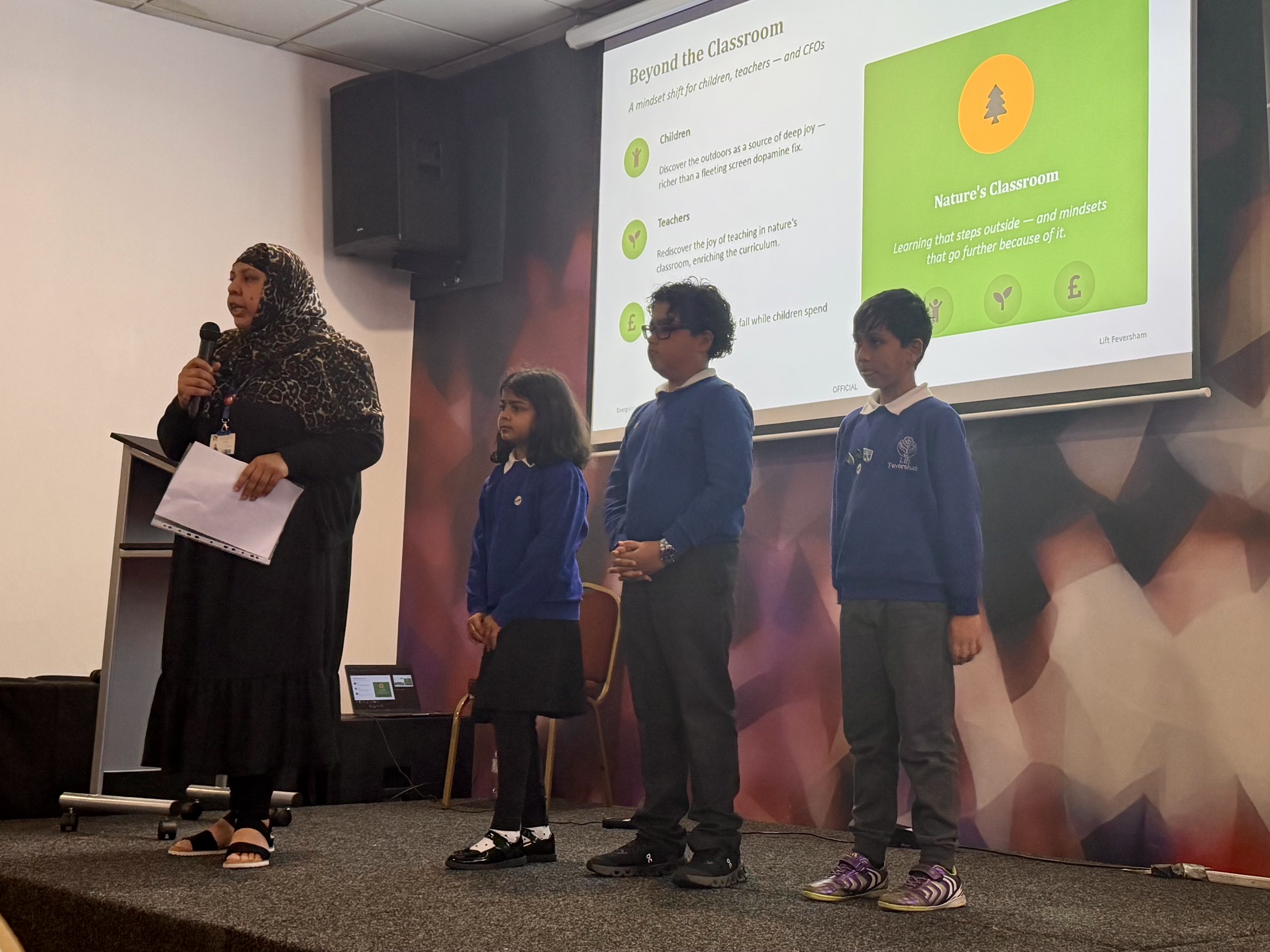
Lift Feversham Primary School was represented by Principal Naveed Idrees, Associate Vice Principal Iram Riaz, and three frankly incredible pupils.
This was the moment that shifted the day from impressive to unforgettable.
Mr Idrees began by explaining that Feversham’s environmental work is rooted in the school’s wider values. Years earlier, he said, the school had been in special measures. Children were miserable. Teachers were miserable. Everybody hated school. The response was not to do more of the same. It was to change the purpose and feeling of education.
The school invested in music as a vehicle for improvement, but, the Principal said, the work connected to something deeper.
“What makes us human?” he asked. “In the age of AI, that’s the question.”
A robot, he said, might have a mind and a body, “but it doesn’t have a soul.” For Naveed Idrees, the soul is where children connect with something bigger than themselves: curiosity, creativity, connectedness, care.
“We focused on how do children care about themselves, care about others and care about the environment,” he said.
Then he offered the school’s phrase.
“We have a saying in school: be like the sun. Be like the sun. The sun brings light, which is knowledge, and warmth, which is kindness. So be like the sun. Bring warmth and kindness, but don’t be like the winter sun. The winter sun just has knowledge, brightness, but no kindness, no warmth.”
It was a beautiful piece of school philosophy. It was also a better climate communication strategy than many professional campaigns will ever manage.
At Feversham, sustainability isn't a badge. It's part of a wider educational philosophy about care, curiosity, community and agency.
Mrs Riaz explained that before the formal programmes arrived, the school had already been building habits.
“Through our themed weeks, through our themed days, we’ve done a drip effect where it’s a little bit often and now it’s turned into habits which just come naturally to both the children and the adults,” she said.
The school’s forest school grew from a previously underused plot of land. It's now, she said, “not just an outdoor classroom for every child from our two-year-olds right up to our 11-year-olds,” but also an outdoor garden and orchard.
Then Hafsah spoke.
“Hello, my name is Hafsah and today I’m going to talk about the Eco-Warriors’ rules,” she said.
The eco-warriors, Mrs Riaz explained, became the “plug police”, patrolling classrooms at break and lunch times and switching off screens, devices and interactive whiteboards when they were left on.
“Teachers at Feversham genuinely began to dread the sound of children coming into their classrooms,” she said. The children, apparently, showed “no mercy”.
It was funny, but it was also the day’s most vivid example of culture change. Not a behaviour-change strategy delivered from a distance, but children walking into rooms and making adults behave differently.
Ibrahim spoke next about the school’s orchard.
“Hello, my name is Ibrahim, and I’m here to tell you about all the amazing things that we’ve grown in our school,” he told captivated grown-ups. “We planted apple, pear, plum trees in an unused part of our forest school and these have begun to flower and we have had an amazing harvest.”
The fruit's used in cooking sessions and in the school kitchen. The children have also grown cabbage, onions, garlic and potatoes.
“And you name it,” he said, “everything.”
Finally Zakariayah spoke about clean air.
“As part of Bradford Clean Air School Programme, we began monitoring PM2.5 and PM10 throughout the school and tackling idling cars outside the main gate,” he said. “We also found out that the cleanest air is in the back playground next to the forest school and the dirtiest air is near the staff car park in the front playground.”
It's hard to overstate the force of that moment. A child standing in a football stadium, speaking to a room of adults about particulate pollution, school gates, car idling and the geography of clean air. Imagine how you'd feel if you were his mum and dad?
Mrs Riaz explained that the clean air work had travelled through the curriculum and then home into families. The school also tracks walking to school, encourages park-and-stride, supports cycling and rewards children with badges.
“We’re encouraging our community,” she said. “We live in a built-up area within Bradford, but actually we can do our little bit to help the environment as well.”
Mr Idrees then returned to the wider meaning of the school’s solar project.
“In the first six months, we saved £50,000,” he said. “Because we saved £20,000, we were able to then engage with the community. So hire our building out for free for local groups.”
That changed the relationship between the school and the neighbourhood. Groups that needed space could use the building. A crochet club of older women moved from “a little hut” into the school. Third sector partners with funding but without footfall could reach families through the school community.
“If you look at a school building, it’s closed in the evenings, closed in the weekends, closed in the holidays, mainly,” Mr Idrees said. “And actually, primary schools are probably one of the only places left, stable places left, in terms of third sector spaces. We are struggling with community centres, youth clubs, but every community has a primary school.”
Solar panels weren't simply reducing energy bills. They were releasing space, time and possibility back into the community. According to Idrees, the savings equated to 128 days that the school could give its building free to local groups.
“The panels are a symbol of care and compassion,” he said. “Care for yourself, care for the community, and kindness to others as well.”
Near the end of the school’s presentation, he offered what might have been the most important educational line of the day.
“Don’t get put off by the scale of the task,” he said. “You do what you can. You’ve got a small difference that you can make.”
So, there perhaps, was the day’s answer to climate despair.
Not everything. Something. Not perfection. Participation.
Not a distant target. A child turning off a screen. A school opening its doors. A cathedral roof producing power. A football club helping supporters see clean energy as part of the match day story. A housing charity retrofitting with people, not to them. A farm asking local people to own part of the energy system. A community trust in East Durham connecting the energy transition to poverty, dignity and trust.
The presence of East Durham Trust mattered because it brought the discussion back to the places where energy policy is never abstract. East Durham is a landscape of former pit villages and coastal communities where any serious conversation about transition must carry memory as well as ambition. Communities that have already lived through one industrial transition are entitled to expect that the next one will happen with them, not around them.
Sustainable Ferriby CIC, too, represented another crucial strand of the day: the local civic groups, often volunteer-led, often persistent beyond the limits of funding cycles, doing the practical work of making climate action ordinary in their own places.
And because the subject is serious enough to make even committed people feel overwhelmed, the event also made room for a bit of laughter.
Stuart Goldsmith, introduced as a comedian specialising in climate change comedy, began with the problem every climate communicator knows too well: hypocrisy.
“As soon as you raise your voice, as soon as you proffer any sort of opinion on the climate crisis, whether it’s professionally or in your personal life, the first thing you learn is that you have to stare down your own hypocrisy,” he said. “All of us are caught up in this. We’re all culpable to a greater or lesser extent.”
Goldsmith’s set worked because it didn't mock climate concern. It mocked the impossible purity test that stops us as people, talking.
He described flying to America to speak at a climate conference, refusing a plastic water bottle on the plane and sitting there “with my principles intact as my body crumbled into dust.” He invited “climate confessions” from the audience: short car journeys, steak, log burners, an electric vehicle owner with an Aston Martin as a second car.
The joke was never that climate change is unserious. The joke was that humans are inconsistent, compromised and afraid - and still have to act.
“I think one of the biggest hurdles in the way of us taking climate action and talking about the action we’re taking is this horrible, guilty feeling that actually we don’t do climate very well,” he explained. “Absolutely everybody I’ve spoken to suffers from that feeling and I think it gets in the way.”
He warned against “climate cringe” - that strained tone of worthy sincerity that can make important messages feel unbearable. He also quoted climate scientist and writer Dr Ayana Elizabeth Johnson’s idea of a personal climate Venn diagram: the overlap between what the climate needs, what you're good at and what you love doing.
“That third one is really important,” Goldsmith said, “because this is the work of the rest of your life. And it has to be something you love.”
That line brought the day back to where it had begun. The climate transition is going to require policy, funding, infrastructure, regulation and the serious machinery of government. But it'll also require people to locate themselves inside the work.
A football club can do that through match day loyalty. A chip shop through local conversations and practical choices. A cathedral through moral leadership and planning courage. A school through children who know how to care for their place. A housing charity through trust, materials and community labour. A community trust through the lived realities of poverty and resilience. A comedian through laughter that makes the fear breathable.
Katie White had said in her keynote that “positivity, action, stories are contagious. And so is the opposite.”
At Valley Parade, the stories were contagious.
Not because they pretended the crisis was small. Not because they reduced net zero to lifestyle tips. Not because everyone in the room agreed on every detail.
But because they showed that the North East and Yorkshire aren't empty spaces waiting for solutions to arrive from elsewhere.
The work's already here.
On roofs. In classrooms. In kitchens. In club offices. In empty homes. In former pit villages. In orchards. In solar panels above ancient stone. In children who know the cleanest air in their school is by the forest school, and the dirtiest is by the staff car park.
The question we have to ask now is whether policy can keep up with them.
Header image: Lift Feversham Primary School was represented by Principal Naveed Idrees, Associate Vice Principal Iram Riaz, Hafsa, Ibrahim and Zakaria





