




Please don't click away because you've landed on a MagNorth piece concerned with “evidence-based policy”. I know this over-used title appears in strategies, prospectuses, manifestos, funding bids and partnership agreements (and some of our articles) with such frequency that (for me at least) it begins to feel less like a discipline than a badge of seriousness.
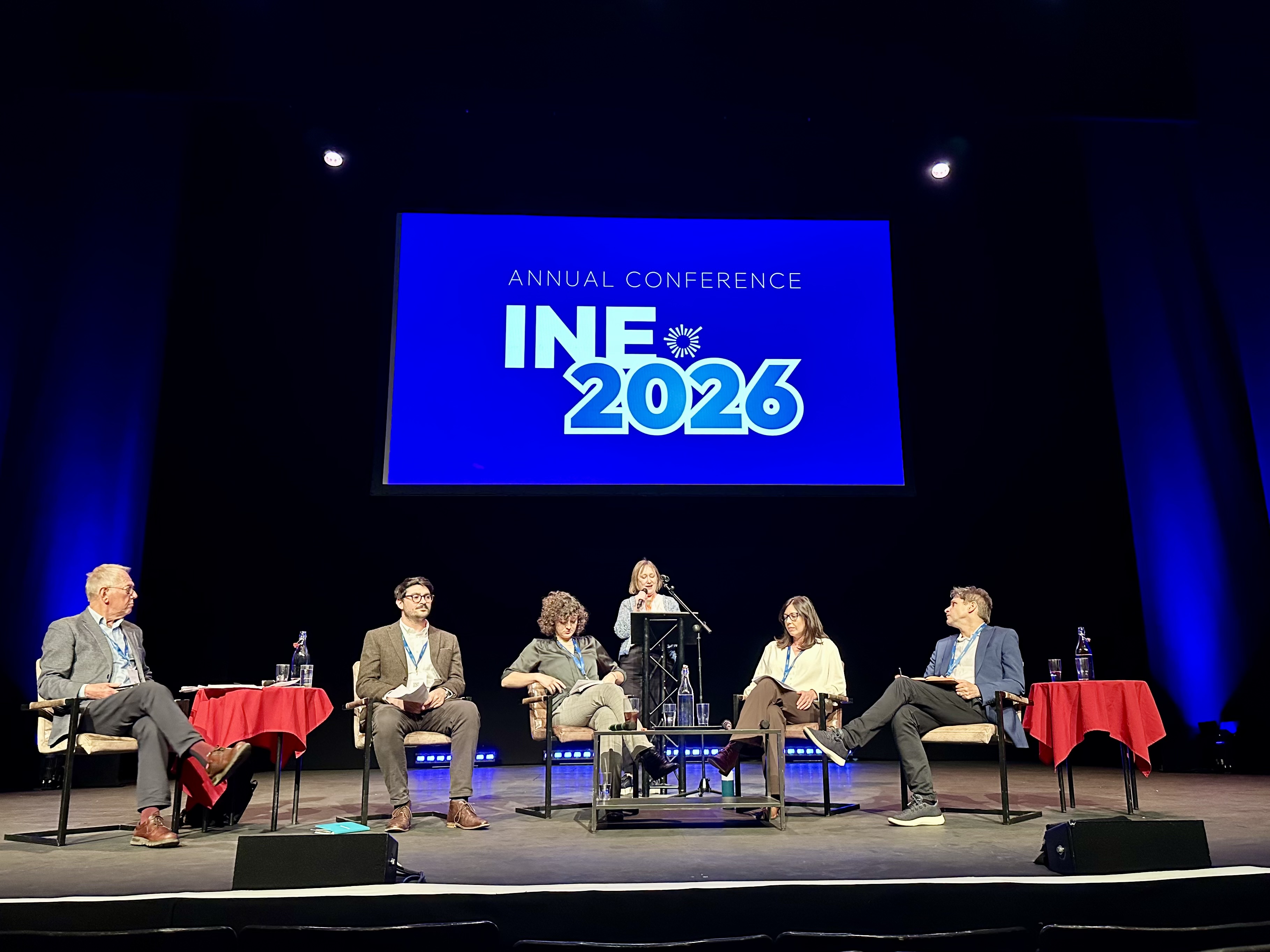
But at Newcastle's Northern Stage on Tuesday, at the fourth annual Insights North East conference, the phrase recovered some of its weight.
Insights North East - the collaborative hub for place-based policy insights based at Newcastle University - describes its role as connecting the region’s policymakers to evidence and actionable insight, with the aim of making a positive and long-term impact for people in the North East. Its 2026 conference, Powering Policy for Long-Term Transformation, set itself a deliberately difficult question: how can the region ignite the cross-system partnerships needed to sustain long-term, evidence-based approaches to entrenched policy challenges?
The language of the people who are Insights North East seems laser-focussed. Because the challenges laid out across the conference programme weren't small, neat, departmental problems. They were the kinds of problems that refuse to stay in their lane: education and skills; social mobility; the labour market; child poverty; housing; public health; climate action; transport; inclusive growth; community cohesion; digital exclusion; food insecurity; local government finance; and the stubborn geography of opportunity.
The prospectus framed Insights North East not as a consultancy taking to the stage with answers, but as a system-builder: a place where academics, public authorities, health bodies, voluntary organisations and civic institutions can bring together research, practitioner knowledge and lived experience. Its track record spans work with mayoral and combined authorities, councils, universities, the NHS, Health Equity North, VONNE, Durham Community Action, Local Trust, the National Innovation Centre for Data and others. Its stated measure of success isn't the number of projects delivered, but whether policy decisions are shaped by rigorous evidence and by the communities whose lives are affected by those decisions.
And the distinction - between doing work for communities and doing work with them - became the thread running through the day.
The conference’s formal themes were broad: Education, Skills & Opportunity; Energy, Environment & Climate Action; Inclusive Economy, Innovation & Growth; Public Health & Wellbeing Equity; and Connectivity, Community & Housing. But beneath them sat a single, more difficult question: how does a region build the capacity, trust and patience required for transformation when politics increasingly rewards speed, simplicity and performance?
This question that came sharply into focus during one of the day’s most important sessions: Behind the Headlines: Making Sense of Public Opinion, a conversation between Dr Michael Richardson, Human Geographer at Newcastle University, and Andrew Fowler of More in Common UK.
More in Common's work is centred on research into what Britons think and why. Its UK work includes polling, focus groups and segmentation research designed to move beyond a simple left-right map of the country, arguing that public opinion is now too fragmented and layered to be understood through old political categories alone.
Richardson opened the session with what he called “the Geordie philosophy of Sam Fender”, invoking the line from Crumbling Empire: “I’m not preaching, I’m just talking.”
It was more than a warm regional reference. It felt like an instruction for the room.
Community, Richardson warned, is too often discussed in spaces where the communities themselves feel alienated, or where they lack “the permissions or perceived permissions to be in these spaces”. The task, then, was not to perform listening, but to take listening seriously.
Fowler’s first intervention was stark. Asked what the recent local elections revealed about the North East, he described “the story of insurgency” - not only the rise of Reform UK, but also the growth of the Green Party, and a wider breakdown of the traditional blocs that have shaped British politics.
Where the North East may once have been viewed as a Labour heartland, Fowler suggested that picture is now “increasingly becoming a bit more complicated”. Some lifelong Labour voters are moving towards Reform; others towards the Greens. The result, he said, can feel “chaotic and difficult to make sense of”.
But the crucial point was not simply party political churn. It was expectation. The 2024 general election, Fowler argued, had been received by many voters as a possible moment of change after “a decade and a half of Tory rule”. But, he said, “a lot of people haven’t necessarily felt that”. The divide now may not simply be between left and right, or progressive and conservative, but between the old governing parties and new insurgent parties offering the promise - however credible or otherwise - of rupture.
That's an uncomfortable thought for northern policy leaders. Because the region’s institutions are still largely built around partnership, continuity, negotiation, funding cycles, governance boards and incremental delivery. Public mood, by contrast, may be moving towards impatience.
Fowler was careful not to overstate regional exceptionalism. The North East, he said, contains a particular sense of being overlooked by Westminster - “some of that may be geographical, some of that may also be historical” - but the core concerns he hears in focus groups are also familiar across the country: cost of living, immigration, and a feeling that government isn't in control.
That's a key point, because one of the temptations in northern policymaking is to assume that the North is divided from the rest of the country in wholly distinct ways. Fowler’s analysis suggested something more complex. The region has its own history, geography and political memory; but its anxieties are also national anxieties, refracted through local experience.
Richardson pushed the point further. Is division overstated? Are there deeper areas of common ground beneath the noise?
Fowler’s answer was one of the most useful moments of the session. As politics fragments, he said, unexpected common ground is emerging across voters who appear, on the surface, to be moving in opposite directions. He described a focus group in Sheffield with mothers concerned about childcare who were unsure whether to vote Reform or Green - not because those parties offered the same politics, but because both appeared to represent rejection of the status quo. That's not a comforting story. But it is a clarifying one.
It suggests that the current political volatility can't be explained only by ideology. It's also about exhaustion, anger, credibility and the search for somebody - anybody - who appears to recognise the pressure people are under.
The danger for policymakers is that “public opinion” becomes another phrase flattened by repetition. Everybody claims to know what “the public” thinks. Every party claims to speak for “ordinary people”. Every campaign produces a headline statistic. Every institution runs a consultation.
Fowler warned against that simplification. “One thing I’ve realised in my time working in public opinion,” he said, “is how many publics there really are.” It's easy, he suggested, for one politician, media ecosystem or campaign to claim to be “the voice” of people. In reality, the public is segmented, diverse and often internally conflicted.
That observation has to land heavily in a region now investing so much hope in devolution, combined authorities, civic partnerships and place-based policymaking. If there are many publics, then listening can't be a single event. It can't be an online survey at the end of a process, a tick-box consultation, or a workshop with the usual suspects. It's got to be a discipline - and that discipline has to begin early.
Later in the session, Fowler returned to this point in response to a question about whether the way a policy is “sold” to the public is more important than the content of the policy itself. Public opinion, he argued, shouldn't be “brought in at the end of the conversation” after a policy has already been developed. It needs to be present “from the beginning of that policy, of that programmatic development”. Policymakers should ask people not simply whether they prefer the wall “red or blue”, but what's being built in the first place.
That's a very different model of democratic engagement. It's asking institutions to move beyond communications and into shared design. It asks them to understand public opinion not as a risk to be managed, but as a form of knowledge.
And the session’s hardest material concerned trust: Fowler said More in Common’s work on polarisation identifies falling trust as one of the central drivers of the current moment. He used a striking line from the organisation’s research: only one in five people would trust a politician to watch their bag while they went to the toilet. It is a funny statistic until it isn’t. “The public do not feel that politicians have their back,” he said.
More troubling still was his description of how that distrust has changed. It's no longer simply that people think politicians are incapable of delivering change. Increasingly, he explained to the auditorium, some people believe politicians never wanted to deliver change in the first place. The public mood has shifted from “the system is broken” towards “the system was rigged to begin with”.
For policy leaders, this creates a profound problem. Even when people support a policy in principle, they might not trust government to deliver it. Fowler described focus groups where participants liked a policy, backed it and understood its value - until asked whether they would support the government implementing it. At that point, suspicion returned: perhaps ministers would fail; perhaps they'd distort it; perhaps they'd only do it to win votes.
This is the straitjacket now tightening around public life. A policy can be evidenced, sensible and popular in abstract - and still fail because the messenger is distrusted.
Thankfully Andrew Fowler resisted despair. Trust, he said, has not eroded equally everywhere. People still trust some institutions, particularly where they feel respected by them. Doctors and the NHS still command trust. The BBC, he suggested, still holds respect among important middle segments of the public. But perhaps most significantly for a room full of North East policymakers, he argued that trust increasingly returns at the local level.
When people are asked about national politics, he said, the words that come back are often “rubbish”, “broken”, “crap”. But when asked about their local areas, the language changes: community, parks, pride, green spaces. “This kind of return to a more local place-based politics,” Fowler said, “the tangible impacts of politics…that is actually where people still trust.”
This should be read as both warning and opportunity. The warning is that national politics is contaminating local delivery. Distrust generated by Westminster scandals, party management, culture-war performance and perceived incompetence doesn't stay in Westminster. It leaks into local government, public health, climate policy, housing and transport.
The opportunity is that place still means something. People might distrust politics in the abstract, but they care about the park, the bus, the school, the GP surgery, the high street, the estate, the river path, the community centre, the child who can't access support, the neighbour who can't afford the rent. For a region like the North East - or anywhere in the North - that's not sentimental is it? It's strategic.
Fowler’s remarks on climate policy made the same point. One of the great challenges of net zero, he argued, is that it can feel intangible. If it succeeds, many people might not even notice it. That makes it hard to build a public narrative around. The answer, he suggested, is to root climate action in tangible community assets and co-benefits.
Parks work because people use them. Community-owned solar panels work because people can see them and because they give communities agency. Climate action can't be presented only as a moral imperative or a technocratic target. It has to connect to what people can point to, use, own, enjoy and recognise as theirs.
This is where the conference’s wider themes came together. Education, health, climate, housing, transport and inclusive growth are often treated as separate policy domains. Insights North East’s programme reinforced that they're connected. Fowler’s contribution explained why that connection has to also be felt by the public. If policy remains abstract, people might agree with it and still not mobilise around it. If it's tangible, local and agency-building, it's got a real chance of becoming trusted.
But the conversation also raised an uncomfortable question about authenticity. Fowler argued that voters increasingly want politicians to express values, not merely offer policy lists. This helps explain why unlikely coalitions can form: voters with different economic views might gather around a figure or party that appears to express their frustration, identity or desire for change.
He didn't present this as an unqualified good. But he did suggest that the public's become tired of being told that change is complicated, slow or impossible. “What the British public are looking for,” he said, “is politicians who say that they can fix their problems.”
For senior leaders, this is a difficult message. Responsible policymaking often requires honesty about trade-offs, constraints and timescales. But if all people hear is caution, delay and process, then those promising instant transformation will fill the vacuum.
The answer isn't to imitate populism. It's to make long-term policy legible, authentic and morally serious.
Fowler put it plainly: people want to know “why are we doing this?” Policy needs narrative. Not spin, not slogan, not a comms grid - narrative. A meaningful account of who benefits, who bears cost, what values are being honoured, and why the institution making the case has the legitimacy to make it.
That noun - legitimacy - felt present through much of the session.
It surfaced again in the discussion about social media, AI-generated consultation and the future of public opinion. Fowler warned against assuming that X, formerly Twitter, offers a meaningful picture of what the public thinks. Some groups are far more likely to post, argue and perform politics online, while “the vast middle” often now avoids those spaces entirely. Social media, he suggested, can shorten the distance between people while also shallowing the interaction, turning what might once have been a fuller conversation into “a short shouting match”.
This point has become urgent. Research published this week by the Social Market Foundation, reported by The Guardian, warned that local social media groups can fuel misinformation, particularly in “news deserts” where trusted local journalism is weak. Its analysis found misinformation spreading around local issues and elections, with immigration and Islamophobia prominent among false claims.
For MagNorth readers, hopefully this is a central tenet of why you're with us? The decline of local media, the rise of algorithmic anger and the weakening of trust in institutions aren't separate stories. They're part of the same civic emergency. If people no longer trust politicians, don't encounter reliable local journalism, and no longer feel that consultation changes anything, then misinformation doesn't arrive in an empty space. It arrives in a space already prepared for it.
The conference’s quiet radicalism lay in its insistence that evidence has to be relational. Data alone won't save public policy. Nor will participation theatre. Nor will another glossy strategy. Evidence has to be connected to people, place, delivery and trust.
That's why Insights North East’s model is interesting way beyond the North East. Its prospectus talks about “system-builders, not service providers”; about working “with”, not “for”; about being “of and for the region”; and about connecting academic research, practitioner expertise and community insight. Those aren't decorative phrases. They'rre conditions for legitimacy that lots of us understand
The session ended with perhaps the most sobering answer of the day. Asked whether the public understands the time pressures facing policymakers, Fowler recalled a woman in a focus group who felt Labour might have some kind of plan, but that it would take two years - and she needed help now. She had children, SEND pressures and immediate cost-of-living concerns. She couldn't wait for national politicians to “get it together”.
That then, is the human reality behind policy impatience. Long-term transformation is absolutely necessary. But for lots of us, long-term transformation can sound like another way of saying: not yet.
This is the bind facing the North East, and the wider North too. The region needs deep, sustained, cross-system work on poverty, health, education, transport, housing, climate resilience and economic opportunity. It needs evidence, research, data, lived experience and institutional partnership. It needs the kind of infrastructure Insights North East is building.
But it also needs to understand the public mood clearly. Not caricature it. Not fear or flatter it. Understand it.
The lesson from Northern Stage wasn't that policy should chase every gust of opinion. It was that policymaking without public legitimacy is increasingly fragile. The more complex the challenge, the more seriously people must be brought into the work early. The more long-term the solution, the more visible its short-term meaning must become. The more distant Westminster feels, the more important local trust becomes.
There's still civic capital in the North East. There's still massive amounts of pride, practical wisdom, institutional memory and community attachment. There are still lots of people who believe in place. But belief can't be assumed. It has to be earned.
That might be the real work now: not simply producing better evidence, but building the conditions in which evidence can be trusted, shared and acted upon.
Or, to borrow Richardson’s opening frame, perhaps the task is not to preach. It is to talk - properly, honestly, early, and with the people whose lives are supposed to change.





