



.jpg)
How can collective radical reimagination shape a better future for people in Teesside? What have communities learned from testing, learning and storytelling through this participatory process?
These big ideas and fundamental questions about creativity, co-creation and community-led decision-making were explored in Borderlands’ Weekend of Dreaming this January. The MagNorth team attended and learned so much about the people-powered change that is taking place in the region.
Kickstarting collective energy, the weekend was facilitated to be so much more than an event: it was an interactive and people-powered deep-dive into the social and cultural landscape of Middlesbrough, Redcar and Cleveland. Led by do-ers, changemakers and communities with the team from Borderlands there to help shape conversations around shared values of authenticity, ambition, equity, transformation and sustainability.
Borderlands is an Arts Council England funded Creative People and Places programme, working across Middlesbrough, Redcar and Cleveland with the aim of supporting more people choosing, creating and taking part in brilliant creative experiences. Borderlands is also supported by the Tees Valley Combined Authority among other partners. Increasingly Borderlands has been focused on developing a programme that meets artists and communities where they are. Building resilience through co-production.
This manifested itself in an ambitious programme shaped by care and consideration called the Communities of Possibilities. The Weekend of Dreaming took place to celebrate this programme, but also to act as a laboratory for what is truly possible. Moving beyond the abstract and art to instead ground a collective practice of dreaming in the reality of local life in Teesside.
So, what were some of the themes that are helping people to find joy and meaning in their lives? And how can arts-led ideas improve wellbeing? The Weekend of Dreaming became a collective radical reimagining of how art, community and local action intersect to create lasting change.

Radical resourcefulness: participatory ingenuity
The first day of the Weekend of Dreaming saw a number of presentations including one from Sawdust, a creative woodwork studio in Teesside that empowers communities, people and places through place-making.
The team ran a workshop and shared their story about running the North East’s first Park(ing) Day, putting Middlesbrough on the map as part of a collective global movement of artists repurposing car parking spaces for social good. They transformed two urban car park spaces on Albert Road in Middlesbrough into a small pocket park that was packed with local music, literature, and playful moments from grassroots creativity.
SAWDUST founder, and one of the Tees Valley Artists of the Year for 2025, Will Hughes explained the Park(ing) Day idea was driven by smart strategic working with local community groups, ensuring the idea was shaped by what really mattered to local people. They said: “The whole project was about showing that the town centre can be somewhere people want to linger and a place that feels made with care. It was a small demonstration of hope that reclaiming even the tiniest amount of public space can really shift perceptions and spark conversations about what Teesside’s streets could be in the future.”
The team faced challenges in terms of engagement, but values of patience and listening ensured a space where radical imagination could grow in unlikely places. Will told the Weekend of Dreaming audience: “Sometimes fewer people attending a workshop can be a good thing because it enables deeper and more meaningful connections. And in our experience people working with their hands feel truly free in how they think and act, which is always a good way to let imagination and ideas flourish.”
Artist Kat Lynas from Stellar Creates shared the Tomorrow Street project.. It explored what the High Street of tomorrow might look like if it was shaped by the aspirations, needs and imagination of the local community. The Stellar Creates team co-created an installation that popped up at Middlesbrough Town Hall during the October half-term.
Kat explained one of the most striking things was how responsive participants were to thinking boldly about the future: explaining that everyday people can quickly shift their hearts to become playful, ambitious and joyful if they are given the right opportunities to connect.
“This left me thinking, how do we keep space for collective imagination alive? It is so important to give our participants space for their work to be valued. There’s a real power in letting children and young people see their work as something bigger than themselves - not just something to stick on the fridge.”
Bootstrapping community solutions: an assets-based approach
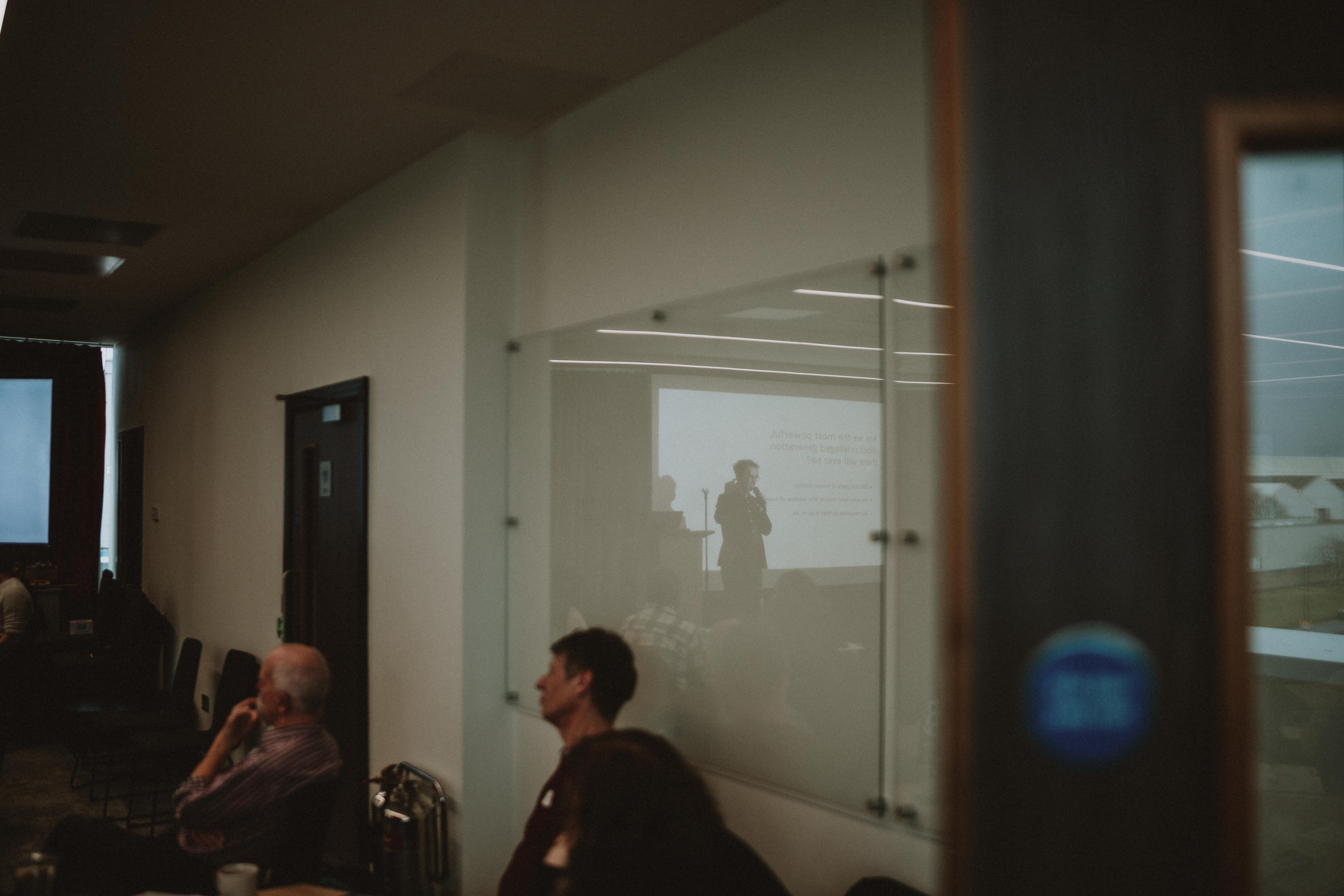
Middlesbrough poet Bob Beagrie took to the stage on the second day of the Weekend of Dreaming to share his project Reimagining Middlesbrough. This idea set out to create a poetic map of the town through a collaborative process of psychogeographic wanderings and site-specific workshops with diverse community groups.
“Collaborative writing became such a powerful tool for bringing these perspectives together. It opened up so many layers of history, memory and subjective experience - leading to pieces of work that felt both meaningful and emotionally charged,” Bob explained.
“Because we worked with such a diverse group it helped to create a deeper mutual understanding of the town, its history and the cultures that shape it. Writing has to be one of the best ways to foster belonging through collective exploration.”
Reimagining Middlesbrough is out now, with copies for sale at the Weekend of Dreaming. As well as showcasing the work from people directly involved in the project workshops and visits, the anthology also includes place-based poetry penned by other local writers and draws attention to the rich literary scene Middlesbrough has had for generations - capturing something of the soul of the town at a moment in time.
Bob added: “Land and story are interwoven in my practice and this is so important in a place like Middlesbrough where we have to recognise its long migrant origins. We used a multicultural lens to our workshops that sparked connection and a deeper belonging.
“The project empowered local people to express themselves creatively, learn new skills and gain confidence in oral and written expression through creative writing, recorded spoken word, and to celebrate different perspectives through the exchange of personal narratives, cultural traditions, their stories of belonging and their visions of the future. The beautiful and resonant worlds helped people to imagine together.”
The Saltburn Folk Festival team enchanted the Weekend of Dreaming with a series of songs produced and performed as part of the Folk Songwriting Project. This idea saw professional folk musicians working with children, young people and older residents to explore heritage, lived experience and hopes & dreams with the songs being performed at the Saltburn Folk Festival.
“People taking part were rightly so proud of their work and you know what, that really helped with feeling pride in where they’re from and that is so important,” said Saltburn Folk Festival team member Nigel Carden who found great delight in finding the extraordinary stories in ordinary everyday people.
“One participant said to me ‘you’ve gotta leave to see it clearly’ and another said ‘I want my kids to grow where folks know my bones’. It was clear that this was such a powerful way to bring people together through music and gave people a chance to think about their voice and their identity in a new way,” he added.
An assets-based approach to creative production and community projects enables artists to explore class, geography and a sense of place in meaningful ways, according to Aaron Bowman Senior Producer of SIDEQUEST CIC.
He told the Weekend of Dreaming: “How do we embed the practice of collective imagination when thinking about biodiversity loss and climate disaster? You’ve got to begin with imagination first and information second.
“The speculative frame is so important to us, which means exploring sideways rather than through direct confrontation. Asking participants to question decisions, challenge power and imagine a collective correlated museum. We had a fundamental belief during our work - that artists are not the experts, the children are.”
Aaron shared the story behind the story of The Pop-up Cardboard Museum of Natural History from the Future. The idea allowed communities to rethink their local area by imagining what one day might be found here, preserved or remembered. He explained the idea enabled imagination to become a civic act with local people reclaiming their surroundings, rewriting local narrative and asserting their right to dream beyond the limits placed on them.
The project directly engaged with Teesside people who claimed they ‘weren’t creative’ through the supported development of a speculative ecosystem. Together people created impressive cardboard creatures which opened the doors to provocations around identity, loss of pride, ecology and uncovered the stories that never made it into official museums. The outputs were 1) a pop-up installation 2) a professionally performed museum and 3) a menageries of extraordinary cardboard creatures.
“We treated participation as expertise, not just contribution. This meant The Pop-up Cardboard Museum of Natural History from the Future was less about representing a better future and more about rehearsing ways of bringing it to life,” Aaron explained.
“What stood out was how quickly people stepped into that imaginative space. Families gathered together to identify creatures to be preserved for the future. The facilitated aspect of the museum ensured visitors were embedding small ways of protecting biodiversity as part of the project too. This meant they weren’t just making objects - they were reframing their place as somewhere with a future worth imagining.”

Intuitive playfulness: breaking down complexity
The power of playfulness ran through the Weekend of Dreaming like a red thread. Rumana Yasmin, the founder of Teesside’s Bok Bok Books, took to the stage to share the Roll to Reimagine project. This idea supported schoolchildren to co-design a cooperative antiracist board game to challenge harmful narratives and boost problem-solving skills.
“We wanted to explore a future based on radical communities, " she said. “Building conditions for imagination by creating a safe space. The tools for understanding are empathy and social justice. And one important thing we discovered was that you don’t need to dumb down. The reality is that children live with complexity every day . We just need to tease out their creativity, we don’t need to simplify it.”
Bok Bok Books is an independent publishing company that aims to address the need for diverse representation in children's literature. This background helped to shape some of the thinking behind Roll to Reimagine - creating new ways for children and their contributions to be braver, more honest and more imaginative than any adult-designed game could be.
Rumana added: “There was a moment of shift that underlined the importance of a collaborative approach. Children told us that anyone can be a victim. And, crucially, we all collectively believed in a fundamental idea - it’s about challenging the system and not challenging each other.”
The strategy behind the Communities of Possibility Becoming Boro: Futures in Play, A Radical Repowering was shared at the Weekend of Dreaming too. Delivered by Furtherfield and produced by Middlesbrough Art Week the project developed ways of thinking from the Live Action Role Play community - helping people to shift from challenges to imagining future possibilities.
Dianne Bowell, the project’s Creative Producer, said: “Becoming Boro was a chance to go slower, more calmly. Taking people on a journey. It was so important for us to give people time and energy to imagine and move themselves into a more creative mindset. Co-creation and participation go hand-in-hand, letting us delve deeply into our community and strengthening relationships here between artists partners and community knowledge holders.”
Creating loops of lasting value: Teesside impact legacies
Sparking pride and imagination in Middlesbrough’s Newport community was the aim of the Don Revie: From Bell Street project. This small idea grew to become something so much bigger than itself, even contributing to discussions on heading footballs and degenerative brain conditions in parliament.
The project aimed to bring together history, culture and participation on the streets around Archibald Primary School in Middlesbrough. Don Revie grew up here and through relentless commitment and no little talent he rose to the very top of English football at the heart of Leeds United’s golden era and managing England.
Despite this legendary status Don’s story was remarkably unknown, particularly to younger generations in Teesside. With Borderlands’ support the idea quickly shifted from a football idea into a wider act of collective radical reimagination through community workshops, creative work in schools and media attention from the BBC, ITV and more.
The idea grew to become a co-created mosaic at the school. Andrew Pain worked on the idea and shared the joy and challenges of such an ambitious project at the Weekend of Dreaming. “Art takes you to different places, the unexpected, together we can move on conversations - that’s what it does,” he said.
Alongside the mural the project boosted local skills, offered practical learning opportunities, and improved participation in community projects. Andrew added: “I told people ‘it’s your project, we’re just the enablers’. It really created a space to imagine that part of Middlesbrough differently: not through deficit or nostalgia, but through connection, ambition and local pride.”
The power of bringing people together was also discussed by Paul Hyde, the director of Whippet Up. Their idea was born in open, generous group conversations and grew to become the ambitious creation of a cardboard masterplan of a Middlesbrough of the future.
The project worked with people living with mental or physical health conditions and with deeply isolated communities. Whippet Up are looking to intervene by offering uniquely creative environments where confidence, connection and agency can grow.
Paul explained to the Weekend of Dreaming: “We created a space to look more closely. So, how do we fit together to create something bigger than ourselves? That’s where an artist comes in - to encourage, to collaborate and to create a process. What I mean by that is not taking over, but offering quality control.
“And we really shouldn’t be scared of encouraging people to get things done. When people say they aren’t arty then we like that. It’s a challenge! Pressure isn’t a bad thing in itself, in fact pressure makes diamonds. This isn’t necessarily down to us, it is co-production after all.”
Cultivating a Living Legacy: sustainability has to mean creativity
Restorying from Guisborough Arts brought the Weekend of Dreaming to life with a series of immersive soundscapes captured from the Teesside town of Guisborough.
Emerging sound artist Michael Perry explained: “We weren’t just working with facts, but heartbeats. Restorying was about who we’ve been but more importantly it examined who we could be. Whether sharing memories, debating local change or imagining what's to come next, the participants consistently described a world shaped by care, connection and a renewed sense of community.
“What really stood out was a shared hunger for something gentler, fairer and more human. And there was something so utterly magical about framing stories to landscapes.”
A project centred on using glass - old and new - to bring people together through shared making and creating was also shared on the final day of the Weekend of Dreaming. Antioch saw workshops taking place across East Cleveland, people in Brotton and Skelton embracing the opportunity with pride.
Antioch began with a simple idea of working with 120-year-old glass from St Margaret’s Church in Brotton. Through creative sessions led by glass artist Jo Lumley participants of all ages and abilities were introduced to the amazing possibilities of glass art and creating something beautiful with their own hands.
Jo Lumley told the Weekend of Dreaming: “The work has been deeply gratifying. The pace, ambition and sheer amount we achieved together was awe-inspiring for participants who were filled with a sense of pride and beauty. From children encountering glass for the first time to older adults finding fulfilment in contributing to a shared artwork - Antioch delivered remarkable moments of imagination, happiness and connection.”
The sense of the next chapter being unwritten was shared by the Clay Lyrical: Fired in Dreams team. Louis Frere-Smith and Mia Williams paid tribute to the wide range of community groups they worked with around Redcar who all approached the creative sessions with openness and curiosity. The project saw research, outreach, new connections and then a series of hands-on sessions as people came together to make a stunning collection of clay tiles.
This work was later exhibited at the Redcar Contemporary Art Gallery, with artists determined to continue project momentum in the region.
Middlesbrough Uncovered was another Communities of Possibilities project that created a momentum all of its own, with BBC and local media features sharing the impact of the unique idea. It set out to reclaim the town’s streets through its own history. A series of immersive walking tours explored how Middlesbrough’s unique social and industrial past shaped the town as it is today.
The project invited people to walk the streets together, hearing guided tours narrated by community voices who reintroduced participants to Middlesbrough’s back lanes and hidden corners. This was particularly crucial at a time when Middlesbrough had been overshadowed by the riots of 2024.
Middlesbrough Uncovered offered a powerful counter-narrative rooted in truth, dignity and collective memory. It began by gathering voices from across the community for interviews alongside deep research into Middlesbrough's layered history. Esteemed electronic artists A Man Called Adam recorded and mixed the interviews, creating an immersive audio world.
But what was really important was the chance for connection and reflection according to project lead Rob Nichols. He said: “What stood out along the way was how much everyone was learning. It was amazing to me that we discovered so many residents didn’t know all that much about our town’s identity as somewhere that's built on inward and economic migration. That’s a history that must be continually retold and told creatively to counter the distortions and simplifications that too often overshadow it.”
There’s a bright future for immersive tours of Middlesbrough. Rob added: “Headphone tours are a way to time travel through decades of local history, hearing the town in new ways and walking in the footsteps of the people who made it.”

How can we be good ancestors to the future people of Teesside?
The Weekend of Dreaming was shaped by the untapped potential of truly giving people hope and possibility. If we co-design positive futures then will that help us to be genuinely good ancestors to the future people of Teesside? Artists, creative producers and community knowledge holders centred on a powerful notion of the intolerance of uncertainty. However, we are living through uncertain times - particularly across communities at the intersection of the culture sector. Is there a way to nurture a frame for this?
Part of the solution to these knotty problems seems to lie in the tiny breakthroughs shared in the Communities of Possibility projects. And in places like Middlesbrough and Redcar there’s certainly a power in dynamism, rolling up sleeves and getting things done. But to be wary of the pressure of every action having to mean something deeper.
Because perhaps the conditions for radical imagination are actually a permission to dream, rooted in an understanding of place and a sensitivity to shared human experiences & skills.
Borderlands Project Director Shahda Khan explained: “The Weekend of Dreaming has demonstrated the collective power of radical reimagination. It has been a privilege to steward this programme on behalf of our communities. There has been so much rich learning to share both with our local stakeholders as well as nationally’.
“Every one of these projects should feel so proud, they’ve become part of a system of cultural advocacy here in the North East. The participatory way community voice has been celebrated through creativity has had the emotional resonance and narrative to shift the way people think. All have delivered results too, ensuring that dreaming leads to tangible, visible changes in the communities and spaces people call home.”
The Weekend of Dreaming was a testament to the fact that change is not something that happens to a community: it is something that happens from within it. The sheer wealth of community-led creativity was an invitation to stop looking for answers from the outside and to start looking at the wealth of imagination already existing in Teesside. By blending the practical with the provocative and the gentle with the radical, the Weekend of Dreaming didn’t just talk about the future it offered a vision of how we could collectively build one.
Shahda explained that Borderlands was looking forward to an exciting twelve months ahead, and will be working closely with partners across Middlesbrough and Redcar & Cleveland. This includes Middlesbrough's City of Culture bid, the town’s bicentenary, and a focus on people-powered work in Redcar. Community work flowing into institutional programmes and making change happen in unexpected ways.
Shahda added: “It is plain to see that when allowed the space, time and resources, communities in Middlesbrough, Redcar and Cleveland are deeply creative and contain a rich diversity of radical solutions for what a more positive future for this region looks like. The ideas shared here have been ambitious and uniquely local and universal in relevance. Communities and creative people have shown outstanding ingenuity and resourcefulness to bring this programme to life in a truly magical way - shifting power and decision-making back into the hands of local people here.
“The Weekend of Dreaming was built on the belief that the power to envision a better future belongs to everyone - people on the high street, community organisers hard at work, and the artist in the studio. In my opinion this dreaming isn't an escape from reality at all; it is a radical response to it. It acknowledges the challenges faced by Middlesbrough, Redcar and Cleveland while refusing to be defined by them.”
All Images: Amelia Read Photography





