



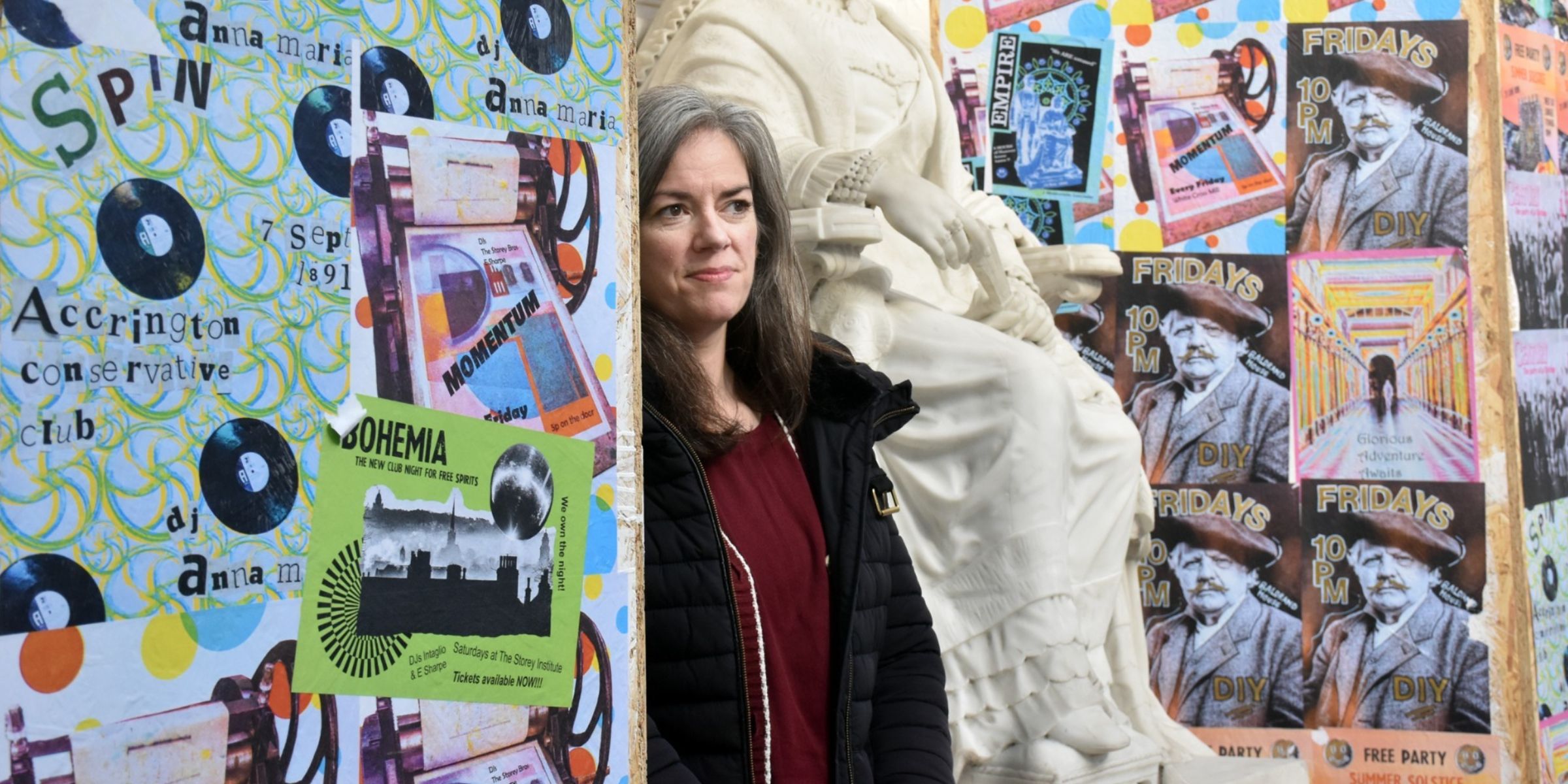
A man in a broad cap and a formidable moustache has found his way onto a rave flyer in Lancaster. The poster promises a Friday night, and the name under his face is DIY. The man is Karel Klíč, a Bohemian-born painter and inventor who died in 1926. A century later, photographer and DJ Ginny Koppenhol has given him a place in the visual language of the 1990s dancefloor.
A flyer is made to leave the person who produced it. It goes in a pocket, gets handed to a friend or ends up on a bedroom wall. What brings Klíč back to Lancaster this November is his part in making detailed pictures travel like that, in quantities a painstaking print from a flat plate could scarcely match.
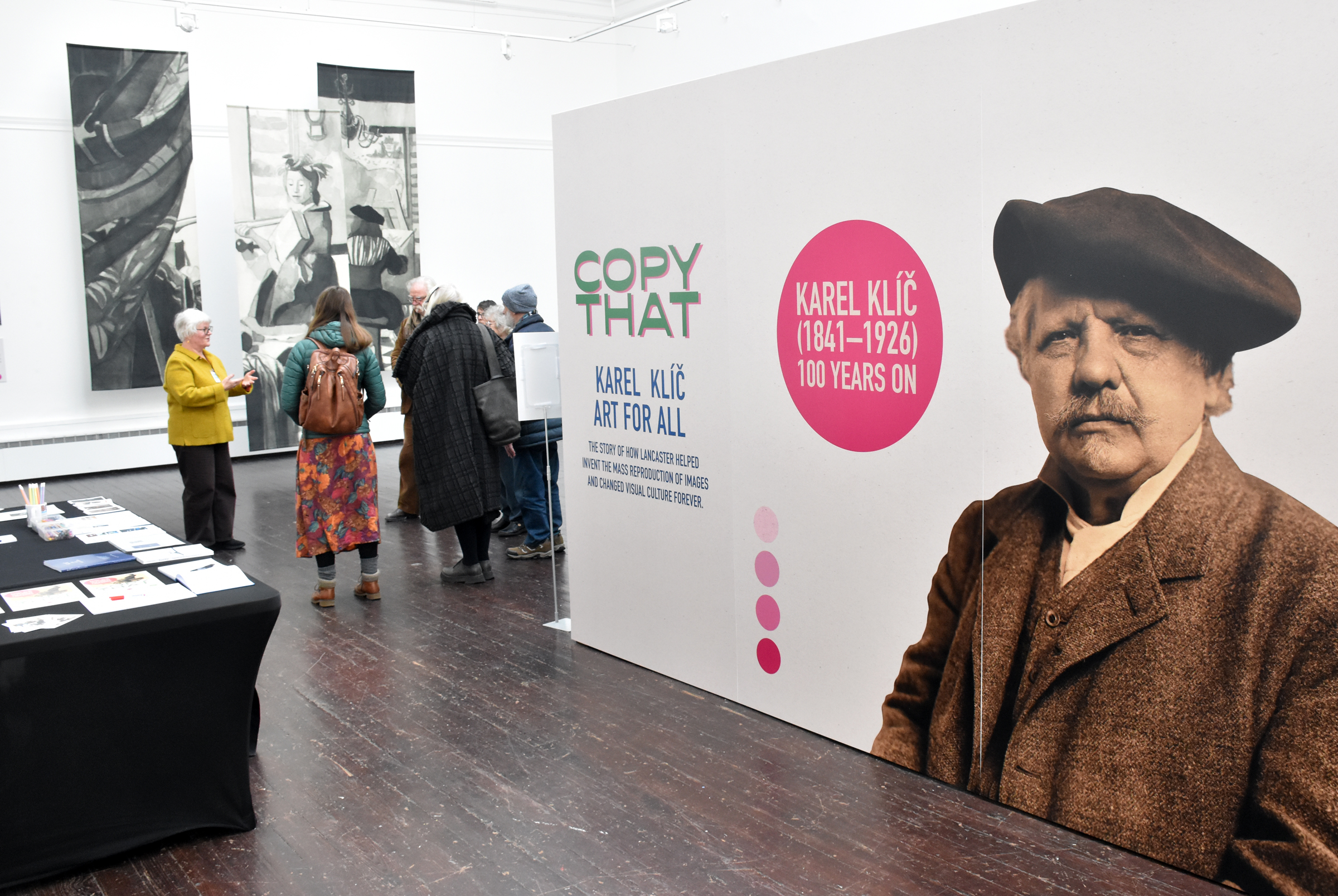
Klíč was born in Bohemia in 1841. He worked as an artist, caricaturist and photographer, and by 1879 had refined a method of turning a photographic image into a print from an etched copper plate. The recesses in the plate held the ink. Variations in how much ink they held gave the picture its range, from delicate greys to dense shadows. Photogravure could carry that detail across from a photograph. The next question was how to make the process work at speed.
His route to Lancaster took him through Accrington. He painted people in both towns, among them Accrington mayor Thomas Whittaker and the industrialist Sir Thomas Storey. In 2025, retired Lancaster University lecturer Dr David Steel appealed for help tracing two paintings once given to Accrington Mechanics’ Institute. One showed a coal merchant, the other a pet dog. It’s a glimpse of a working artist whose pictures still turn up in the history of local families and institutions. Steel’s revised biography can be ordered at the exhibition.
In Lancaster, Klíč found the industrial knowledge and investment to turn a printmaker’s technique into a commercial process. The Storey Brothers already knew how to print on materials such as oilcloth. Klíč worked with engraver Samuel Fawcett, and in 1895 the Rembrandt Intaglio Printing Company was established at Queen’s Mill on Aldcliffe Road. A rotating cylinder could print onto a continuous roll of paper. Fine detail and fast production could now belong to the same process.
The consequences were visible in the places people encountered pictures. A reproduction of a painting could be bought for the home. Photographs could circulate in newspapers and magazines. A postcard could carry a view of somewhere its recipient had never been. Rotogravure became familiar enough to turn up in Irving Berlin’s Easter Parade and, decades later, in the title of Ringo’s Rotogravure. The word travelled almost as far as the pictures.
For Copy That – Karel Klíč – Art For All, Lancashire arts and heritage charity Mirador has gathered paintings, documents, illustrations and other objects from Britain, Europe and the United States. Work by Cornelia Parker sits within a show that also brings together five contemporary responses to copying. Each tests what can happen when a picture changes medium, scale or audience.
Lela Harris’s Reimagining The Masters, made with fabric printer Standfast & Barracks, takes up Vermeer’s The Allegory of Painting, which the Rembrandt company reproduced in Lancaster. Harris divides the composition across large hanging panels. The folds of the curtain occupy a panel of their own. The gaps become part of how you see the picture. What began in a painter’s studio has passed through a Lancaster printing works and returned as a collaboration with another local printer.
Tom Diffenthal and Lauren Paige Dowling of You’re Most Welcome take copying into the photo booth with C.O.P.Y.C.A.T. Its green monitor and small framed portrait give it the air of a machine from another era trying to work out what to make of the person in front of it. In Leo & Hyde’s Speed of Life, projected pictures wash over a printer. Darren Andrews draws on the starling murmurations at Leighton Moss for his photogram work. Across his panels, repeated forms invite you to look for how one arrangement differs from the next. And in Koppenhol’s Rave On, Klíč joins a world of bright colours, repeat patterns and invitations meant to be passed around.

The exhibition brings together a year of public activity by Mirador, supported by the National Lottery Heritage Fund and Arts Council England. At Lancashire Archives in Preston, Harris worked with Lancaster Black History Group and the archives team on a workshop that turned historical research into collage postcards. In Lancaster and Morecambe, Marge Bradshaw introduced participants to cyanotype, a way of making photographic prints without a camera. Work made by young people and adults during the programme is on display in the Thomas Storey Gallery, next to The Printroom, and at The Cornerstone in Dalton Square.
There’s something fitting about seeing this in a building that carries the Storey name. Klíč’s story belongs to Lancaster’s industrial history, and Mirador has given people something to do with it. A Vermeer can come back as fabric. A photograph can become a postcard. A man who helped pictures travel can turn up, a century after his death, on a flyer for a Friday night.
Free at The Storey Gallery, Meeting House Lane, Lancaster, until Wednesday 25 November 2026.
Monday to Saturday, 10am–6pm. Free family drop-ins with some of the artists run on Saturday 21 November, 10am–5pm.
The closing conversation starts at 6pm on Wednesday 25 November, with Lela Harris, Rebecca Pye and Luigi Carnovale. The exhibition moves to Blackburn Museum and Art Gallery from 16 January to 6 March 2027.
Header image: Photographer and DJ, Ginny Koppenholl with her artwork, Rave On, part of the Copy That exhibition at the Storey Gallery until November 25. Photo by Darren Andrews


