



.jpg)
There are crowns that are inherited. There are crowns that are guarded behind glass. And then there are crowns that are made from clay, glass, recycled tweed, local memory and the deep, stubborn affection of a town for its own people.
Our Wic, a new exhibition and interactive installation by artist Lucy Wright and Arts&Heritage, belongs firmly in the third category.
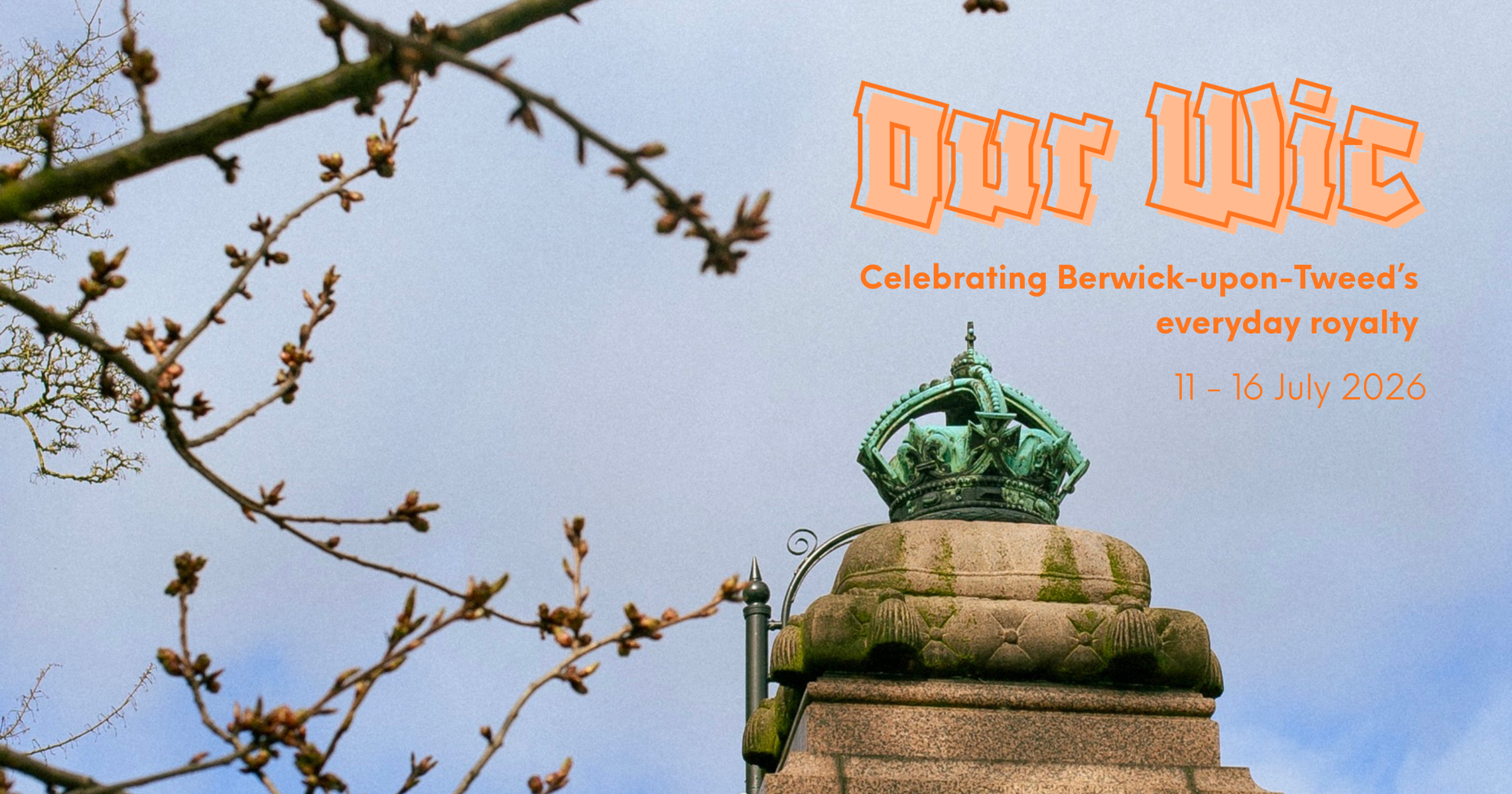
Taking place from 11–16 July 2026 at The Straw Yard and Holy Trinity Church in Berwick-upon-Tweed, the free project celebrates what it calls the town’s “everyday royalty”: the people who make Berwick what it is, not through title or inheritance, but through work, care, skill, creativity, neighbourliness and long familiarity with the place. It is commissioned and funded by Create Berwick, Northumberland County Council and the North East Combined Authority.
Its starting point is one of Berwick’s most distinctive civic traditions: the crowning of the Tweed Salmon Queen, which marks its 80th anniversary in 2026. The Salmon Queen celebration is part of the wider Tweedmouth Feast, with the 2026 festival scheduled to run from 17-19 July, including the crowning ceremony on Friday 17 July.
But Our Wic is not a nostalgic exercise. It is not simply dressing up the past and asking us to admire it. Instead, Wright appears to be asking a more interesting question: what do we do with civic ritual now?
Who gets recognised? Who gets honoured? Who gets to stand in the frame and be seen?
For Our Wic, six local people will be nominated as Berwick’s contemporary “kings and queens”, each representing the town’s present-day industries, communities and forms of labour. Each will wear a bespoke crown created by a local artist or craftsperson, before being photographed for an exhibition at Holy Trinity Church. The crowns are being made across a range of media, including ceramics, stained glass and recycled tweed, by Deborah Whyte, David Purvis, Lucy Baxandall, Jennie How, Anna Corbett and Suzanne Wright.
There is something pleasingly radical in that. Because the language of royalty usually points upwards: to palaces, monarchs, bloodlines and power. Here, it points sideways - towards neighbours. Towards the person who opens up, locks up, mends, bakes, ferries, teaches, organises, volunteers, remembers, makes, fixes, cleans, listens or simply keeps showing up.
In other words, the people without whom a town becomes a shell.
Berwick is a particularly potent place for such a project. It is a town of thresholds: English but borderland; northern but coastal; historic but not preserved in aspic. Its identity has always been made in the crossing - between England and Scotland, river and sea, industry and tourism, military history and everyday life.
That sense of transition sits at the heart of Our Wic. Arts&Heritage describes the project as a celebration of Berwick-upon-Tweed’s “long history of transitional culture”, using the Salmon Queen as a way into broader questions of place, belonging and public recognition.
The title itself is important. Our Wic. Not “the kingdom”, not “the town brand”, not “heritage offer”. Our place. Our patch. Our claim.
Alongside the photography exhibition, the project will include an immersive installation at The Straw Yard, where local people and visitors will be able to crown themselves for the day. The installation will take the form of an elaborate throne room, complete with a bronze Our Wic crown designed by Wright and sculpted using imagery and textures drawn from Berwick’s buildings and landscapes. Visitors are set to be invited to perform their own coronation, pose for a photograph, and lay claim to their own imagined territory.
This might sound playful - and it is. But play has always been one of the ways communities rehearse who they are.
May Queens, Rose Queens, Salmon Queens, gala queens, carnival courts: these traditions can be easy to dismiss as quaint, especially from a distance. Yet across the North of England, they have often carried a complicated mixture of labour history, local pride, gender, beauty, industry, class, public performance and civic continuity. They are not just about ceremony. They are about who a community chooses to place at its centre.
Wright’s wider practice makes that context matter. A Leeds-based artist and researcher, she works across folklore, feminism, social practice, sculpture and performance, with a particular interest in overlooked and female-led folk customs. Her work often challenges narrow ideas of what “folk” belongs to, and who gets to take part in it.
This is central to the project and the celebration - because folk culture has too often been treated as something old, rural, male, white, static and safely decorative. Wright’s work insists it can be stranger, livelier and more useful than that. It can be a tool for resistance. A way of making space. A means of asking who has been written out of the picture.
With Our Wic, that politics is embedded in the act of crowning itself.
To crown someone is to say: we see you.
Not as a consumer. Not as a “stakeholder”. Not as part of a regeneration strategy. But as a person whose presence has weight.
That might just be why this project feels so timely. Across the North, towns are routinely asked to tell stories about themselves - to attract investment, tourism, funding, attention. But the stories that travel furthest are not always the stories that feel most truthful to the people who live there.
Our Wic seems to offer another model. It does not begin with a slogan. It begins with a local tradition, then opens it up. It takes the crown away from abstraction and puts it on the heads of real people.
It also understands that heritage is not only what happened before. Heritage is what a place chooses to carry forward.
The Tweed Salmon Queen links Berwick to its fishing history, its river, its seasonal calendar and its public rituals. In its 80th year, that tradition is obviously loaded with memory. But Our Wic asks what contemporary Berwick might add to that inheritance. What are the industries, communities, crafts and forms of care that define the town now? Who are the people who might never normally be crowned, but perhaps should be?
There is a lovely democratic mischief in the installation, too. Visitors will not merely look at portraits of other people’s coronations. They will be invited to stage their own. To enter the throne room. To wear the crown. To name a territory. To claim space.

For a town on a border, that invitation has bite.
Because territory is never neutral. It can mean ownership, exclusion and power. But it can also mean belonging, responsibility and tenderness. A small claimed place. A seat at the table. A declaration that you are not just passing through.
In Berwick-upon-Tweed, where place has always been layered, contested and remade, that feels like exactly the right kind of art: rooted, public, participatory and just eccentric enough to be taken seriously.
The best civic projects do not flatter a town. They help it recognise itself.
Our Wic appears to do precisely that - by taking an old ritual of crowning and turning it towards the people who keep Berwick alive in the present tense.
For six days in July, the crowns will not belong to distant monarchs or fairy-tale figures.
They will belong to Berwick.
And, more importantly, to Berwickers.
Our Wic – celebrating Berwick-upon-Tweed’s everyday royalty
Dates: 11–16 July 2026Times: 11am–6pm
Venues: The Straw Yard and Holy Trinity Church, Berwick-upon-Tweed
Tickets: Free, booking required
More information: createberwick.co.uk/our-wic
Artist: Lucy Wright
Presented by: Lucy Wright and Arts&Heritage
Commissioned and funded by: Create Berwick, Northumberland County Council and the North East Combined Authority
Header Image: A Berwick Coronation: Lucy Wright and Arts&Heritage





