



%20Frazer%20Hadfield%20(Andy)%20Brassed%20Off.%20Photo%20by%20Kirsten%20McTernan.jpg)
MagNorth tries not review theatre too often. That's partly because the North already has excellent critics, and partly because we're usually more interested in the stories surrounding a production: why it's been made, what it says about a place and whether it matters beyond the auditorium. But sometimes a performance refuses to remain politely inside those boundaries.
Amy Leach’s production of Brassed Off at Leeds Playhouse deserves to be reviewed. It deserves to be celebrated. More than that, it deserves to be recognised as a significant piece of Northern theatre: fiercely rooted in Yorkshire, emotionally overwhelming and urgently concerned with the Britain we have become.
Five stars, then. Not awarded lightly. Not awarded nostalgically. Earned.
Mark Herman’s film was released in 1996, but its story looks back to the pit closures and industrial conflicts that tore through Britain’s mining communities during the preceding decade.
In Grimley, the colliery is threatened with closure. Jobs will disappear, but so will something less easily measured: identity, continuity, fellowship, dignity and the organising principle around which generations of lives have been built.
At the centre of the community is its brass band, conducted by Danny. While the pit prepares to die, the musicians pursue the improbable possibility of reaching the National Championships at the Royal Albert Hall.
Thirty years after the film’s release, Leeds Playhouse has brought Paul Allen’s stage adaptation into its Quarry Theatre, with live performances by Horbury Victoria Brass Band and Wakefield Metropolitan Brass Band. The production runs until 11 July 2026.
The risk with returning to Brassed Off is obvious. It could become heritage theatre: flat caps, brass instruments and sentimental memories of a lost industrial North.
Leach permits none of that.
This production honours the humour, warmth and recognisable characters of the film, but it doesn't encase them in amber. It understands that the economic violence portrayed in Brassed Off didn't end when the credits rolled. Its consequences have travelled through families, towns and generations. The buildings may have gone. But the wounds haven't. That is what makes the production so potent in 2026.
The play is set in the 1990s, but the Britain on stage feels perilously close to our own: households crushed by decisions taken elsewhere; communities told that economic destruction is an unavoidable form of progress; exhausted people encouraged to turn their anger sideways rather than upwards.
Leach has described this story as one whose industrial aftershocks are still being felt. Her production makes those aftershocks visible.
Its boldest intervention arrives through the young figure who appears at the beginning and returns at the end. Dressed in a black hoodie, face concealed by the kind of mask now too familiar from street protests and online footage, he carries the flag of St George.
There's no need for an explanatory speech. We recognise the image. We understand the tension around it.
The choice doesn't lazily condemn patriotism or reduce the flag to a symbol belonging to one political faction. Instead, it asks a more difficult question: what happens to a young person who inherits the grievance of a place but not the structures that once gave that grievance political meaning?
The miners possessed solidarity, organisation, memory and a shared understanding of who held power. Today, accumulated anger is more fragmented. It can be redirected towards migrants, minorities, neighbours or whoever has been designated the latest enemy.
The masked youth therefore becomes more than a contemporary framing device. He's part of the production’s central argument.
He's what might emerge when a country destroys its communities and then refuses to account for what it's done. That single figure brings Brassed Off decisively into the present. It prevents the audience from leaving the story safely in 1996.
It also sharpens one of the evening’s most uncomfortable truths: people don't stop needing identity when their industries disappear. They don't cease needing pride, fellowship or belonging. Something will occupy the vacuum. The question is what.
The production’s emotional centre is formed by three exceptional performances.
Robin Morrissey’s Phil is a man disintegrating under pressures he can neither control nor fully articulate. Morrissey avoids making him a symbol of working-class suffering. Phil is funny, volatile, loving, humiliated, frightened and sometimes appalling. His desperation has got no theatrical polish.
Money problems seep into every part of his life. His identity as worker, father, husband and musician begins to collapse simultaneously. Morrissey’s performance is monumental precisely because it remains so human. He allows us to see the accumulating shame beneath Phil’s anger.
The famous hospital sequence is almost unbearable.
David Birrell gives Danny a corresponding magnitude. His conductor is proud, infuriating, principled and sustained by a belief that the band represents something larger than the individuals within it. Danny’s devotion to music might, in lesser hands, appear naïve. Birrell makes it essential.
His Danny understands that the band isn't a diversion from the community’s real problems. It is one of the things that makes a community possible. Music holds memory. It establishes standards. It teaches discipline, mutual responsibility and the profound civic act of listening to other people.
Birrell’s performance grows in force across the evening until Danny’s determination appears to carry the accumulated dignity of the whole town.
Between father and son stands Sandra, played with devastating truthfulness by Danielle Henry. Henry is extraordinary.
Her portrayal of the family’s struggle is almost too real to watch because she refuses the comfort of making Sandra endlessly patient or saintly. She's furious, frightened and running out of emotional and material resources.
The household scenes convey the reality of economic collapse more effectively than any speech about unemployment could. Poverty here isn't an abstract number. It's pressure entering a marriage. It's embarrassment in front of children. It's the erosion of tenderness by debt, uncertainty and exhaustion.
Henry understands that families don't experience deindustrialisation as a historical trend. They experience it in kitchens, bedrooms and arguments conducted after the kids have gone upstairs.
Together, Morrissey, Birrell and Henry give the production its immense emotional architecture.
.jpg)
Maddie Hansen’s Gloria and Frazer Hadfield’s Andy bring another form of intensity to the stage.
Their relationship is more immediate, combustible and desperate than its screen equivalent. This isn't simply the rekindling of an old romance. Gloria returns carrying knowledge that threatens the community, while Andy's trying to hold together loyalty, love, masculine pride and economic survival.
Hansen gives Gloria intelligence and moral conflict without distancing her from the town. She's neither an outsider arriving to explain Grimley to itself nor a convenient villain employed by management. Her divided loyalties are emotionally credible because the place remains part of her.
Hadfield’s Andy, meanwhile, has a live-wire restlessness. His anger never sits still long enough to become theatrical rhetoric. It passes through his body, his humour and his relationship with Gloria.
Their scenes create the feeling that love itself is being conducted under industrial pressure.
Around them, the company gives Grimley its communal texture.
Wendy Albiston’s Vera and Pauline Tomlin’s Rita bring wit, sharpness and lived authority. Andy Cryer’s Jim and Ewen Cummins’ Harry contribute immeasurably to the sense of a band formed through years of rehearsal rooms, pubs, arguments and shared histories.
Alasdair Linn, as Callum, lands both the humour and vulnerability of the part, while ensemble performers Stacey Ghent and Pete Sowerby move through the production with the generosity and precision necessary to make the community feel inhabited rather than assembled.
The full adult company consists of Wendy Albiston, David Birrell, Andy Cryer, Ewen Cummins, Stacey Ghent, Maddie Hansen, Frazer Hadfield, Danielle Henry, Alasdair Linn, Robin Morrissey, Pete Sowerby and Pauline Tomlin.
No one feels peripheral. That matters in a story about collectivism.
Designer Katie Scott has created an environment that is recognisably industrial without attempting the impossible task of reproducing a working colliery.
The structures suggest pithead architecture, domestic interiors and the machinery of extraction. Stairs, platforms and metal frameworks allow the action to move between homes, rehearsal spaces and industrial terrain while retaining the feeling that every part of Grimley exists in the shadow of the mine.
Scott’s programme interview explains that her research drew on mining landscapes, industrial photography and memories of communities shaped above and below ground. She speaks of the visual contrast between machinery and human movement, and of wanting the audience to feel the lives present within the industrial structures. That thinking's visible throughout the production.
The set isn't merely somewhere for the actors to stand. It makes clear that industry's formed the physical and psychological landscape. The pit is workplace, threat, monument and buried history at once.
Jai Morjaria’s lighting and John Biddle’s sound contribute to a world in which metal, darkness, domestic warmth and public spectacle continually collide. Musical director Jonathan Mitra ensures that the production’s actor-musicians and brass players operate as one dramatic organism rather than two adjoining elements. The creative team also includes associate director Verity Richards, fight director Kev McCurdy and casting director Lucy Casson.
Leach’s direction is exceptionally assured.
She knows when to let silence accumulate, when to release the audience through humour and when to allow music to do what dialogue cannot. Her long association with Leeds Playhouse seems especially important here. She understands both the scale of the Quarry Theatre and the civic role the building occupies.
This is a production made not simply in Yorkshire but with an understanding of Yorkshire.
Nothing, however, quite prepares you for the live brass.
Horbury Victoria Brass Band and Wakefield Metropolitan Brass Band don't supply atmospheric accompaniment. They're the heartbeat of the production.
Their presence changes the air in the room. Last night they got a standing ovation. They deserved more than one.
A brass band doesn't produce distant or decorous sound. It's physical. It arrives through the chest. You feel the players breathing together and hear the human effort behind every sustained note. To watch these musicians playing on the Quarry stage is to understand why Danny believes music matters.
The bands carry histories of their own. Horbury Victoria was founded in 1866 and has long been part of its local community, while Wakefield Metropolitan traces its origins to 1977. Both have extensive traditions of youth development, competition and public performance. Their involvement also carries the legacy of the late conductor Duncan Beckley MBE, who helped bring the musicians into the production before his death in 2025.
At a time when cultural participation is too often discussed as an optional enrichment, the players offer a living demonstration of something more fundamental. Bands create continuity.
They place children beside experienced musicians. They transmit knowledge without requiring a policy initiative. They ask individuals to submit themselves to a collective sound, because nobody wins by playing loudest.
Horbury Victoria and Wakefield Metropolitan are magnificent.
The production couldn't possess its emotional or political force without them.
Parry’s Jerusalem, Elgar’s Nimrod and Billy Bragg’s Between the Wars are also woven through the evening with formidable effect. Each carries a different understanding of England.
Jerusalem contains aspiration, mythology and contested patriotism. Nimrod opens a space for public grief. Bragg’s song offers us the voice of organised labour and a post-war promise that those who served and worked might one day inherit a fairer country.
Placed beside the masked youth and his St George’s flag, the music asks who now gets to define England - and what sort of England is being offered.
.jpg)
The production’s young performers make that question more than theoretical.
Oliver Bowman and Stuart Naylor share the role of Shane, while Aria Trijonyte and Maari Arnold Kent share Melody. All four come through Leeds Playhouse Youth Theatre and associated programmes. I was exceptionally lucky to find myself sat next to Maari and her dad last night. Watch this space. She's seems already to be an incredible young lady.
And this quartet's presence isn't decorative.
Brassed Off is a story about inheritance: the inheritance of music, community, political injury and hope. By placing young people within the professional company, Leeds Playhouse makes the production’s message materially true.
At the end of the press-night performance, Alasdair Linn addressed the audience on behalf of the theatre.
He explained that Leeds Playhouse is a charity, connecting with thousands of people each year through its engagement programme. He spoke about the young performers in the show and asked those leaving the theatre to consider supporting the work that creates such opportunities.
It would have been easy for that appeal to feel separate from the production. Instead, it felt like its final scene.
Art is passed through generations only when institutions, musicians, teachers, artists, audiences and communities make that transmission possible.
Theatre doesn't remain alive through applause alone, does it?
The shadow of Pete Postlethwaite inevitably hangs over Brassed Off.
His speech at the Royal Albert Hall remains one of British cinema’s great indictments of political abandonment: “I thought that music mattered...”
The line contains Danny’s heartbreak. He has spent his life believing in discipline, excellence and beauty, only to discover that those things are expected to compensate for the destruction of the people who created them.
But the speech also refuses the false division between art and politics. The band matters because the people matter. The music matters because the community that made it matters.
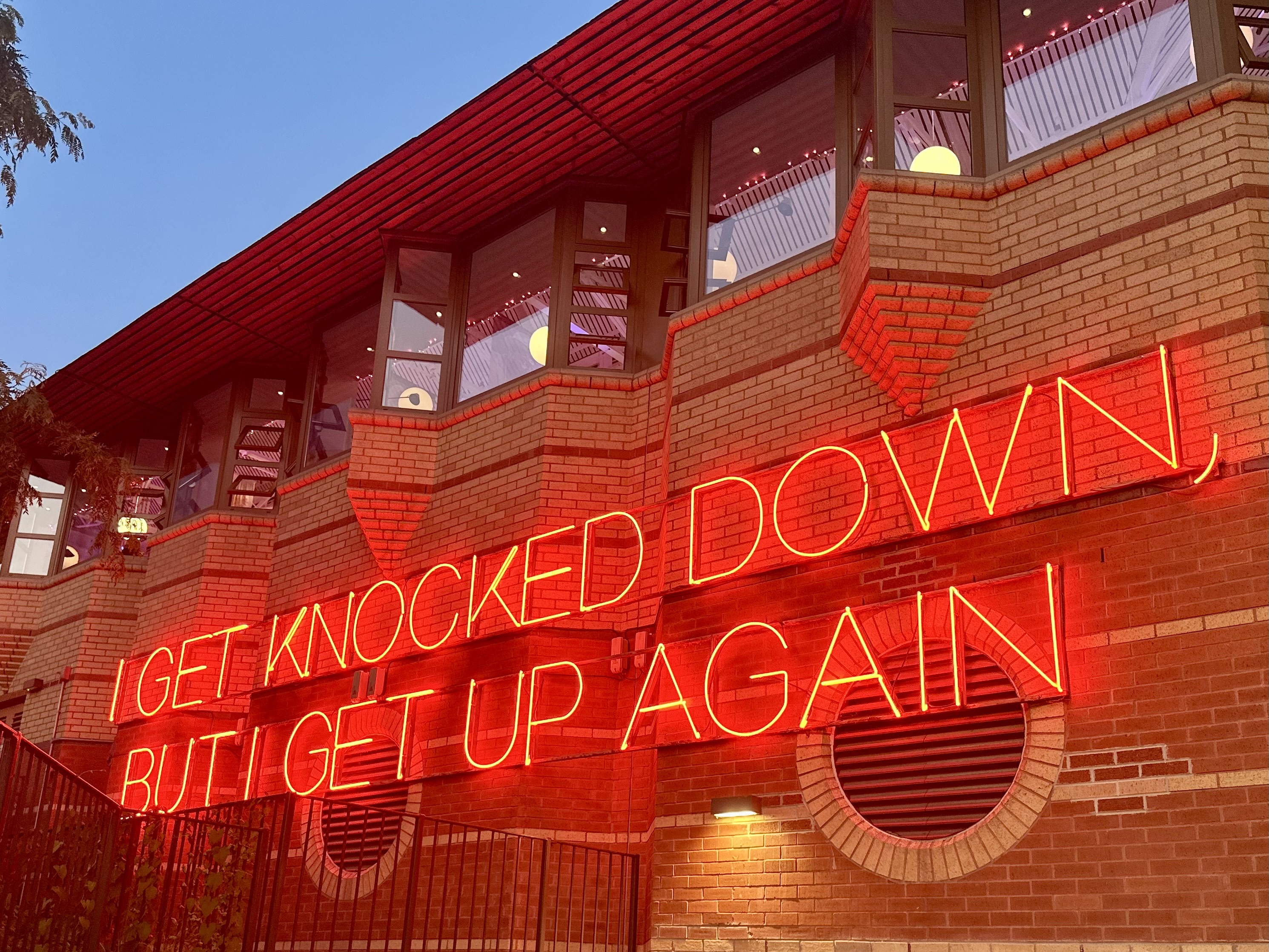
The speech was later sampled at the beginning of Chumbawamba’s 1997 Tubthumping, a song whose most famous declaration now appears in enormous red neon letters outside the Playhouse:
I GET KNOCKED DOWN BUT I GET UP AGAIN.
It's tempting to read that only as an upbeat expression of Yorkshire resilience.
This production complicates it.
People in the North have indeed got up again, repeatedly and magnificently. They've built cultural institutions, bands, charities, campaigns, businesses and new forms of community in places where economic foundations were deliberately removed.
But resilience mustn't become another demand placed upon communities by those who keep knocking them down.
The achievement of Brassed Off is that it celebrates endurance without romanticising the damage that made endurance necessary. It grieves. It rages. It laughs - often loudly. And then the brass begins, and an entire theatre seems to breathe as one.
.jpg)
Amy Leach has created a production of exceptional intelligence and emotional power. Katie Scott’s design gives the story an industrial landscape haunted by memory. The company performs with courage and absolute commitment. The young actors make its generational argument visible. Horbury Victoria and Wakefield Metropolitan Brass Bands raise the roof and, for almost three hours, remind us what collective endeavour sounds like.
This production isn't a revival preserved for those who remember 1984.
It's a warning to those governing Britain now.
It's a celebration of working-class cultural life.
It's a love letter to Yorkshire that's honest enough to include the pain.
And it's a declaration that art doesn't sit at the edge of community, waiting to be funded when more important things have been dealt with.
Art is how communities remember.
How they gather.
How they grieve.
How they resist.
How they pass something better to those who come next.
Music mattered then.
It matters now.
★★★★★
Brassed Off is at Leeds Playhouse’s Quarry Theatre until 11 July 2026.
Header image: Maddie Hansen (Gloria) Frazer Hadfield (Andy). Kirsten McTernan





