



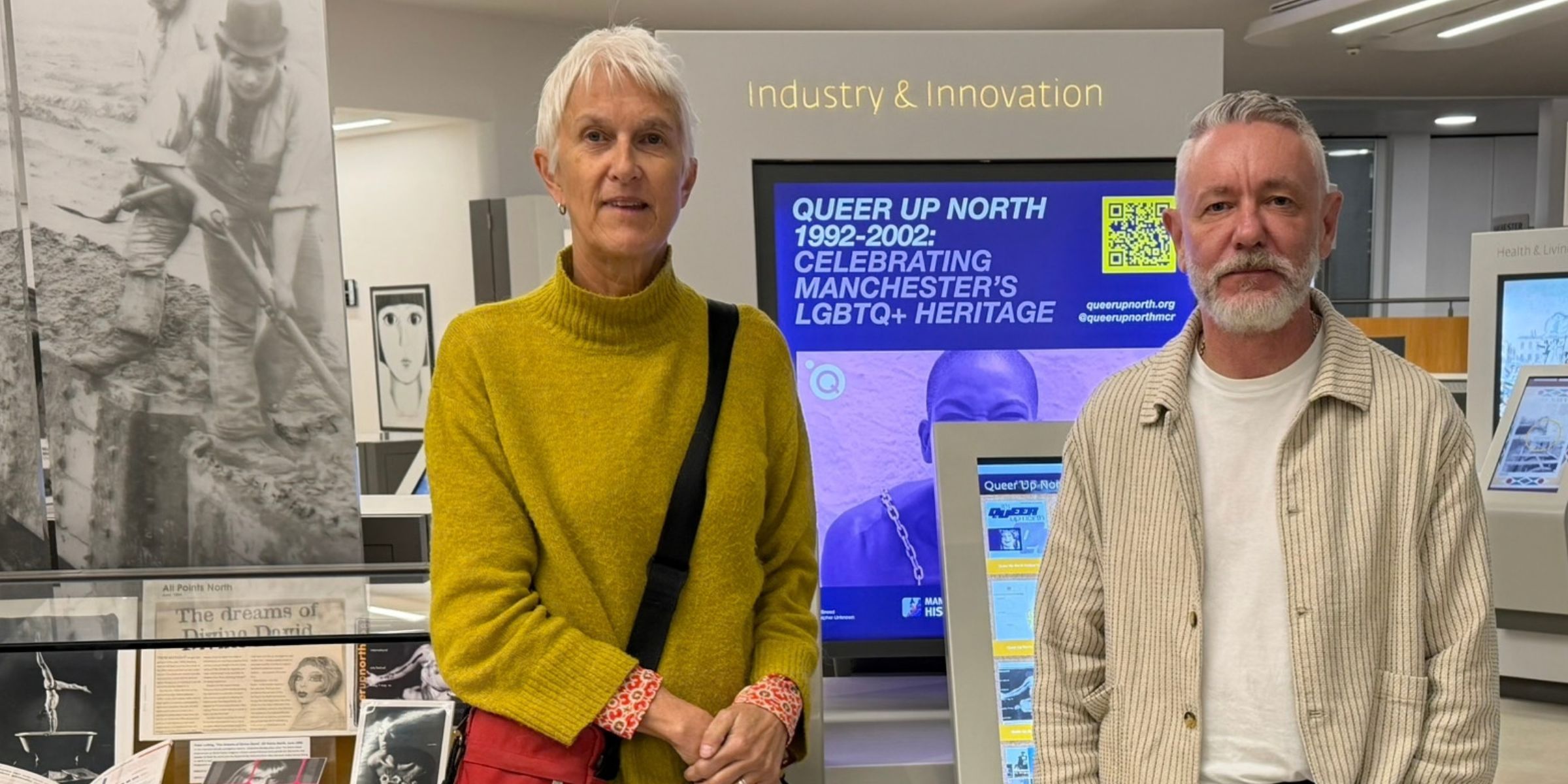
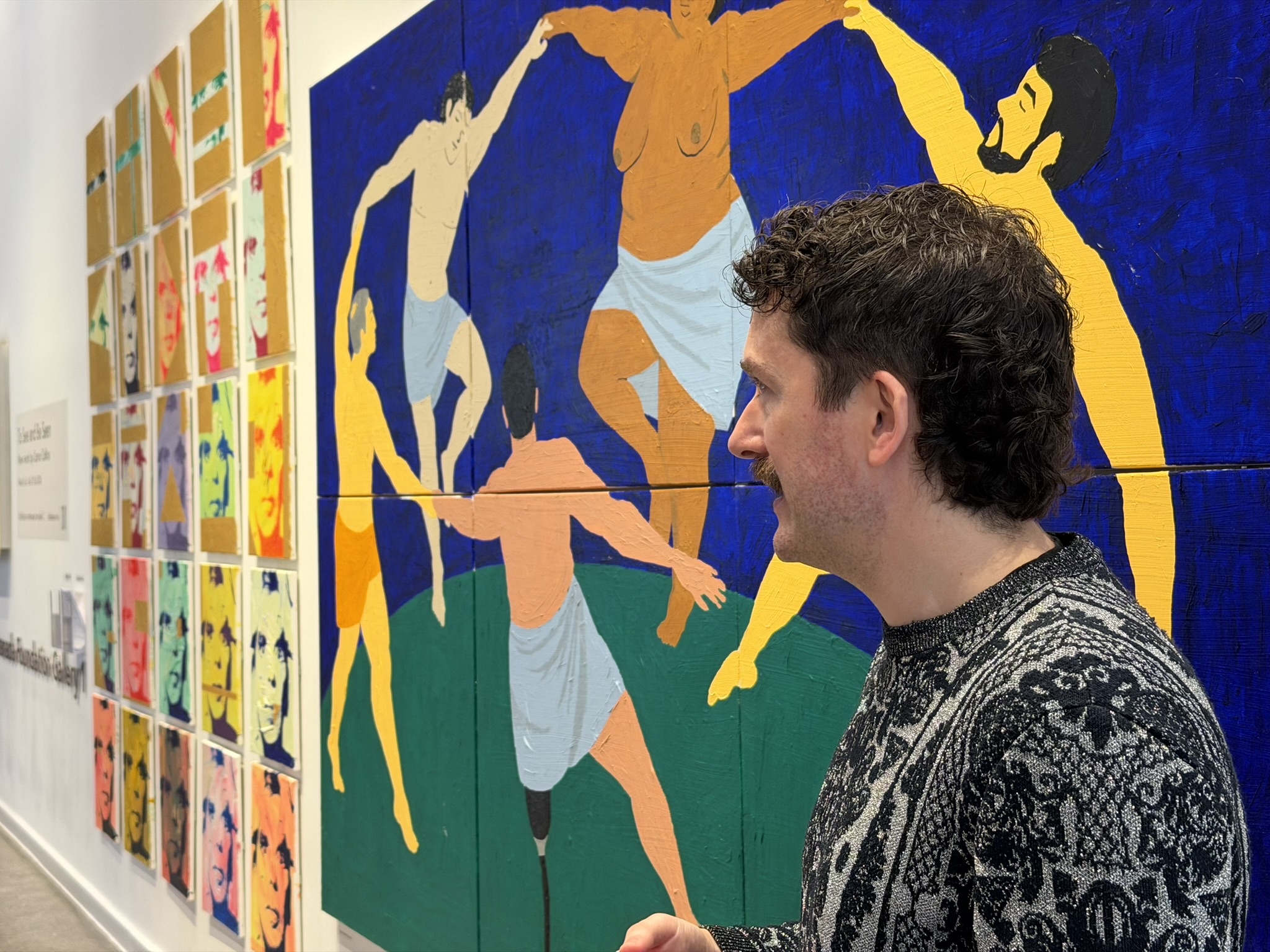
At Manchester Central Library, Gavin Barlow and Tanja Farman are looking back at something they once had very little time to stop and consider.
There are programmes, photographs, posters and correspondence. There are images they remember immediately and others that take a little working out. There are jokes about how young everyone looks, moments of recognition, and the recurring astonishment of people encountering evidence of just how much they managed to do.
The rather excellent founders of Queer Up North have returned to the first decade of a festival they began in 1992. A new digital archive, launching on 2 October, is about to make that history available to a much wider audience. An exhibition at the library offers a physical encounter with some of the material; elsewhere in the city, artists are making new work in response.
But before any of that, there were boxes.
Sixty-four of them, Barlow and Farman recall discovering as they explored the material held at Central Library. They knew an archive existed. They hadn't fully understood its richness.
“Then we discovered 64 boxes of stuff.” Gavin Barlow's surprise was palpable.
The discovery changed the scale of the undertaking. Here were the records of a festival, and the traces of the relationships that made it possible: arrangements, invitations, images, personal responses, a multitude of faxes, the paperwork behind an ambitious public life.
For anyone accustomed to encountering cultural events through their finished programmes, it's a reminder of how much happens before an audience takes its seat.

Queer Up North began with two people working at the green room, Manchester’s performance venue. Farman remembers being its front-of-house manager when she first met Barlow, who initially volunteered in the box office. Their backgrounds were both in the very practical business of making art happen.
They didn't begin with a plan for the major international festival that followed. The first ambition was a small programme, presented within the original Manchester Festival.
Then an audience arrived. And the possibilities grew.
“As Tanja says, our ambitions were…just do some few events, but actually, it kind of took off almost immediately,” Barlow recalls.
The account includes an early grant of £11,000, “which seemed like a million dollars”. Farman confirms.
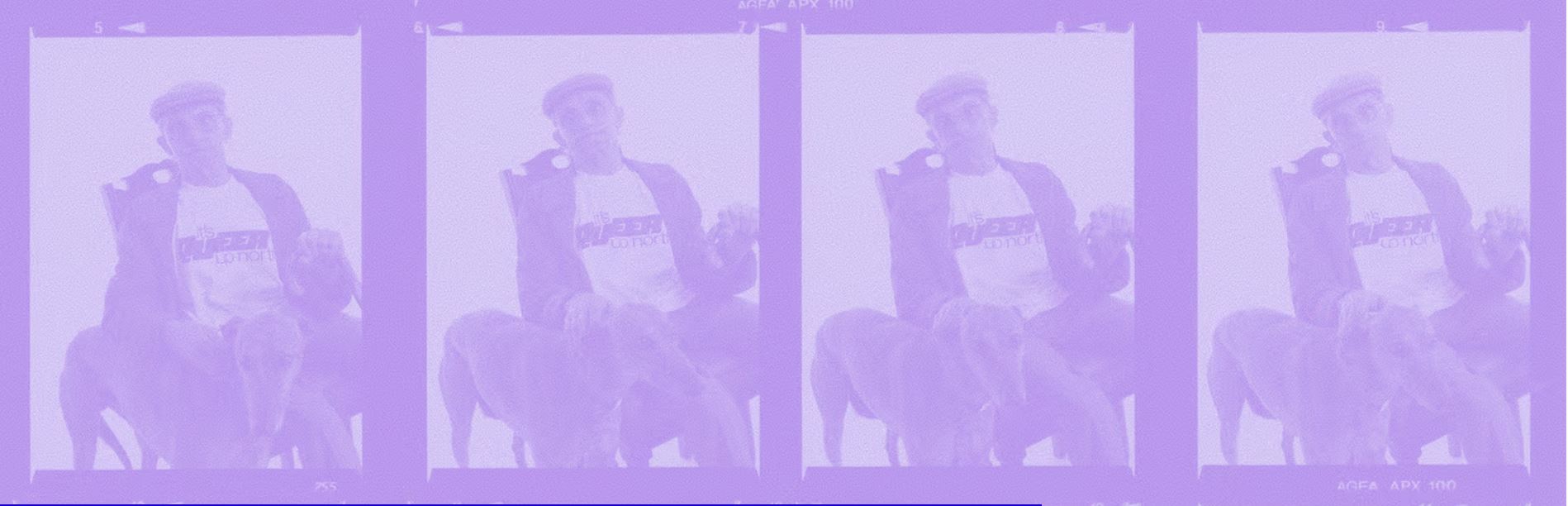
Its name already had a life in the city. “It’s Queer Up North”, a play on the familiar “it’s grim up north”, had appeared at Flesh, the club night at the Haçienda. The festival borrowed it, later shortening its title to Queer Up North.
The phrase was stuffed with wit, geographical confidence and a willingness to be public. It placed queerness and Northern identity in the same breath.
Looking through the exhibition, the founders return to the force of the festival’s imagery: a billboard near the Green Room; a whippet used in a campaign that played knowingly with Northern stereotypes. Those images, they say, recur in people’s memories without prompting.
Innovative - and of the moment - design helped make the festival recognisable. It also helped announce that this work belonged in the city.
In their recollection, early-1990s Manchester offered a particular combination of people, venues and willingness. They could ask, find a collaborator, try something. A relatively small team could work across the city rather than wait to possess a building of its own.
Their early experience of international performance at the green room mattered too. The programme could be distinctly Mancunian while looking far beyond Manchester.
Barlow is clear; “It felt like it could only happen in Manchester at that time.”
“But international too. We invited…artists from the US,” adds Farman.
It would be easy to turn this into a comfortable story about the city’s creative confidence in the 1990s. Barlow and Farman’s account resists that simplification.
Our conversation returns to HIV and AIDS, and to the homophobia surrounding the epidemic. From the distance of 2026, they suggest, it can be difficult to grasp the extent of that climate.
Visibility became part of the reason to make the work happen. There was a need to tell stories from within queer lives when so much was being said about them from outside.
Barlow explains the belief behind the project; “We need to be visible. We need to be telling our story.”
The festival created opportunities for artists to speak, perform, challenge and entertain. Its founders were also clear about its artistic purpose. Their experience lay in programming performance, and they wanted ambitious local, national and international work. It complemented the city’s wider LGBTQ+ community life while developing a particular place within its cultural sector.
That distinction helps explain the importance they attach to working with established venues.
At the Royal Exchange, Library Theatre and Cornerhouse, queer work could meet audiences within institutions central to Manchester’s artistic life. In their telling, these partnerships helped shift expectations about what those places might present, and whose experiences belonged on their stages and screens.
The change depended on people willing to open doors. Throughout the conversation, the founders recall colleagues, programmers, administrators, artists and supporters. Whatever confidence the finished posters projected, the work behind them was absolutely collaborative.
Among the Manchester artists they remember are David Hoyle and Kate O’Donnell. International relationships also developed over repeated visits, including with Lois Weaver and the Canadian puppeteer Ronnie Burkett.
The archive allows those connections to be followed across time. A programme records a performance. Correspondence reveals the relationship around it.
Mentioning the warmth in some of the letters, they recognise it immediately. These are personal responses someone took the trouble to write and send. They help recover how the work felt to the people who encountered it.

The present project required its own substantial labour.
Project manager Abigail Ward has worked with Barlow and Farman on the archive and its interpretation, including curating the library exhibition. Manchester Histories and Archives+ have also been central partners. The project received £248,500 from The National Lottery Heritage Fund, with additional support from The Granada Foundation.
Barlow and Farman describe intensive days of looking through material together: selecting images, identifying artists, correcting labels and supplying context that a photograph alone couldn't provide.
“There was no way that we could curate and select materials by doing that remotely,” Farman explains. “We had to both be looking at each artifact or image at the same time.”
Memory was useful, but it also needed testing. At points in our conversation, dates are queried and recollections corrected. The archive gives them something to return to.
They estimate that more than 1,400 items have been digitised. That remains a selection from a much larger collection, shaped by questions about what would communicate the history most effectively.
This matters because the period sits just before the routine digital documentation of cultural life. Work could reach large audiences and still leave little that a younger person might easily discover online.
Barlow; “It’s in danger of being overlooked. It’s in danger of…being lost a little bit.”
There's another urgency: some of the artists are no longer alive. The opportunity to connect records with the people who can explain them doesn't last indefinitely.
Yet the founders are wary of allowing the project to become a nostalgic celebration of themselves. They want it to tell a story that people can use now.
“It could feel like a vanity project. It could feel like nostalgia.” The test they set themselves follows immediately: “How does this tell a story that’s relevant to now? How does this connect to people?”
That ambition is already finding an audience. Both describe events bringing together people who experienced the festival and younger artists and producers encountering its history for the first time.
At HOME, Conor Collins offers one answer to what that encounter might produce.
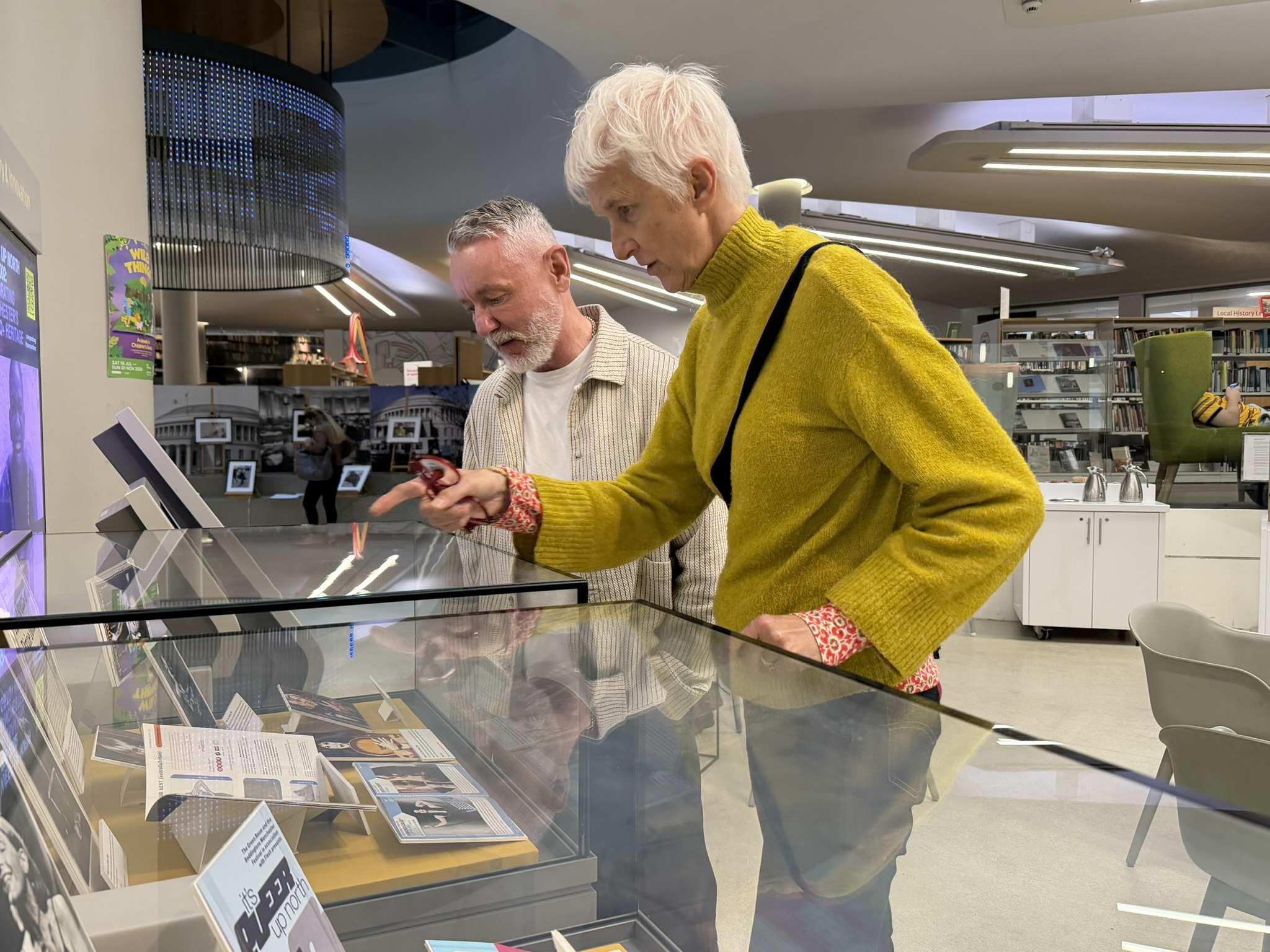
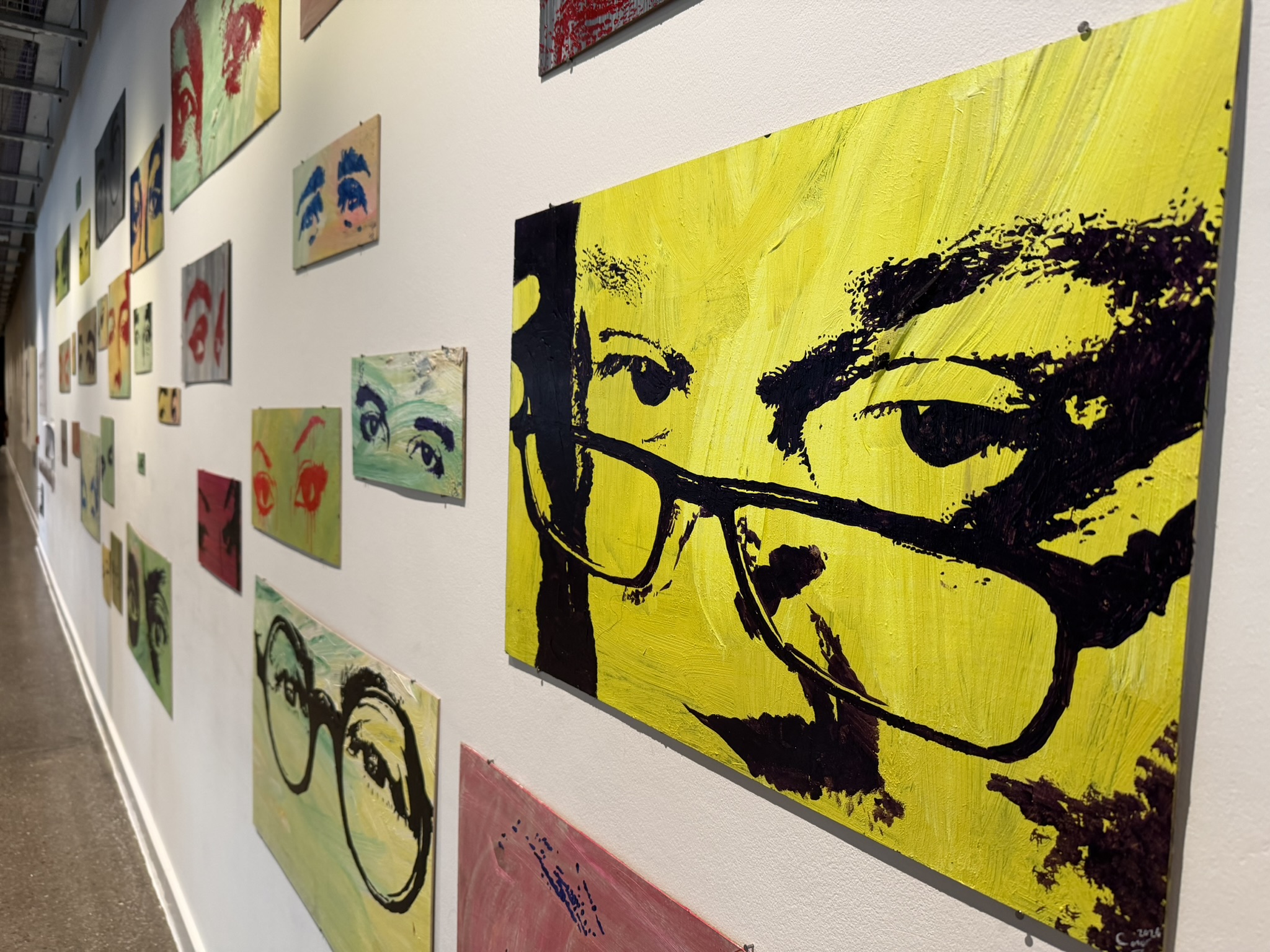
His exhibition, To See and Be Seen, responds to the archive through painting and questions of identity, visibility and remembrance. Walking through it with him brings a different pace to the day: an energetic account of ideas, experiments, artistic references and practical discoveries.
For Collins, preservation has a human consequence. People die, but their stories can continue to circulate. Those stories become vulnerable again when the people who remember them are gone. An archive gives future encounters somewhere to begin.
“We have two deaths,” he says, explaining the idea behind a work he calls Encore. The first is when we stop breathing. The second comes when people stop telling our stories: when the people who remember us are themselves gone.
“But an archive sort of preserves that.”
His series of David Hoyle paintings developed through an experiment that refused to behave as expected. Collins explains trying to degrade the painted surfaces with paint stripper and white spirit. They resisted his efforts. The work subsequently developed through his use of gold and an exploration of censorship.
He sees an unexpected resonance between the paintings’ persistence and the survival of the people and stories represented in the archive.
Elsewhere, an archival photograph prompted him to revisit the idea of dancers, thinking about the different bodies a contemporary painting might include. The material has become a starting point for his own decisions.
“I purposely had an empty gap here,” he says, explaining that it could invite the viewer into the dance.
His account also brings the conversation down to something very practical: space.
Collins usually works at home. He describes an earlier project spilling paintings into the kitchen and bath. For this commission, access to space at HOME allowed him to prepare and work on several paintings together.
It changed what he could do.
That experience belongs alongside Barlow and Farman’s memories of supportive venues. An institution can contribute through a commission, a room, a working relationship and the permission to attempt something. Those decisions have consequences long before anyone writes about a city’s cultural reputation.
As founders Barlow and Farman had initially explored the possibility of another festival. They explain that raising the money for an event at the scale and quality they wanted proved difficult. Conversations about the richness of the existing material helped point them towards the archive project.
The work has since prompted further conversations about what might come in future. They're interested in a legacy, without pretending that its next form is settled.
A documentary by Brett Chapman, It’s Queer Up North: Saving the Show, forms part of the launch programme. Contemporary artists and writers have been invited to respond to the history. The public encounters continue.
When we discuss what younger queer artists might take from the festival, Barlow and Farman recognise that making a creative life remains difficult. They also see energy in people organising nights, events and work for themselves.
The encouragement emerging from their conversation is to draw inspiration from the archive while making something of your own.
At the library, the scale of the achievement is present in the material before us. So is the uncertainty that accompanied it. They didn't know, at the beginning, what they were setting in motion.
Manchester now has a fuller opportunity to understand that history. The next question is what its artists, audiences and institutions will do with it.
The Queer Up North digital archive launches on Friday 2 October 2026 at queerupnorth.org.
The exhibition Queer Up North 1992–2002 is at Manchester Central Library until 31 December.
Conor Collins’ To See and Be Seen is free to visit in HOME’s Granada Foundation Galleries, with no booking required.
HOME currently lists the exhibition until Saturday 31 October 2026.
The archive launch evening at HOME on 2 October includes The Adventures of Priscilla, Queen of the Desert, Brett Chapman’s documentary and a party with DJ Kath McDermott.
Header image: Queer Up North founders Gavin Barlow and Tanja Farman (MagNorth)





