



Before the discussion began, I chatted with three attendees. All raised public transport as an issue, alongside the need to focus on public health. One also expressed concern about the apparent ‘hollowing-out’ of the third sector in her community.
These were informal conversations, rather than a representative account of opinion in the room. But they brought an immediate, practical context to an evening about devolving power: the services people rely on, their health, and the organisations supporting their communities.
For North East mayor Kim McGuinness, the arithmetic of devolution can't begin and end with splitting a funding pot between the region’s seven local authority areas. Different places have different economies, different needs and different routes towards a better future. Treating them identically, she told the room, would miss the point of bringing decisions closer to home.
It was one of the clearest practical statements in an evening concerned with a much larger redistribution: of power, resources and the ability to shape a place.
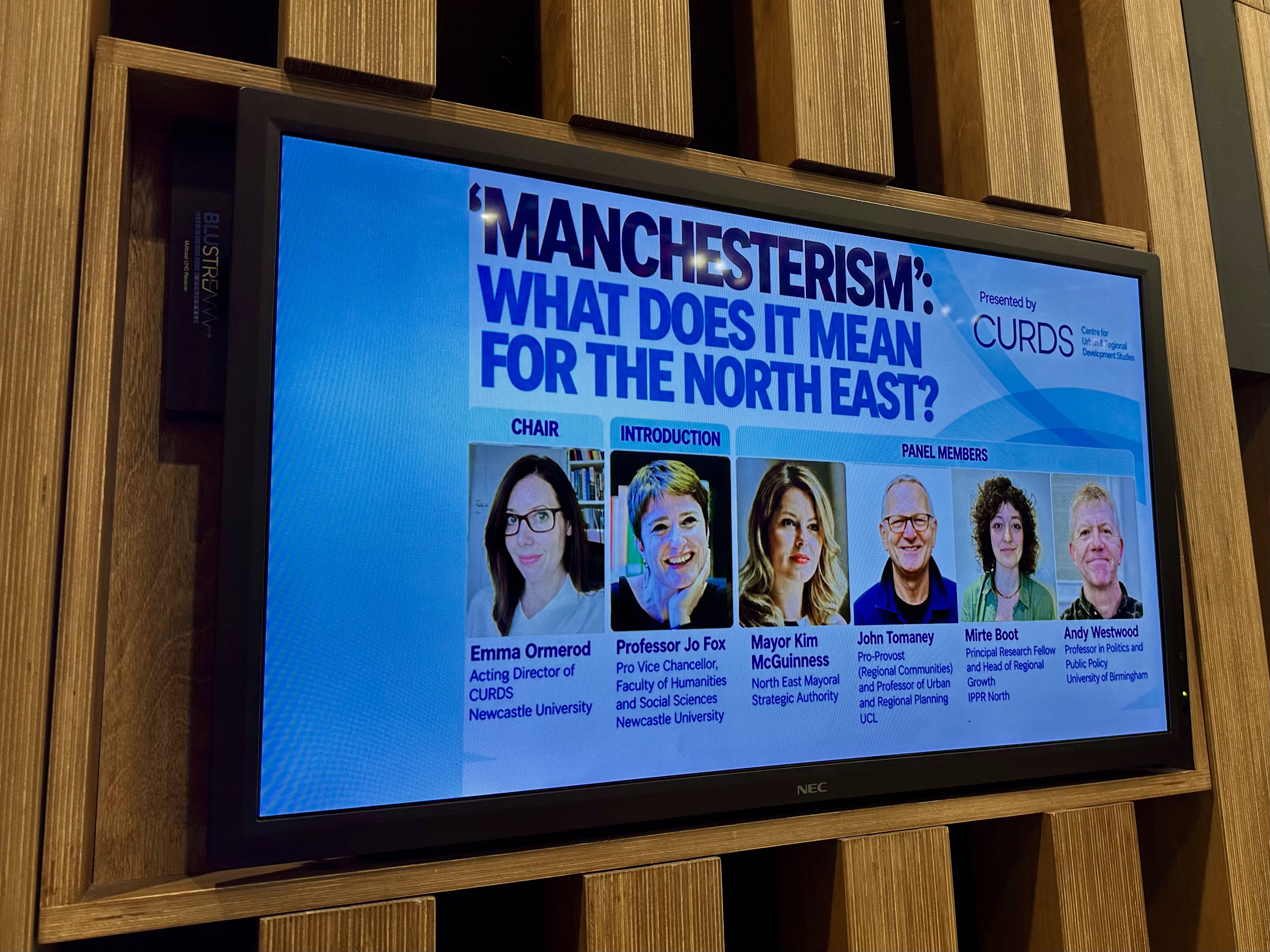
At Newcastle’s Catalyst on 27 October, a discussion organised by Newcastle University’s Centre for Urban and Regional Development Studies asked what “Manchesterism” might mean for the North East. With Andy Burnham now in Downing Street, the experience of Greater Manchester has acquired national significance. Its combination of regional leadership, investment and negotiated powers is helping to shape the government’s approach to England’s regions.
Chaired by Dr Emma Ormerod, director of the university’s Centre for Urban and Regional Development Studies, the panel brought together political leadership, regional policy research and academic scrutiny. North East mayor Kim McGuinness offered the perspective of a leader tasked with turning devolved powers into practical change. Professor John Tomaney, UCL’s Professor of Urban and Regional Planning, brought expertise in regional development, governance and communities left behind by economic change. Mirte Boot, Principal Research Fellow and Head of Regional Growth at IPPR North, contributed a focus on regional inequality and the policies needed to tackle it. Professor Andy Westwood, Professor of Politics and Public Policy at the University of Birmingham and a former government adviser, brought experience of both Whitehall and Greater Manchester’s approach to development.
But a place’s experience becomes more complicated when it's offered as a model for everywhere else.
McGuinness acknowledged what the North East could learn from Manchester, including its experience of bringing buses under public control. She also resisted the suggestion that a route to growth could simply be copied across.
“I think it becomes problematic if people think that you can copy and paste an economic model, or you can copy and paste a route to growth, or you can copy and paste a route to change, because you can’t.”
The North East’s cities sit within a region of towns, former coalfield communities, countryside and coast. The opportunities associated with offshore wind and new industries exist alongside the needs of established businesses, high streets and the everyday services on which communities depend.
What emerged from the discussion was a demanding proposition for supporters of devolution. Winning powers is part of the work. Deciding whose lives those powers improve is the test that follows.
John Tomaney brought that question directly to Manchester’s reputation for success.
He acknowledged the visible transformation of the city and its economic growth. His challenge concerned the distribution of the proceeds. What did a transformed centre mean for disadvantaged communities in the outer boroughs? Who'd benefited, and who remained beyond the reach of the success story?
It's a question with implications well beyond Greater Manchester. Across the North, the language of regeneration can describe changes that are substantial and visible while leaving other experiences of a place largely untouched.
Tomaney’s argument requires us to distinguish between the growth of an economy and the fortunes of the people living within it. His concern was whether the inequalities associated with Manchester’s development were problems the model had yet to overcome, or consequences of the way growth had been pursued.
That distinction is obviously critical when other regions are invited to follow. For Tomaney, transport was one means of reaching people whom growth had passed by.
“Because fixing the buses is one of the best things you can do for the most disadvantaged households in Manchester,” he said.
“But where the infrastructure goes, again, is part of the question of how the proceeds of growth are distributed among different groups in society.”
It also gives substance to the promise of good growth in every postcode. Such a promise has to be tested against places where investment is harder to attract, transport is less reliable and the benefits of a successful regional economy can still feel remote.
Andy Westwood complicated another familiar account of Manchester: the idea of a city whose revival simply drew investors towards an irresistible opportunity.
His account emphasised the work of public institutions in making investment possible. He described the efforts of Manchester’s former leadership to find investors when neither central government nor the market was providing what the city needed. Public finance and the willingness to reduce investors’ risks were important parts of the story.
The implication for other northern places is significant. Investment requires institutions with the resources, expertise and persistence to shape it. Devolution therefore raises questions about the capacity to act as well as permission to act.
Westwood also cautioned against searching for a single model. Regions need to learn from one another, while having the freedom to make different choices. “But the point of devolution is that different places have to do things in different ways, and the system is so deeply uncomfortable with that,” he said.

For McGuinness, the case for those choices began close to home.
She spoke about affordable transport, housing, high streets and access to culture. These are the things through which a constitutional argument becomes recognisable in a household’s daily life. Her warning was that devolution would lose public trust if it remained a term people could neither connect with nor see making a difference.
An audience question made the problem explicit: Did people in North East communities actually understand what devolution was?
McGuinness accepted that understanding remained limited. But she questioned whether familiarity with the terminology was the right expectation of people already occupied with work, children and the demands of daily life. “What this is fundamentally about is changing your life, improving your life,” she said.
“But if they know their mayor got them a cheaper bus fare, that’s good enough for me. If they know that there’s someone on their side when it comes to fighting for better childcare, that’s good enough for me. So I think there’s an increasing understanding that there is more coming to us, things like metro extensions, bus fares and so on.”
That's a persuasive argument about relevance. It leaves a further democratic question: how do people help choose the priorities?
Mirte Boot offered some possible answers. Participatory budgeting and citizens’ assemblies could give communities a more direct role in regional decisions. Such involvement would need to be designed into devolution.
“But when we think about good growth, that involves things like social infrastructure and youth clubs and libraries and all the things people need to thrive,” Boot said. “And we can build that into the way we design these policies.”
This is an important distinction for a publication committed to moving power closer to northern communities. A mayor can offer a stronger regional voice. The quality of local democracy will also depend on the opportunities people have to influence that voice between elections.
Boot’s discussion of fiscal devolution supplied another essential condition: resources.
Greater control over revenue and borrowing could allow regional leaders to invest over the long term. But places begin with unequal tax bases. A settlement that increases local freedom also needs a way to prevent existing inequalities between regions becoming entrenched.
Her argument is consistent with IPPR’s published work on devolving tax, spending and borrowing powers. The government had also announced, ahead of the Budget, that it would set out a roadmap for fiscal devolution.
The detail is key. Responsibility without sufficient resources can leave regional leaders accountable for problems they lack the means to resolve.
The discussion became particularly compelling when it turned to health.
McGuinness placed poverty at the centre of health inequality, arguing that opportunities, disadvantage and economic policy have to be considered together.
“Health inequality is a poverty issue,” she said. Later in the same answer, she added: “Because more shiny buildings won’t do it.”
Tomaney described research in Sunderland into community-led support for men’s mental health. His emphasis was on the value of non-clinical interventions within communities, including support that reaches people before they enter formal health services.
“These are interventions which are taking place in communities where real differences are made in real lives in a very short space of time,” he said.
That gave particular resonance to the concern one attendee had raised with me before the event about the third sector. Their observation can't establish the condition of the sector across the region. It does, however, raise a question worth pursuing: what resources and stability will community organisations need if they're to help fulfil devolution’s ambitions for public health?
This opened a different way of thinking about what regional leadership might achieve. Better health depends partly on the conditions in which people live, the relationships available to them and whether help exists close enough to reach.
Transport, housing, employment and community provision belong within that account. Their connections are visible in ordinary life, even where government responsibilities have separated them.
There were unresolved tensions too.
An audience question raised the relationship between ambitions for a green industrial future and investment associated with oil-rich countries and carbon-intensive activity. McGuinness argued for pragmatism, before emphasising the danger that opposition to net zero posed to the region’s industrial opportunities and jobs.
The employment argument deserves attention. So does the original question about the sources and conditions of investment. Regional leaders seeking economic transformation will face choices about what they accept, what they require and how those decisions are scrutinised.
Towards the end, one adjective returned repeatedly: Hopeful. That was a significant part of what I took away from the evening too. The discussion had exposed difficult questions about inequality, resources and trust, while conveying a belief that the North East (and the wider North) had an opportunity to shape its own future.
“And it’s about creating hope. I think this is a very hopeful moment,” Boot said in her closing remarks. She acknowledged the possibility of reversals and the need to design change step by step. Westwood, too, described it as a hopeful time. “I fundamentally believe that in the North East, we can be in a position where we don’t just benefit from devolution, but we can lead it,” McGuinness said. “We can create a model that they’ll be talking about in Manchester.” Westwood stressed the expertise that would be needed across public institutions, universities, colleges and businesses to turn ambition into delivery.
Tomaney’s contribution kept returning the discussion to the society people wanted to inhabit, and to the need for spaces in which they could debate it.
That's where the promise of devolution becomes most substantial. Decisions about growth are also decisions about the distribution of security, opportunity, time and influence.
For us at MagNorth, the commitment to devolution carries a responsibility to follow those decisions beyond the announcement: into our towns and villages, estates and high streets, workplaces and community organisations.
The questions raised in Newcastle should travel across the North. Where is investment going? Who can influence it? Which communities are seeing their circumstances change? What happens when the promised benefits fail to arrive?
I left Tyneside last night with that sense of hope, and with the practical concerns raised before the discussion still in mind: public transport, public health and the organisations supporting communities.
There is much to hope for in the possibility of shaping those things closer to home. Following what happens to them will be part of our work.


