



There are performances that feel like a showcase. There are performances that feel like a statement. And then there are the rarer ones - the ones that feel like an artist quietly, firmly opening a door and inviting everyone in.
Melanie Macharia’s Soul Safari, at Contact Manchester on Friday evening, belonged firmly in that third category.
When MagNorth first spoke to the Manchester-based Kenyan artist in April, ahead of the show, she described Soul Safari as “a reckoning, a homecoming and, in some ways, an answer to a question she has been carrying since leaving Kenya.” The immersive concert, she told us then, would blend original music with Kenyan coastal and Kikuyu folk traditions, moving between Swahili, Kikuyu and English, and exploring home, identity, cultural connection and belonging.
What actually emerged at the Oxford Road venue was not simply a promising artist testing an idea. With Kenyan cuisine being served at the event and Macharia's unique spin on 'merch' (instead of traditional tshirts and totes, there was the opportunity to purchase beautiful beaded jewellery and bracelets), it was a fully inhabited piece of work: emotionally clear, culturally specific, musically generous and quietly ambitious.
That matters, because Soul Safari was not delivered as part of someone else’s machinery. Macharia conceived, organised, promoted and delivered the performance herself. In an industry where emerging artists are often asked to wait for permission, she built the room, filled it, and then proved she knew exactly what to do with it. From the outset - and her arrival in the auditorium - she captivated: entering from behind the audience, and singing before entering the space, the opening was particularly memorable.
And while Macharia looked and sounded incredible on stage, her five-piece band weren't kept in the shadows. Also adorned with Kenyan beads and jewellery - they completed the moment.
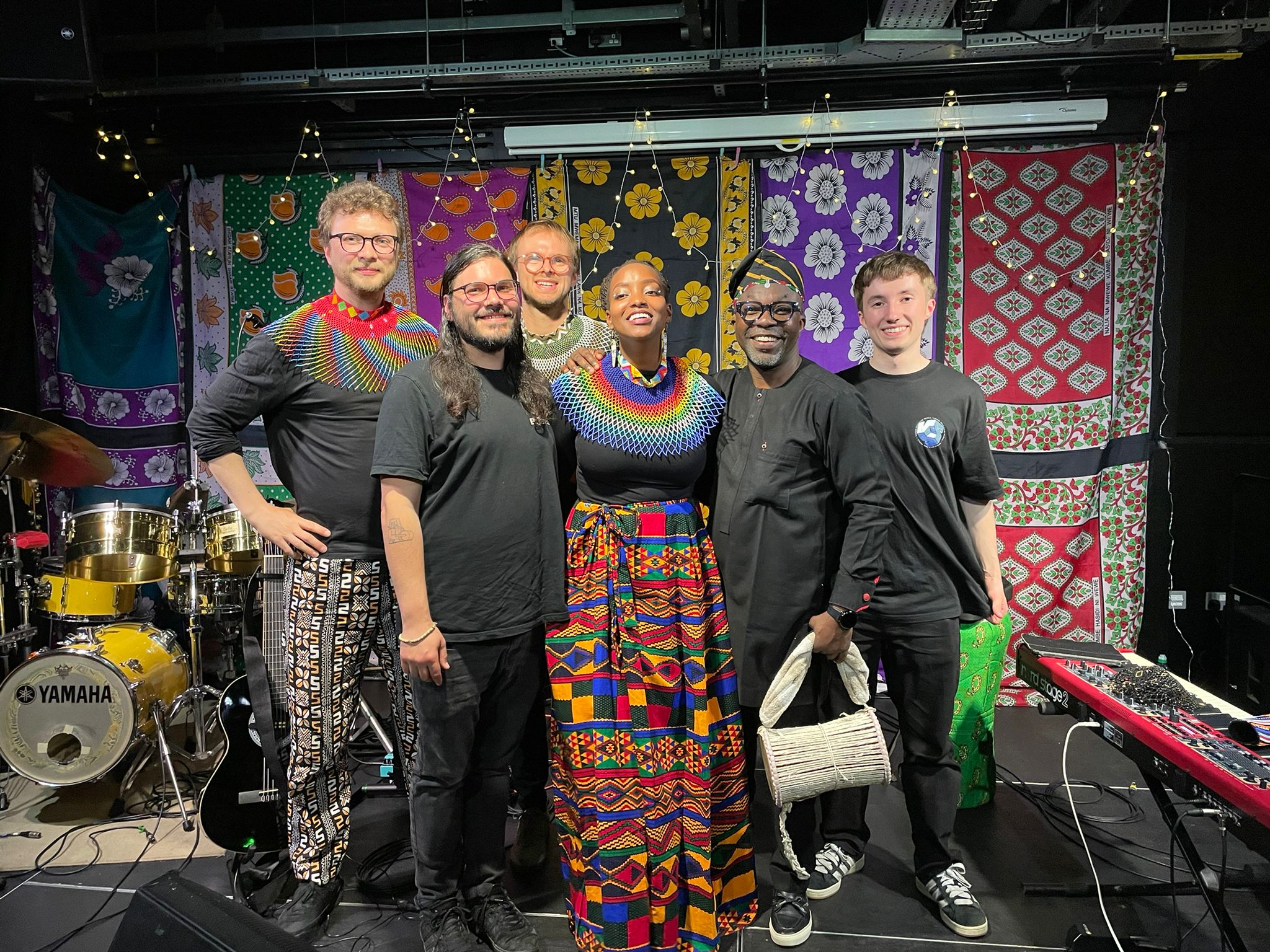
The obvious attention to detail also brought a costume change, with the first half consisting of dark colours, but before the post-interval set, the artist shared with the audience that the brighter colours in the second half were representative of the woman she was becoming and the joy in her life - which touched everyone.
One traditional Kenyan folk song had us being asked to stand, if we were able - and our host gave instructions on what to sing and how to dance along. There was further audience participation as at certain points Macharia pulled the willing on stage, including one of the first friends she made iafter arriving in Manchester.
The show sold out. More importantly, it justified the attention. And more importantly even than that, it felt like an intensely personal experience - and an honour to be in the room.
At its heart, Soul Safari is an act of return. Not a nostalgic return, and certainly not a sentimental one, but a return to language, lineage, memory and sound. Macharia’s original songs sat alongside Kenyan folk material, creating a performance that never felt like an archive exercise or cultural display case. Instead, the music breathed in the present tense.
.jpg)
This was one of the most compelling aspects of the evening. Macharia did not present Kenyan tradition as something fixed, distant or decorative. She treated it as living material: something that can travel, adapt, converse and still retain its roots. The result was a performance with genuine cultural value — not because it explained itself to the audience, but because it trusted the audience to meet it.
There was no forced theatricality here. No over-polished “musical theatre” sheen. Instead, Macharia worked through song, story and presence: allowing the emotional logic of the music to lead. The performance carried shape and intention, but it also left space for intimacy. It understood that storytelling through song does not always require dramatic insistence. Sometimes it requires confidence, stillness and the courage to let a room listen.
That confidence has clearly been hard-won.
In our earlier interview, Macharia spoke about arriving in Manchester in 2023, the loneliness of migration, and the gradual discovery that distance from Kenya had sharpened rather than softened her sense of connection to it. “I had to leave my country to love my country,” she said - a line that became both the emotional key to Soul Safari and a useful way of understanding the artistic journey behind it.
The development of the work was supported by an Arts Council England Develop Your Creative Practice grant, which enabled Macharia to return to Kenya in 2025 and spend time researching, listening and reconnecting with family, language and tradition. That support matters. So too does the backing of Forever Manchester. These are not decorative endorsements. They are signs that cultural bodies have recognised both the seriousness of Macharia’s vision and her future potential as an artist working in, and contributing to, the UK’s creative ecology.
And Soul Safari made that potential visible.
This was a grassroots performance, but it did not feel small. It had the quality of a beginning - the sort of beginning that makes you suspect an artist is only just arriving at the scale of work they are capable of making. The room may have been intimate, but the trajectory felt wider: from Manchester to Kenya, from personal story to shared experience, from local performance to international possibility.
That is not hyperbole. It is built into the form of the work.
Macharia’s use of call-and-response, audience participation and multilingual performance gave Soul Safari a communal energy that resisted the neat separation between performer and audience. In her April interview, she spoke about wanting to create something “shared, not performed at a distance,” and that ethos is central to the show’s achievement. Public listings for the event described it as an immersive concert combining live music, call-and-response moments, visual elements inspired by Kenyan heritage and spoken narrative — but in performance, those elements added up to something more than format.
They became a way of making belonging audible.
For Manchester, that feels significant. The city’s creative ecosystem is often praised for its openness, its grassroots venues, its cross-cultural energy and its appetite for new work. But those claims only mean something when artists are able to make work that is not diluted to fit existing categories. Macharia’s contribution is precisely that: she is not simply adding another gig to the calendar. She is expanding the terms of what a Manchester-based live music performance can hold.
Kenyan folk song. Original composition. Migration. Memory. Audience participation. Spiritual and emotional repair. Cultural confidence. All of it belonged in the room.
There is also a leadership story here, and it should not be overlooked. Independent artistic leadership is not only about having an idea. It is about carrying that idea through the practical, exhausting, often invisible work of making it happen: fundraising, planning, promotion, delivery, audience-building, collaboration and risk. Macharia did that. She did not wait to be framed by an institution before stepping forward as a creative practitioner. She built the frame herself.
That gives the success of Soul Safari a particular weight. A sold-out show is always encouraging. A sold-out show built around original music, Kenyan cultural traditions, multilingual storytelling and audience participation - independently led by an emerging artist - is something more. It is evidence of appetite. It is evidence of capability. It is evidence of a voice that can connect across communities without flattening its own specificity. And the audience demographic on Friday night reflected that perfectly.
The most powerful thing about Soul Safari, though, may be its refusal to choose between the personal and the communal. Macharia’s story is specific: a Kenyan artist in Manchester, navigating distance, language, family, culture and self-recognition. But the emotional questions beneath it are widely recognisable. What do we lose when we leave home? What do we recover when we look back? What parts of ourselves have we been taught to soften, translate or hide? And what happens when we finally stop apologising for them?
In answering those questions, Macharia didn't not offer a lecture. She offered music.
.jpg)
That is why the performance worked. It did not ask the audience to admire identity from a respectful distance. It invited them into the experience of return - through rhythm, voice, story, food and participation. It made culture feel not like a subject, but a practice. Something done together. Something carried. Something renewed.
And this is only the beginning. Songs from Soul Safari are feeding into Macharia’s forthcoming EP, extending the life of the project beyond a single evening and into a broader body of recorded work. In our April feature, she spoke of the performance as one step in a larger process: a way of carrying Kenyan musical identity, personal story and contemporary Manchester energy into the next phase of her creative life. With new music due to be released on the 27 May, that next phase is already beginning.
For those in the room at Contact, there was a sense of witnessing an artist at a threshold. Not fully formed in the limiting sense - the best artists never are - but fully committed. Clear about her material. Clear about her cultural ground. Clear about the kind of spaces she wants to create.
Soul Safari was intimate, yes. Reflective, certainly. But it was also quietly historic in the way grassroots culture often is: not because it arrived with noise and spectacle, but because it marked the moment an artist stopped asking whether her story belonged here and began showing us exactly why it does.
Macharia is based in Manchester. She is made in Kenya. And on the evidence of Soul Safari, she is becoming an important new voice in the UK’s creative landscape - one whose work carries both local value and international reach.
This was not just a good gig.
It was the start of something.
All images: @byellierjd





