



There is music waiting inside a tree.
It might wait for decades, while timber seasons in a workshop. It may reveal itself beneath a craftsperson’s hands, as wood is cut, curved and persuaded into an instrument. Or it may remain silent for 5,000 years, buried in darkness beneath a landscape that has changed almost beyond recognition.
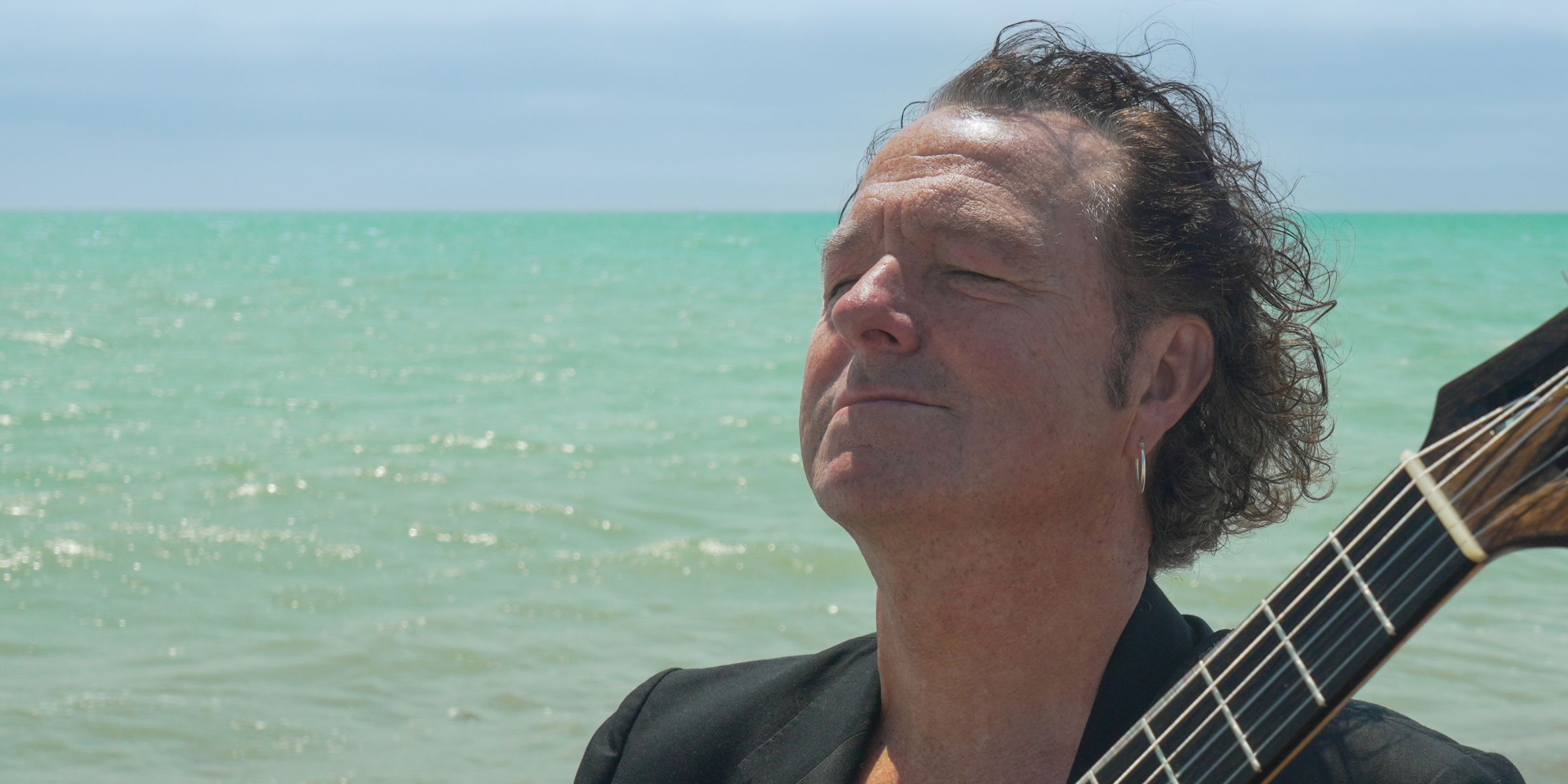
When Richard Durrant walks into Blackburn Cathedral on 25 September, the guitar in his hands will contain wood from a forest that disappeared during the Neolithic period.
Close by will stand another surviving fragment of that vanished world: a 13-metre table made from an immense Fenland black oak uncovered during agricultural work in 2012.
Durrant’s guitar and Table for the Nation were both fashioned using ancient black oak preserved beneath the peat of the East Anglian Fens. At Blackburn, the instrument and monumental installation will be brought together for the first time since the table was unveiled at Ely Cathedral in 2022.
Durrant will then play his own composition, Bog Oak Bourrée.
It's a meeting of music, material, landscape and time - and a reminder that objects can carry histories extending far beyond the lives of those who make or encounter them.
Five thousand years ago, the Fenland Basin was home to an extraordinary high forest of enormous oak trees.
These weren't simply larger versions of the trees familiar in the British landscape today. The Fenland Black Oak Project describes them as giants: immensely tall, straight oaks that would have dominated the low-lying landscape and provided food, fuel, shelter, tools and building materials for the people living around them.
They must have appeared permanent. But they weren't.
As sea levels rose, drainage through the Fenland river system slowed and the forests were flooded. Trees fell into the silt and became submerged beneath waterlogged ground.
The airless conditions prevented the usual organisms from breaking the timber down. Iron carried in the water reacted with the tannins naturally present in the oak, gradually darkening it. Layers of peat formed above the fallen trees, sealing them away.
The forest disappeared, but parts of it survived underground.
Black oaks are still occasionally uncovered as the Fenlands are cultivated, although exposure places them in immediate danger. Once removed from the stable, waterlogged conditions that preserved them, the ancient trunks can deteriorate and split. Some have historically been abandoned at field edges, burnt or allowed to decay.
Saving the wood requires knowledge, time and considerable technical skill.
Durrant remembers being with black-oak specialist Hamish Low at his timber yard in Lamberhurst, Kent, while a tree even older than the wood in his guitar was being cut into planks.
“I remember watching water pouring out of the wood as the machinery painstakingly cut the huge, long planks from the ancient tree,” he says.
“I helped carry one of the planks and was struck by the rainbow of colours in the wood. Just seconds after the cut, we were the first humans to set eyes on this part of the tree - and we saw bright blues, greens, purples and reds.”
The experience brought another fleeting transformation to mind.
“It reminded me of landing a mackerel, whose incandescent colourings were so beautiful yet so quick to fade - just like the shining colours inside the ancient oak straight after the cut.”
For one brief moment, a surface hidden for 6,500 years was vivid with colour. Then contact with the air began to change it.
The material used in Durrant’s guitar was sourced by luthier Gary Southwell from Low. Dark bands of ancient oak run vertically down the back of the instrument’s body. The grain remains visible: not smoothed into anonymity, but made central to the object’s beauty. It looks less like decoration than evidence.
The wood has travelled across five millennia to become capable of sound.

The story of Table for the Nation began in spring 2012, when a 13.2-metre section of buried oak was discovered during routine cultivation at Wissington Fen in south-west Norfolk.
Found during the year of Queen Elizabeth II’s Diamond Jubilee, it became known as the Jubilee Oak.
Its scale presented both an opportunity and an enormous practical challenge. Specialist craftspeople had to lift, mill and slowly dry the timber without destroying what had survived underground for thousands of years.
Ten consecutive planks were cut from the trunk. During nine months inside a specially constructed dehumidifying kiln, almost 1,800 litres of water were extracted from them. The drying process reduced their combined weight by 1.8 tonnes.
The intention was to preserve the oak at its full, astonishing length.
A table offered a solution.
Its horizontal form allowed the planks to remain unbroken and enabled people to see - and touch - the size of a tree from Britain’s ancient high forests. But a table is never only a sculptural platform. It's a place of meeting, eating, argument, agreement and shared attention.
Hamish Low and a multidisciplinary group of craftspeople, designers, students and volunteers created a work that could carry both meanings: the physical presence of the oak and the social promise of people gathering around it.
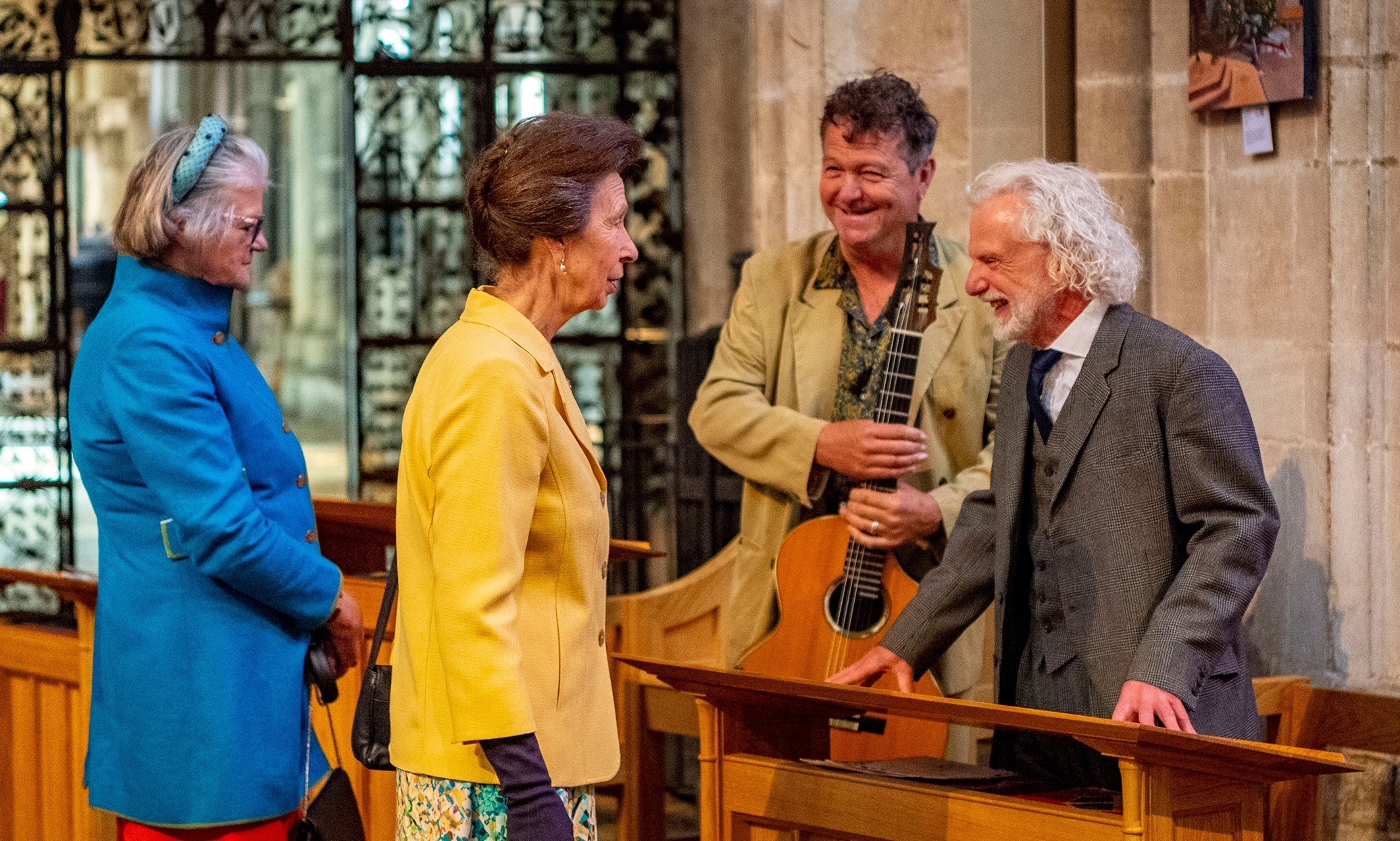
The completed table was unveiled by the Princess Royal beneath Ely Cathedral’s Lantern Tower in May 2022. Richard Durrant played his bog-oak guitar during the occasion.
Since then, the installation has continued its journey through English cathedrals, taking on the life of each building it enters. It's hosted community gatherings, meals, creative activity, conversation and ceremony.
It's now in residence at Blackburn Cathedral until April 2027, accompanied by an exhibition telling the story of the oak, the project and the ancient forest from which it came.
On 25 September, the guitar will join it again.
Durrant describes the table as “awesomely handsome”, but the Blackburn meeting will be quieter and more contemplative than the unveiling at Ely.
“When I was there for the unveiling ceremony with Princess Anne and hundreds of others, there was a lot of noise and excitement - and actually very little time to contemplate those ancient trees and play music,” he says.
“At this concert in Blackburn Cathedral, I want to offer some moments where the vibrations of this particular guitar, this particular guitarist and the timeless music I have chosen can properly connect.
“Perhaps this shared experience will also allow us to contemplate this incredibly fortuitous coming together. I mean, life is a game of chance - but this is off the scale.”

MagNorth encountered Richard Durrant earlier this summer, when The Art of Levitation arrived at Theatre by the Lake in Keswick.
The concert forms part of a significant year for the guitarist and composer. In 2026, Durrant marks four decades since graduating from the Royal College of Music and making his London debut at the Purcell Room.
Little about the path between those moments has been conventional.
Raised in a working-class family in Brighton, Durrant struggled at school with then-undiagnosed autism and ADHD. Alongside those difficulties came an intense musical concentration. By his early teens, he was composing and had passed Grade 8 examinations in guitar, cello and music theory. At 16, he toured Portugal as a soloist with Brighton Youth Orchestra, performing Joaquín Rodrigo’s Concierto de Aranjuez.
At the same time, he was appearing in folk clubs and playing double bass in a bluegrass band.
Those musical worlds were never forced apart.
Durrant has built a career by moving between them: classical discipline and folk inheritance; the concert hall and the open road; Bach and Bert Jansch; Scarlatti and John Renbourn.
His refusal to accept the boundaries surrounding classical music is reflected in the instrument he has chosen.
The guitar’s dramatically shaped cutaway and asymmetrical headstock - with two tuning pegs on one side and four on the other - give it a profile unlike that of a conventional classical guitar.
“In the somewhat conservative world of the classical guitar, this makes Gary’s inspirational talent a breath of fresh air,” Durrant says.
“As someone who also prioritises self-expression over tradition, I feel I have found the perfect instrument. The guitar gives me originality in design, a great sound and, through that ancient tree, a spiritual link to the history of the British Isles.”
Knowledge of the tree doesn't simply add an interesting provenance to the instrument. It deepens Durrant’s sense of the life he and the guitar have shared.
“Just consider the significant portion of my life that I have spent holding that guitar in my arms, the number of miles we have travelled together and the emotional experiences that I have shared with so many thousands of my fellow humans.”
His Blackburn programme continues the conversation between musical traditions. Music by Bach, Scarlatti and Purcell will sit beside the English Folk Baroque of Renbourn and Jansch and Durrant’s own compositions, including the tour’s title work, The Art of Levitation.
He'll also play a second remarkable instrument: the guitar used by Julian Bream on his debut album.
The programme isn't constructed as an exhibition of precious objects, however. Durrant’s instruments are there to be played. Their history only becomes fully alive when it passes through a contemporary musician and reaches an audience.
That seems particularly true of the bog-oak guitar.
Its timber belongs to a period so remote that its age can become difficult to comprehend. Music gives that timescale an immediate physical presence. Strings vibrate against wood that began growing before Stonehenge reached its familiar form.
When Durrant first took the instrument home, its history didn't produce an immediate rush of music.
It had the opposite effect.
“I had absolutely no idea what to play on it,” he recalls. “I would open the case, look at the guitar and then close the case.”
Ultimately, he turned to Johann Sebastian Bach.
“I got to know the guitar via Bach’s fiddle sonatas and lute suites, and the Bourrée from the first Lute Suite became the Bog Oak Bourrée.”
That initial exploration eventually grew into Stringhenge, Durrant’s 2018 double album.
The title contains a characteristic piece of Durrant playfulness, but the creative connection is serious. Ancient British material meets music composed centuries later; both are carried into the present by a musician unwilling to distinguish too rigidly between inheritance and invention.
The bourrée has its roots in European folk dance and was later absorbed into Baroque music. It's therefore aptly chosen for an instrument that unsettles tidy separations between past and present, classical and folk, nature and human craft.
Durrant’s composition doesn't attempt to recreate the music of Neolithic Britain. That world can't be recovered so easily. Instead, it places an ancient material inside a continuing musical tradition, allowing the oak to participate in a new act of creation.
There is another reason Durrant understands the symbolic pull of Table for the Nation.
“I have strong childhood memories of our family table,” he says. “It was a focal point around which so many significant moments were shared: celebrations, games, announcements, concerns, debates, homework, daily bread - not to mention my guitar practice.”
The great black-oak table in Blackburn Cathedral and the ordinary table of a family home might be worlds apart in size and ceremony. Their underlying purpose is recognisably similar.
A table gathers people and bears witness to what passes between them.
“Live music in the right setting is also a significant focal point that lends expression to our feelings, emotions and spirituality,” Durrant says.
“Both a humble family table and a mighty ceremonial table provide symbols of our humanity - and so does our need to create music.”
At Blackburn, one ancient wooden object will stretch horizontally through the Cathedral, still and monumental. The other will be held against a human body and made to resonate.
One invites people to gather around it. The other offers them a reason to gather.
Durrant performs standing, rather than adopting the seated posture traditionally associated with classical guitar. He talks to audiences about his life and work, bringing an informality to the stage that can disguise the technical command beneath it.
He has also spent years questioning the environmental cost of the conventional touring model.
After once driving around 35,000 miles a year playing gigs, Durrant began making concert journeys by bicycle, transporting his instruments and equipment in a specially adapted trailer. He has since cycled approximately 9,000 miles between performances around the British Isles.
The endeavour is practical, symbolic and deliberately visible. Bicycle and trailer frequently appear beside him onstage, making the method of travel part of the performance story.
It would be too easy to treat the bog oak as a piece of environmental nostalgia: a beautiful remnant of a lost natural world safely contained within an elegant object.
But its history offers a more uncomfortable message.
The high forests were destroyed as the climate changed and sea levels rose. The ancient oak survived because the flooded landscape buried it. Its reappearance in the present connects human craft with environmental transformation across an almost unimaginable span of time.
The people who inhabited the Fenlands 5,000 years ago might also have looked at those immense trees and believed that something so established could never disappear.
Our own age should recognise the danger in that assumption.
“These surviving remains of Britain’s ancient forests should remind us how fragile life is,” Durrant says, “and therefore how fragile our precious planet - the Earth - is.”
Blackburn Cathedral is an especially resonant setting for the reunion.
The site has been a place of Christian worship for more than 1,500 years, yet the present cathedral also contains a significant collection of modern art and describes itself as a centre for the religious, artistic and cultural life of Blackburn and the wider county. It really is a beautiful space.
It's one of England’s newest cathedrals, standing within a town shaped by industrialisation, immigration, faith and continual reinvention.
During the table’s residency, the Cathedral intends it to function as more than an admired artefact. People are being invited to gather around it and bring it into the shared life of the building.
That purpose matters.
A table only fulfils its most fundamental role when people come together. A musical instrument similarly remains incomplete without musician, space and listener.
On 25 September, these two ancient wooden objects will occupy the Cathedral differently. Both have been preserved through acts of extraordinary craftsmanship. Both transform remnants of natural history into something social.
And both ask what it means to inherit a material older than our buildings, institutions, musical traditions and ideas of nationhood.
Richard Durrant’s concert will last an evening. The notes will rise into the Cathedral and disappear.
The oak will remain.
But for a short time, after 5,000 years beneath the earth, part of the ancient forest will be heard.
Richard Durrant: The Art of Levitation
Friday 25 September 2026, 7.30pm
Blackburn Cathedral, Cathedral Close, Blackburn BB1 5AA
Further information and tickets are available from Blackburn Cathedral.





