



.jpg)
A young woman wants to see the sea. A stranger waits on a cliff. And somewhere below them, the last grey seal is swimming towards the shore.
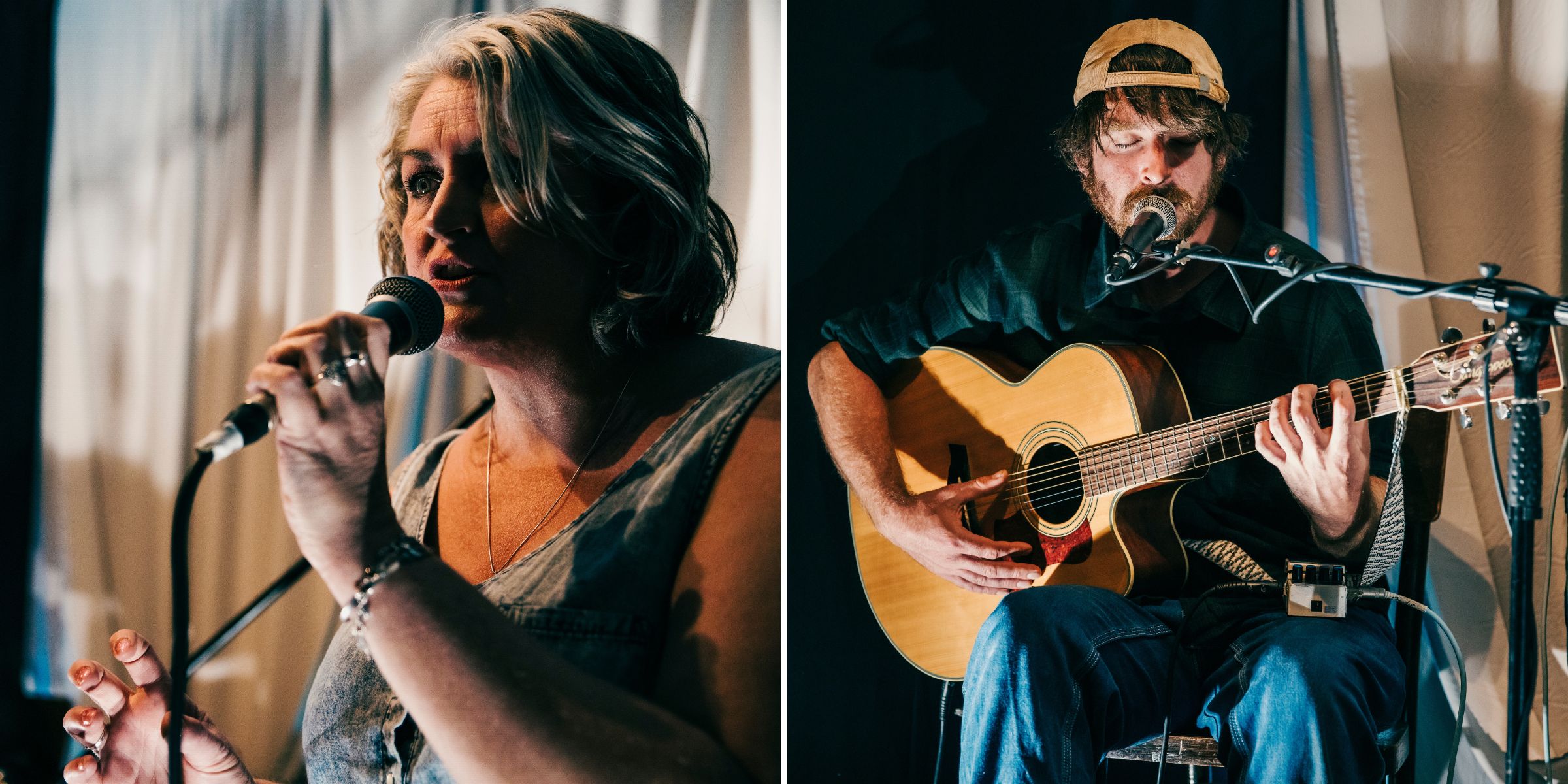
It is a spare and unsettling beginning for The Ballad of Blea Wyke, a new work of spoken-word theatre and live music created by Yorkshire writer and performer Hannah Davies with musician Jack Woods.
The production takes an old selkie myth - one of those stories in which the boundary between the human and natural worlds becomes temporarily permeable - and carries it to a not-too-distant future on the North Yorkshire coast.
There, on her eighteenth birthday, a young care-leaver called Cerys breaks the restrictions of a locked-down city and sets out in search of the cliffs where she was born.
The coast is crumbling. The natural world has contracted. The final grey seal is approaching land. And Cerys is being pulled towards a past which may be personal, ancestral or mythic - perhaps all three at once.
Presented through Davies’ lyrical storytelling and Woods’ live guitar, loops, harmony, poetry and song, the piece comes to rise at Bluebird Bakery in Acomb on 10 July before travelling to Helmsley Arts Centre on 17 July.
It sounds like exactly the kind of work that can be diminished by conventional theatrical description. It is not quite a play, not simply a concert and not a poetry reading accompanied by music. Instead, the different forms appear to move through one another, creating a contemporary ballad in which story, sound and landscape carry equal weight.
Selkie stories are traditionally associated with the coastal cultures of Scotland, Ireland and the wider North Atlantic.
In their best-known form, a seal comes ashore, removes its skin and assumes human form. Frequently, a man discovers and hides that skin, preventing the selkie woman from returning to the sea. She may live with him for years and bear his children, but when the hidden skin is eventually recovered, she returns to the water.
They are stories about transformation, captivity, desire and belonging. They are also stories about possession: of bodies, identities and the skins through which somebody is permitted to move freely between worlds.
Davies’ version dispenses with the familiar fisherman imprisoning a woman by locking away her sealskin. But the act of shedding a skin remained central to the work’s creation. Between 2019 and 2022, Davies experienced Topical Steroid Withdrawal, a debilitating condition that can occur following prolonged use of topical corticosteroids. “The image in the folk tale of a seal shedding its skin to transform into a Selkie resonated,” she explains.
“As I healed through the illness, the pandemic and lockdowns were unfolding around me, and the sense of that also flavoured the piece.”
That combination gives The Ballad of Blea Wyke its emotional territory. There is the body which has become painful and unfamiliar. There is the world outside, suddenly restricted. There is the longing to escape confinement.
And there is the question contained within every transformation story: what happens when the identity we have inhabited no longer fits?
Davies does not transplant the original myth intact. Instead, she uses its imagery as a structure through which a different story can emerge. “It nods to some of the original folk tale,” she says, “but there are no fishermen locking seal skins in boxes and trapping fair maidens - all that stuff is out.”
What remains is the pull of the coast and the possibility that a person might recover something essential by returning to it.
The title locates this myth firmly in Yorkshire.
Blea Wyke lies near Ravenscar, on a stretch of coast where high ground meets the North Sea and human ambitions have repeatedly collided with geography. It is an appropriate place for a story concerned with unstable boundaries.
Cliffs collapse. Paths alter. Settlements face the sea and the weather. The apparent solidity of the land is constantly being revised by water.
The Yorkshire coast is frequently sold through nostalgia: fishing villages, beaches, headlands and childhood holidays. But Davies and Woods appear to be interested in a different coast - one that is beautiful without being benign.
Their landscape is crumbling and ecologically diminished. The presence of “the last grey seal” places the work within a possible future in which the natural world has not disappeared entirely, but has become frighteningly scarce. That image is powerful precisely because seals remain such an emotionally legible part of Britain’s coastal wildlife.
To imagine the final animal swimming ashore is to imagine extinction not as an abstract graph or distant prediction, but as an encounter: One creature. One shore. Nobody left behind it.
The environmental concern within the piece does not appear to function as a lecture added onto the story. It is embedded in the same mythology that shapes Cerys’ journey. The seal is both an animal and the remnant of an older story. The coast is both a real Yorkshire landscape and a threshold. Cerys’ search for where she came from becomes inseparable from the question of what kind of world remains available to her.
The production has developed gradually rather than arriving fully formed.
It began as a micro-commission within York Theatre Royal’s Green Shoots programme in 2022. Since then, it has been supported and developed through Say Owt and Next Door But One, with research-and-development performances at York Theatre Royal Studio, Theatre at the Mill and Scarborough Fringe in 2025. That route feels typical of Yorkshire creativity.
Northern cultural life does not depend only upon major buildings, large commissions or work arriving from elsewhere. It also relies on networks of artists, small venues and organisations prepared to stay with an idea while it finds its form. Say Owt has been part of York’s spoken-word ecology since 2014, staging poetry slams, scratch nights, workshops and open mics while bringing nationally and internationally recognised poets to the city.
Next Door But One is a York-based, LGBTQ+ and disability-led theatre company whose work combines professional performance with sustained creative activity involving different communities. For Matt Harper-Hardcastle, the company’s CEO and Artistic Director, supporting The Ballad of Blea Wyke was partly about recognising the potential of the original rehearsed reading. But it was also about place. “A piece set in Yorkshire, for Yorkshire audiences chimed with so much of our company’s own ambition,” he says.
The company also wanted to support Davies’ continued development as what Harper-Hardcastle describes as “a leading voice in theatre and spoken word”. There is no reason work rooted in a specific northern landscape should be regarded as culturally narrow. The opposite is often true. The more precisely a story understands its terrain - the cliff edge, the weather, the local mythology and the distance between a city and the sea - the more confidently it can address experiences that reach beyond that place.
And clearly, illness is not exclusively Yorkshire. Nor are confinement, ecological grief, care, recovery or the desire to discover where we belong. But they may be felt differently when placed beside a particular stretch of coast and allowed to speak through the image of a seal slipping between land and water.
Davies is a slam-winning poet and theatre-maker whose writing credits include work for the Royal Court, Ice & Fire and York Theatre Royal. She has also taught playwriting at the University of York and worked as Executive Producer for ARCADE.
Woods studied at the British and Irish Modern Music Institute and works across guitar, mandolin and violin. He writes and records under the name Pascallion and has appeared on BBC Introducing. Together, they offer a combination well suited to the ballad form.
Historically, a ballad was not simply a poem printed on a page. It was carried in the voice, shaped by rhythm and melody, and passed between people. It was news, folklore, warning, remembrance and entertainment. That lineage feels especially appropriate here. Davies’ language supplies the narrative and imagery. Woods’ live guitar, looping and harmonies provide what might be understood as the tide underneath it - repetition, return and gradual accumulation.
The production is directed by Em Whitfield Brooks, whose career has moved between community opera, small-scale theatre, choral work and creative facilitation across Yorkshire and Hull. Her involvement suggests a work attentive not only to individual performance but to the architecture of voices: how speech becomes song, how a harmony can alter a story, and how an audience can be drawn into the same shared imaginative space.
PitchWitches, the vocal quintet led by Whitfield Brooks, will open the Helmsley performance with close-harmony song. The York date is currently listed by Say Owt with support from poet Aimée Donnell.
Perhaps all selkie stories contain an argument between the life somebody has been given and the life to which they remain secretly attached. The human world offers one kind of belonging - but the sea offers another. The tragedy comes from the belief that only one can be chosen.
In The Ballad of Blea Wyke, Cerys begins inside a city which has closed around her. She is eighteen, leaving care and searching for a place of origin that may offer no simple welcome. Her movement towards the coast is therefore more than escape. It is a journey towards uncertainty. The cliffs are unstable. The landscape is damaged. The myth waiting for her may not provide comfort. But the sea remains visible.
After illness, lockdown and the narrowing of the world, Davies has made a story about somebody insisting upon reaching open water. Not because the natural world will solve everything. Not because old myths can restore what has been lost. But because transformation first requires the possibility of another form. The skin we inhabit may be wounded. The place we remember may be changing. The coast may be falling into the sea. Still, something within us turns towards it. And somewhere beneath the cliffs, the last grey seal continues to swim.
Friday 10 July 2026, 8.30pm
Doors at 7.30pm
rise at Bluebird Bakery
201 Acomb Road, Acomb, York, YO24 4HD
Tickets: £12 plus booking fee
Friday 17 July 2026, 7.30pm
Helmsley Arts Centre Studio Bar
Meeting House Court, Helmsley, YO62 5DW
Tickets: £15; under-18s £10, plus online booking fee
The Ballad of Blea Wyke is written and performed by Hannah Davies and Jack Woods, directed by Em Whitfield Brooks, and produced by Hannah Davies in association with Say Owt and Next Door But One.





