



.jpg)
Some histories refuse to stay safely in the past. The Spanish Civil War is one of them.
It began in July 1936, when generals including Francisco Franco attempted a military coup against Spain’s elected Republican government. The war that followed was brutal, intimate and international. It tore through Spanish towns, villages and families, but it also became something larger: an early confrontation with European fascism, watched with dread by people who understood that what was happening in Spain might not remain in Spain.
Nazi Germany and Fascist Italy supported Franco’s forces. Britain and France, meanwhile, held to a policy of non-intervention. For many working people across Britain, that official neutrality felt like a moral failure. Around 35,000 men and women from roughly 50 countries travelled to Spain to fight, drive ambulances, work as medics or otherwise support the defence of the Republic; around 2,500 went from Britain and Ireland, and about 500 of them were killed.
Among them was a young man called Sam Wild.
Born in Ardwick, Manchester, in 1908, Wild worked as a labourer. He was also involved in the National Unemployed Workers’ Movement during the 1930s, part of a generation shaped by depression, class politics and the sight of authoritarianism spreading across Europe. Later, reflecting on why he went to Spain, he said he had watched Mussolini in Abyssinia, Hitler in Germany, the persecution of Jews, trade unionists and communists, and the establishment of fascism elsewhere. “I came to the conclusion that fascism was determined to conquer the world and it was about time someone started doing something about it,” he recalled.
People’s History Museum in Manchester is marking the 90th anniversary of the outbreak of the Spanish Civil War with a special day of talks, film, music and archive access on Saturday 11 July, exploring a conflict that “exposed the growing threat of fascism” and inspired “an extraordinary international response by ordinary people.”
It's an event about Spain, of course. But it's also about Manchester, the North, and the long history of people here looking beyond their own streets and recognising a shared struggle elsewhere.
PHM describes the Spanish Civil War as one of the stories already shared in its galleries at the national museum of democracy. The commemorative event will explore how thousands of people from Britain supported the Spanish Republic, not only through military service but through fundraising campaigns and humanitarian aid, using objects, photographs and personal testimonies from the museum’s collection.
That range of participation has to be highlighted. The popular memory of the Spanish Civil War can sometimes narrow around a handful of famous names: Orwell, Hemingway, Capa, Picasso. They matter, but they're not the whole story. PHM’s collections allow us to look instead at the wider infrastructure of solidarity: trade union banners, vouchers, letters, photographs, children’s drawings, food campaigns and the remnants of lives lived with political seriousness.
The museum holds images documenting Sam Wild’s experiences in Spain. Wild arrived in early 1937, fought at Jarama, was wounded, and later served at Brunete, Belchite, Teruel and the Ebro. By late 1938, he had become commander of the British Battalion of the International Brigades.
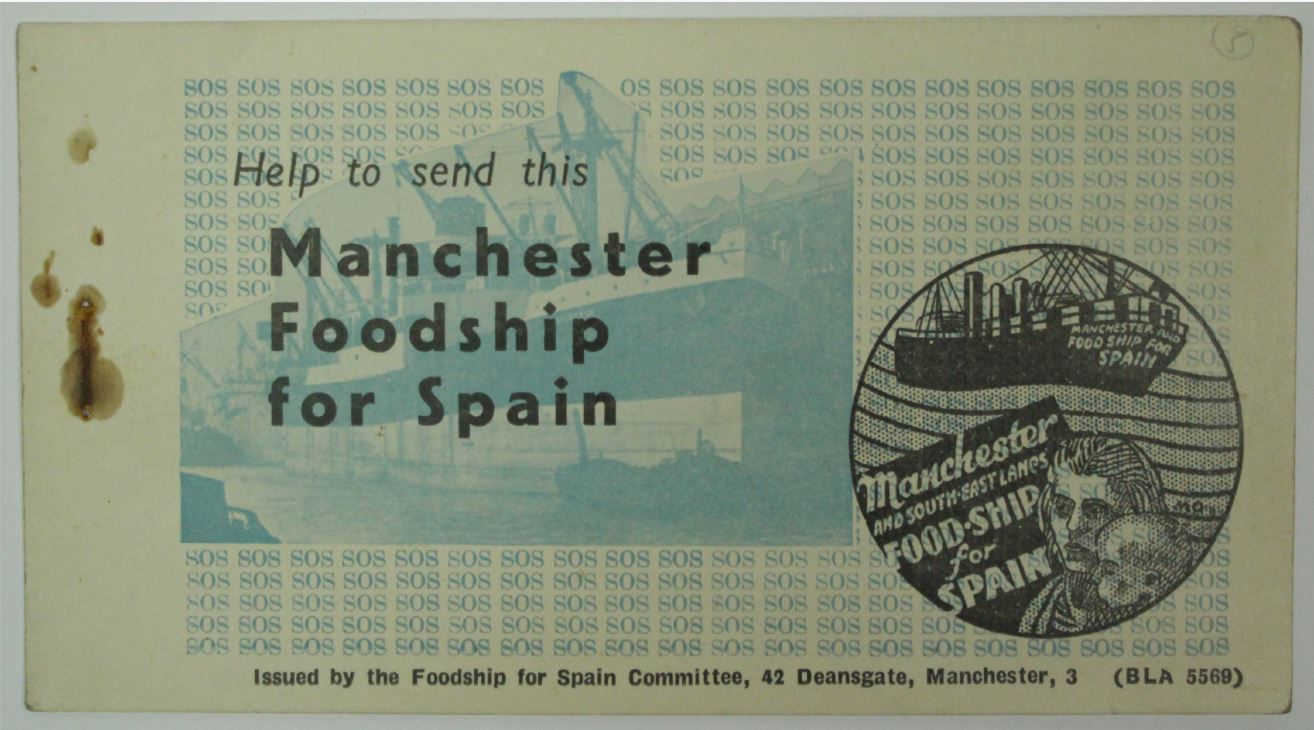
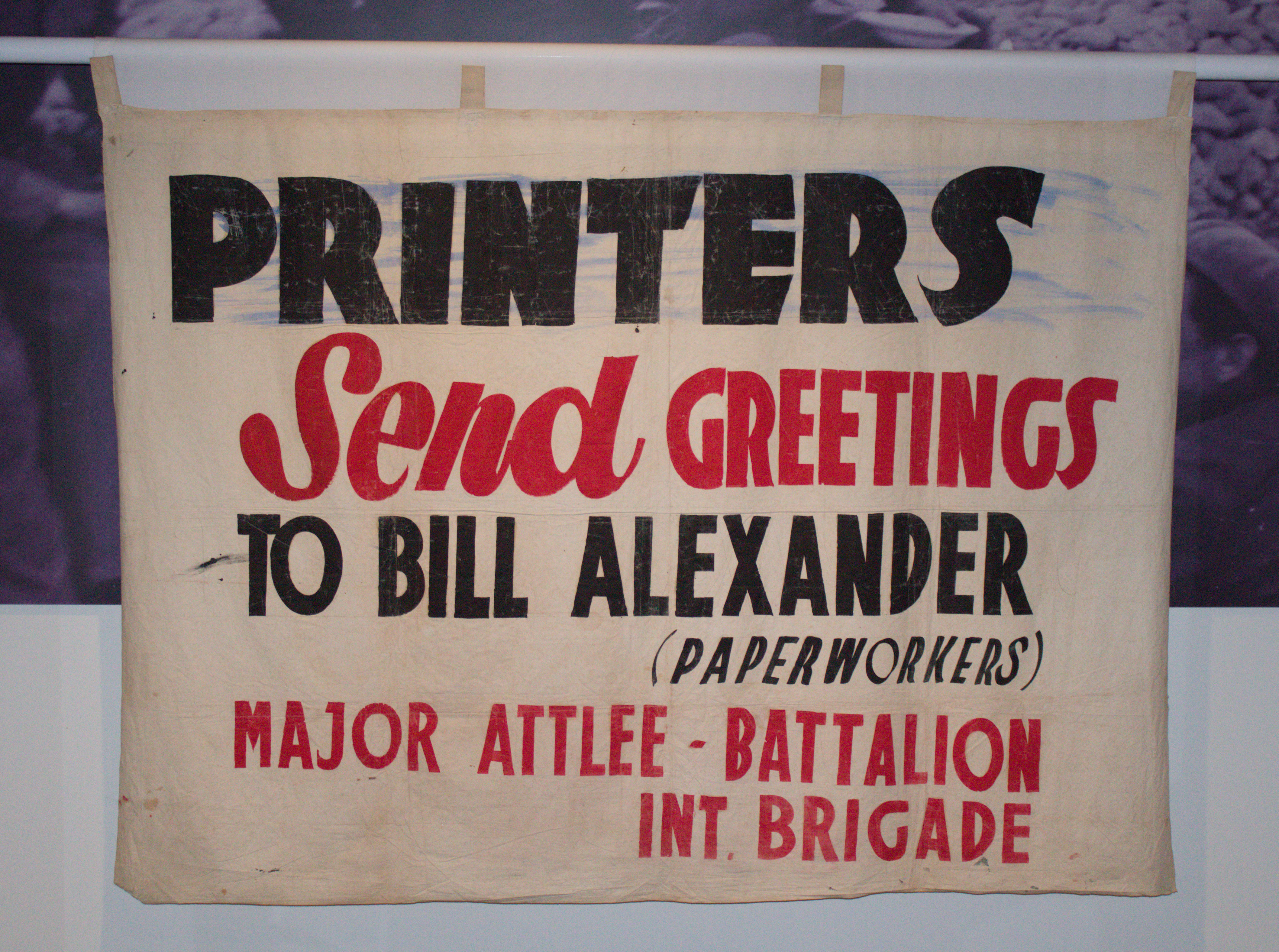
But the story didn't belong only to those who carried rifles. Across Britain, trade unions organised support for Spanish counterparts. PHM points to the Printers Send Greetings to Bill Alexander banner, dating from around 1937, as one example currently on display. Working people raised funds despite economic hardship; co-operative shops sold milk tokens to support children and older people affected by the war, and vouchers were bought to help fund Manchester’s “Foodship for Spain.”
There's something almost unbearably moving about that: people with little, giving what they could, because they understood the moral geography of the moment.
The Spanish Civil War wasn't an abstraction to them. It was democracy under attack. It was fascism rehearsing itself. It was Guernica, refugees, hunger, prison, exile and the knowledge that if the Spanish Republic fell, the consequences wouldn't stop at the Pyrenees.
PHM’s collections also include drawings made by refugee children who fled Spain during the conflict. More than 4,000 Spanish children were welcomed into Britain, and the artworks depicting the Battle of the Ebro offer a child’s-eye record of war: not strategy, not ideology, but fear, violence and witness.
That's another reason this anniversary is important. The Spanish Civil War is often described as a prelude to the Second World War, which is true, but insufficient. It was also a war against civilians, memory, language, labour organisation, regional identity and democratic possibility. Franco’s victory brought four decades of dictatorship, ending only with his death in 1975.
For decades, many of those stories were suppressed, buried or overshadowed. In Spain, Francoist memory politics silenced much of the Republican experience. Elsewhere, the scale of the Second World War pushed Spain into the margins. But those margins are now being revisited. Researchers in Catalonia have been working to identify foreign International Brigade volunteers who died or disappeared during the conflict, with hopes that remains still lying in unmarked graves might be found and reburied with dignity.
Memory, in other words, is still active. That's why a day at PHM isn't only a commemoration. It feels like a public act of recovery.
The Spanish Civil War at 90 – Collections & Conversation is being hosted in partnership with the International Brigade Memorial Trust and Instituto Cervantes. The programme includes talks by historians and authors Chris Hall and Dr Richard Baxell, a film presentation curated by Marshall Mateer, live music from Chorlton-based group The Mad Donnas, and opportunities to view specially selected archive materials from PHM’s collections.
Visitors will also be able to encounter a letter written by George Orwell, whose own experiences in Spain shaped some of his later work, alongside objects that speak to the wider Aid for Spain movement.
The event’s strength is that it doesn't ask us to remember Spain only through the exceptional. It asks us to remember through the ordinary: the labourer from Ardwick, the printers’ banner, the milk token, the food voucher, the child’s drawing, the family story handed down and then carried into a museum archive.
This is where People’s History Museum is at its best. Its purpose is not to place history behind glass and leave it there. It asks what people did when power felt remote, when governments failed to act, when democracy looked fragile, and when solidarity had to be organised from below.
The uncomfortable truth is that those questions haven't gone away.
We need to be careful with historical analogy. The 1930s aren't a costume cupboard for the present. But the Spanish Civil War still speaks because it shows how quickly democratic crisis can become international crisis; how ordinary people can recognise danger before institutions are ready to name it; and how solidarity can travel through ports, print rooms, union halls, kitchens, chapels, clubs and streets.
For us in the North of England, this isn't someone else’s history. It belongs to Manchester, where Sam Wild’s story is held. It belongs to the co-operative movement and the trade unions who raised funds. It belongs to the families who understood hunger and still sent help. It belongs to those industrial communities where anti-fascism wasn't a theory but a position taken at considerable personal cost.
And it belongs, too, to the descendants: people like journalist Gideon Long, Sam Wild’s grandson, who has written for PHM about his grandad’s war and recently visited the museum with a Spanish television crew interested in Manchester’s links with Spain, working-class history and the long arc from Peterloo to the present.
That arc is massive. Peterloo. The labour movement. The hunger marches. Spain. Anti-fascism. Democracy. These obviously aren't identical struggles, but they do rhyme across time.
Ninety years on, the story of the Spanish Civil War remains raw because it's about what people are prepared to risk for others. The British volunteers weren't adventurers in any simple sense. Many were working-class men and women with political convictions, shaped by unemployment, trade unionism, anti-fascism and internationalism. Some were young. Some were frightened. Some didn't come home.
Spain called, and they answered.
At People’s History Museum this July, their answer's going to be remembered not as nostalgia, but as evidence: that ordinary people have always been capable of extraordinary moral clarity when history demands it.
The Spanish Civil War at 90 – Collections & Conversation takes place at People’s History Museum, Manchester, on Saturday 11 July. Tickets are £10, with concessions at £8 and free tickets available. PHM is open 10.00am to 5.00pm every day except Tuesday.
Header image: Sam Wild (second from right) with Spanish and Cuban comrades. Image courtesy of People's History Museum





