



There are places we preserve by holding them still. Buildings are repaired, paintings conserved, boundaries marked and stories carefully recorded. Spurn isn't one of those places. At Spurn, land, sea and human history are in constant motion.
Here, at the very end of the Holderness coast, preservation means learning to live with movement. Sand shifts. Tides cut through roads. Cliffs retreat. Structures disappear beneath beaches and emerge again somewhere else. The North Sea takes away; the Humber deposits; the long, narrow finger of land between them bends, breaks and reforms.
Spurn isn't simply changing. Change is what Spurn is.
Yorkshire Wildlife Trust’s Heritage Walking Tour begins at the Discovery Centre, close to Kilnsea, where our guide, Billy Clarke, explains that even the building has been designed with impermanence in mind. Raised above the ground, its services exposed and accessible, its structure can - if necessary - be dismantled in sections and moved.
It is, Billy tells us, “like a big Lego set”.
That's not some eccentric architectural flourish. In December 2013, a tidal surge washed through the narrowest section of the peninsula and destroyed the road leading to Spurn Point. The event didn't create instability here; it just provided a dramatic reminder of it.

Today, Spurn is more than three miles long but, in places, only around 50 metres wide. The North Sea lies on one side, the Humber Estuary on the other. At high tide, water can cover the kilometre-long washover and turn the Point into a tidal island.
Before we've walked very far, Billy points out a First World War pillbox. He would normally take us inside, but swallows are nesting. The history lesson will have to accommodate the present inhabitants.
It's a small decision, easily overlooked, but one that captures the nature of Yorkshire Wildlife Trust’s work here. Spurn’s military, maritime and social history matters enormously, but it exists within a living reserve. The building has survived a century; the birds need it now.
Billy grew up in Withernsea, only a few miles up the coast. He studied zoology at the University of Hull and now divides his working life between Yorkshire Wildlife Trust and The Deep in Hull.
His knowledge is academic, local and accumulated through years of paying attention. He can easily explain coastal geomorphology, identify the shriek of a sandwich tern and spot the brief appearance of a grey seal in the water. He also knows how to hold the attention of a mixed group without making anyone feel that they have asked a daft question.
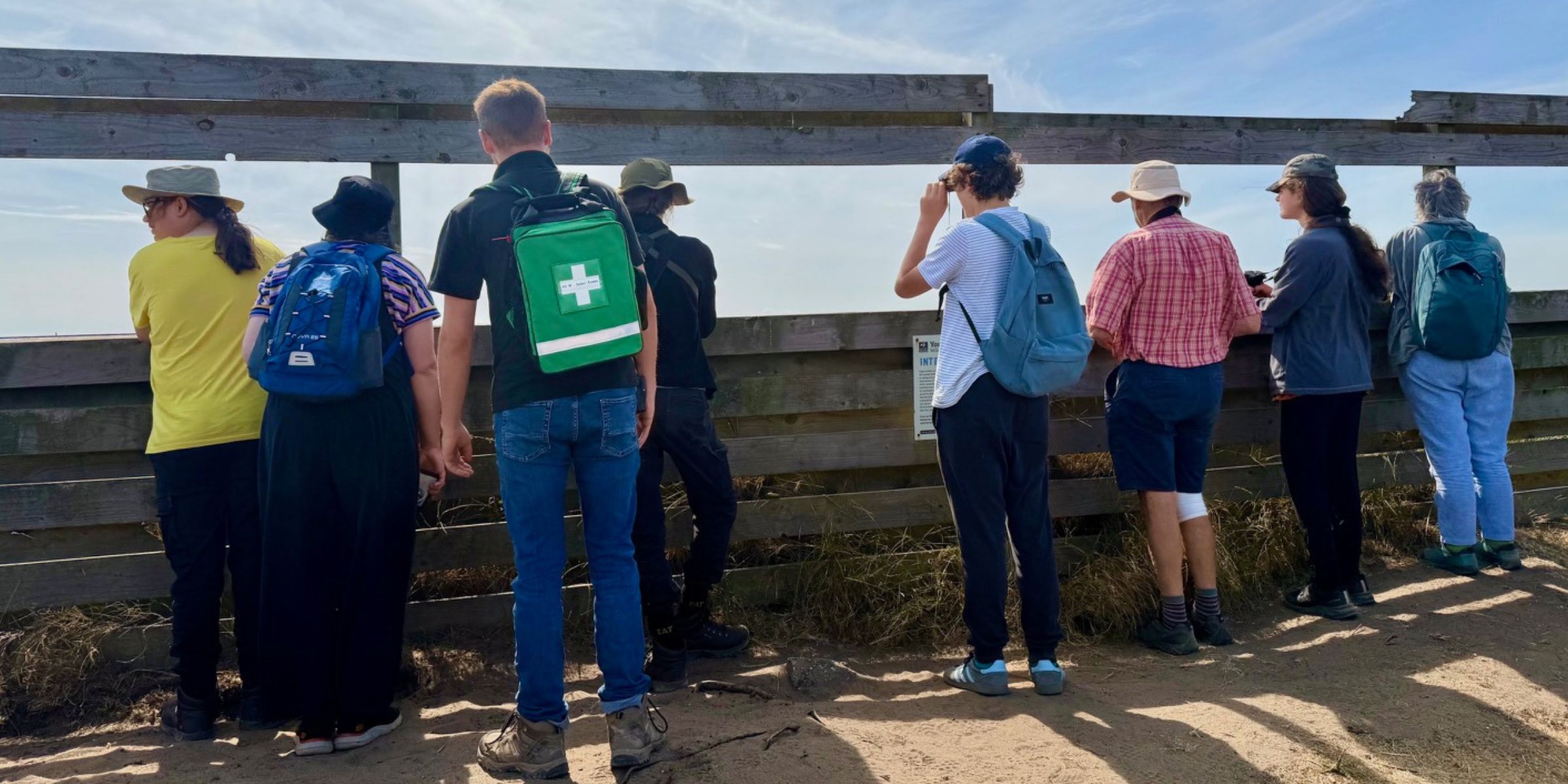
There are seven people on the walk, as well as me. Four are young men or teenagers, and their interest is conspicuous. They're not being dutifully dragged along while staring at their phones. They ask questions. They look for fossils. They want to know about marine life, birds and the practical work of conservation.
One has undertaken work experience with the National Trust. When he starts talking about longshore drift - I know I've found my tribe. Another is studying conservation. A family has travelled from Cheadle in Stockport, making the journey after spotting the YWT Yorkshire Day offer almost at the last minute.
The demographic is worth noticing. Conservation organisations frequently discuss how to engage younger people, particularly young men. Here, on a windswept strip of East Yorkshire, it's already happening.
Part of that success lies in the landscape itself. Part of it lies in having someone like Billy interpret it.
He explains how material eroded from the Holderness coast is carried south by that longshore drift. Where that movement meets the powerful flows of the Humber Estuary, the water loses energy and releases its burden of sand and sediment. Over thousands of years, those deposits have formed Spurn.
But this isn't a completed geological structure. It grows, contracts, moves and occasionally breaks into separate islands. Billy borrows a description he heard from another visitor: viewed across a sufficiently long period, Spurn is “the wagging tail of Yorkshire”. It's difficult to improve upon that.

Walking above the beach, the evidence of erosion is everywhere.
Holderness is made largely from soft glacial deposits rather than solid rock. Great ice sheets once carried material here from different parts of Britain and beyond, leaving behind boulder clay containing fossils from markedly different geological periods.
As the cliffs crumble, fragments of that deep past are released onto the beach. A walk along this coast might uncover ammonites, fossil corals, shells or pieces of ancient seabed. The Discovery Centre even holds a mammoth tusk.
Billy finds a piece of Jurassic rock and shows us the impression left where an ammonite once sat. Nearby, the outline of a fossilised shell is visible in the sunlight.
Against such timescales, 2026 suddenly feels very small.
The erosion, however, isn't abstract. Billy points towards Clubley’s Field, named after a former Spurn warden. Maps show the field occupying the same location for around a century, but its boundary is now perilously close to the cliff. Yorkshire Wildlife Trust expects that the fence will soon have to be moved inland.
The average rate of loss along the Holderness coast is often described as around two metres each year, but averages can disguise the violence of individual storms. In winter, waves throw rocks onto the clifftop and tear away great sections of land.
There's a powerful temptation to ask why the coastline can't simply be defended.
Billy explains the difficulty. Groynes and other hard defences might protect one community or stretch of coast, but by interrupting the southward movement of sediment they can starve the beaches further along. Saving one place can intensify erosion somewhere else.
At Spurn, the sand being carried away from one part of the coast is also the material from which the peninsula is formed. Loss and creation are part of the same system.
Yorkshire Wildlife Trust is therefore caring for something it can't - and shouldn't - completely control. Conservation here isn't an attempt to freeze the coastline into a preferred shape. It's the more complicated business of protecting habitats, managing access and allowing natural processes to continue in a landscape also carrying centuries of human history.
Spurn’s strategic importance has always been obvious. It reaches across the mouth of the Humber, guarding access to one of Britain’s great estuaries.
Settlements including Ravenser Odd and Ravenspurn once occupied this shifting territory. Both were lost to the sea. Their remains now lie somewhere beneath the water, east of the present peninsula.
Military defences have existed here in various forms for centuries, but Spurn’s role intensified during the First World War. Barracks, gun positions, tunnels and a railway were built to defend the Humber. Much of the infrastructure remains, although it is increasingly fragmented, buried or exposed by the movement of sand.
The pillbox near the Discovery Centre was designed for ten people: nine operating weapons around its perimeter and another supplying ammunition. Its ventilation system was reportedly arranged so that a grenade dropped into it could roll back towards the attacker. (Is that karma?)
Further along, concrete anti-tank blocks lie below the modern cliff line. They provide a stark visual measure of how much land has already gone. Structures once positioned across solid ground now sit among sand and water.
Then there is Spurn’s gloriously reckless railway history.
Billy describes the “sail rail” vehicles improvised from wooden platforms, railway wheels and whatever could be found to act as a sail - old boat canvas, bedsheets and even a cinema screen. Families rode along the track with children sitting at the edges, their legs dangling over the sides.
The first experiment had no brakes. Its operators eventually had to slash the sail to slow down before running out of track. Another sail-powered vehicle reportedly met a train coming in the opposite direction, leaving its occupants to jump clear.
“It wasn’t ingenuity,” Billy laughs. “It was madness.”
Spurn contains many serious stories: invasion, shipwreck, coastal loss, lifeboat crews and wartime defence. But the sail rail reminds us that history is also made from improvisation, bravado and people doing things that would now generate several weeks of risk assessments.
Spurn is internationally important for wildlife. Its mosaic of beaches, mudflats, dunes, grassland, saltmarsh, lagoons and scrub creates feeding and resting places for birds moving across vast distances.
The peninsula’s position makes it one of Britain’s great migration watchpoints. Autumn can bring extraordinary falls of birds, while insects including butterflies, dragonflies, hoverflies and ladybirds also move through in impressive numbers.
Yet Billy is careful not to turn birdwatching into a closed world available only to people who can identify every call.
Earlier that day, he had helped run an event called Birds and the Gen Zs, intended to introduce young people to birding. The participants weren't experts and weren't expected to pretend otherwise.
“As long as you’re outside enjoying nature and having a look, you’re birdwatching,” he says. “You’re doing it right.”
It might be the most important sentence spoken during the walk.
Environmental engagement is sometimes burdened by specialist language or an unspoken fear of getting something wrong. People worry that they don't know enough to join in. Events like this dismantle that barrier. Curiosity is sufficient qualification.
Yorkshire Wildlife Trust’s work at Spurn reflects that wider mission. There are beach cleans, guided safaris, fossil walks, migration events and activities for families. Billy tells us about a recent visit by children who had never previously been to a beach. They learned about conservation, joined a beach clean and repeatedly presented possible discoveries to the staff.
“Is this a fossil?” Billy was asked perhaps 200 times.
Whether each object was a fossil hardly mattered. The important thing was that every child had begun looking.

Towards the end of the walk, two grey seals appear close to shore.
At first, there's only a dark head breaking the surface. Then another. Billy helps everyone find the right point between the ships and turbines on the horizon. For a few moments, the group's completely absorbed.
Elsewhere, Sandwich Terns call overhead. Oystercatchers occupy the shingle. Common Lizards shelter in the long grass. The military remains, fossils and lost roads might provide the walk’s historical structure, but living Spurn keeps interrupting.
And that's exactly as it should be.
The Heritage Walking Tour succeeds because it doesn't separate natural history from human history. At Spurn, they can't sensibly be divided. The railway, wartime structures, lighthouse, lifeboat community, shifting sands, migrating birds and collapsing cliffs all belong to the same story: how people have attempted to inhabit, defend, understand and care for a place that refuses to remain fixed.
And the tour does something else. It demonstrates why good interpretation matters.
A landscape might be nationally protected, scientifically significant and historically remarkable, but designations alone don't create public attachment. People protect places when they're helped to notice them - when geology becomes intelligible, a bird call becomes recognisable and a half-buried piece of concrete is restored to its human story.

Billy Clarke is very good at helping people notice.
His knowledge is worn lightly, his enthusiasm is contagious and his connection to this coast is unmistakable. In another era, he might simply have been described as a naturalist: someone whose understanding comes from education, observation and a lifetime spent looking closely at home.
Yorkshire Wildlife Trust’s task at Spurn is immense. It must protect wildlife of international importance, manage visitors, respond to erosion, maintain historic structures and help people navigate a place where the safest route can change with the tides. But perhaps its wider role is contained in this modest walking tour.
Seven visitors set out with a young zoologist. Four of them are young men already curious about conservation. Along the way, they encounter seals, terns, fossils, moths, military defences, disappearing fields and a railway contraption powered by an old cinema screen.
They leave understanding that Spurn isn't simply a destination at the end of Yorkshire.
It's a place where the past is continually being uncovered, the future is visibly arriving and the land beneath your feet can never be taken for granted.





