



.jpg)
Have you got ideas in notebooks that will never see daylight. I have.
They sit in Notes apps, sketchbooks, Google Docs, half-remembered voice memos recorded on buses, or in the bit of the brain reserved for “one day, when I've got more time”. Artists know this territory well. Writers know it. Musicians know it. Anyone who has ever tried to make something in the spaces between paid work, rent, childcare, admin, funding forms, rejection emails, Instagram algorithms and a background sense of economic dread knows it. (Don't start weeping though - this is a good news story!)
The tragedy is that many of these ideas are not bad ideas. Some are brilliant. Some are daft in exactly the right way. Some are the beginning of something. Some are the sort of thing that might never survive a funding application, but would make complete sense if you stumbled across it on a street corner, in a fridge, in an IKEA, or in the palm of your hand.
Short Supply, the quite-superb Manchester-based arts platform founded by Mollie and Bek Balshaw, has decided to do something magnificently obvious and more than a bit radical with those ideas.
They're going to try them!
Not perfect them. Not endlessly package them. Not turn them into a 14-page strategy document with three measurable outcomes, a stakeholder engagement plan and a headshot in black and white.
Just try them.
.jpg)
Their project, 100 Ideas, is a year-long public experiment that takes 100 sidelined, half-formed or “saved for later” ideas and turns them into real actions: online, on the street and with the public. Some are playful. Some are conceptual. Some involve strangers directly. Together, they ask what becomes possible when creatives stop waiting for ideal conditions and start making contact with the world again.
That may sound small. It isn’t.
Because beneath the humour, the miniature exhibitions and the deliberate low-fi scrappiness, 100 Ideas is taking aim at one of the more exhausting conditions of contemporary creative life: the creeping professionalisation of imagination.
Artists today are expected to be many things before they are allowed to be artists. They have to be administrators, marketers, bid-writers, content creators, brand managers, community engagers, project evaluators, self-promoters, caption writers, invoice chasers, audience developers and occasionally their own HR department. Somewhere, if time allows, they are meant to make the work.
Short Supply’s argument is that this has consequences. Not just practical ones, but imaginative ones. When artists spend too much of their lives proving, packaging and performing the value of their practice, the messy act of trying something can become strangely difficult.
Mollie and Bek have nailed it in the press release announcing the project: “We started 100 Ideas because so many artists are spending huge amounts of their lives organising, pitching, proving and packaging themselves, while the actual act of trying things gets pushed further and further away.”
They go on: “A lot of creative people have become experts at building infrastructure around their practice, but feel further than ever from their own imagination. 100 Ideas is our way of pushing back against that. It’s about contact, movement, publicness, and giving ideas a chance to exist before they get buried under pressure.”
There it is: before they get buried.
Because the graveyard of unrealised creative work isn't filled only with laziness, self-doubt or bad discipline. It is filled with people who were told, directly or indirectly, that their ideas needed to be more polished, more strategic, more legible, more fundable, more London, more connected, more institutional, more fluent in the correct language of contemporary culture.
And for artists working from our beloved North of England - particularly those without inherited access, family money, elite networks or the confidence that comes from being told early on that every room is yours to enter - that pressure can feel doubled.
Short Supply has always understood that. Its work is rooted in the realities of building creative life outside traditional centres of cultural power. It supports early-career artists across the UK, particularly those from working-class, queer and marginalised backgrounds, and has built a national audience by speaking openly about visibility, opportunity and creative survival.
The directness is part of the appeal. Short Supply does not talk about access as an abstract virtue. It talks like people who know what access feels like when it is missing.
Which is why 100 Ideas lands differently from a neat “public art project” or social media challenge. It is not simply a series of quirky interventions. It is a refusal of the conditions that make creative people freeze.
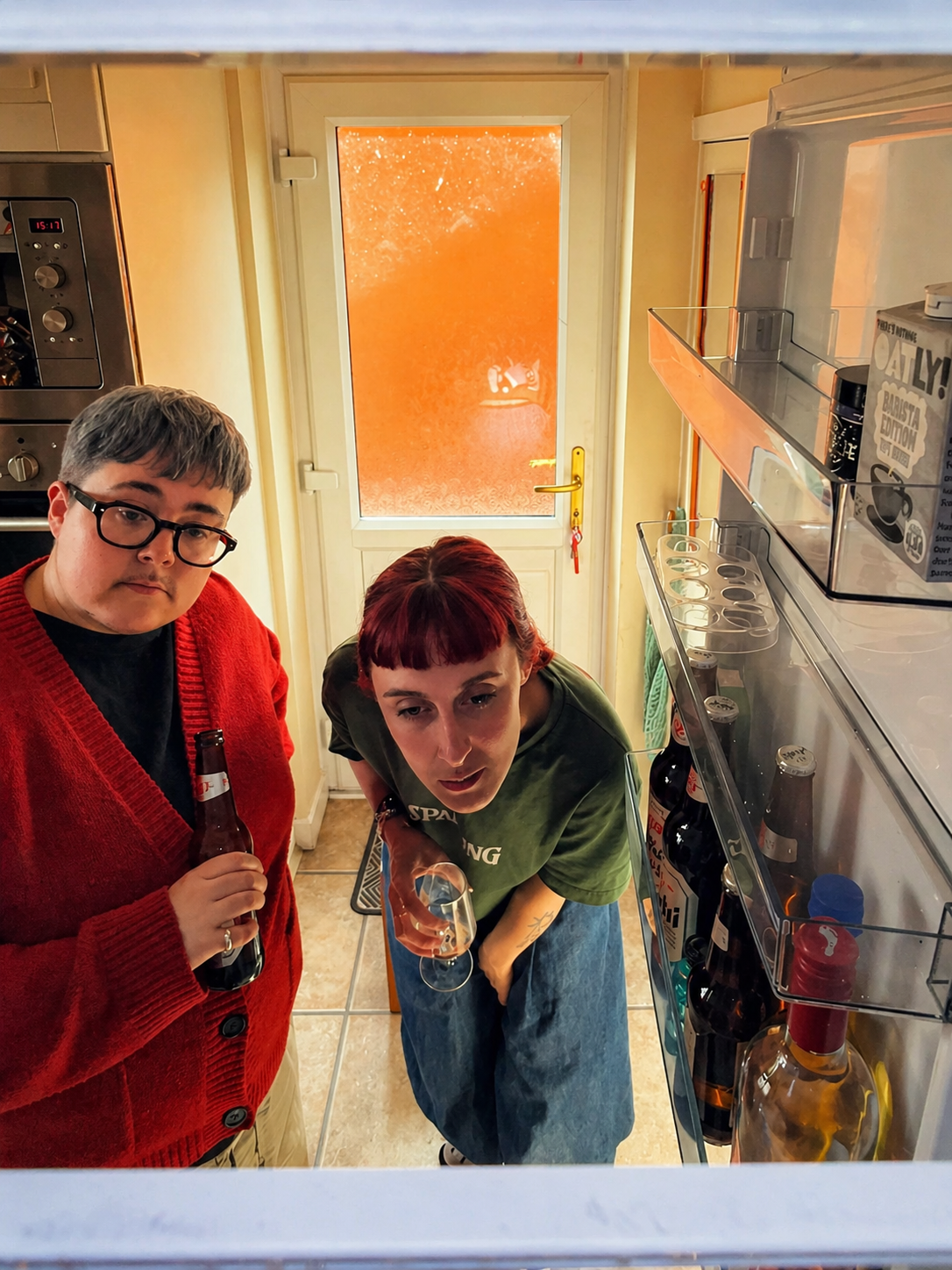
So far, the ideas have included 30-second sculptures in IKEA - quick public performances made from ordinary retail space and absurd time limits. There has been Finding Paintings That Already Exist, reframing the street as a gallery through attention rather than production. There has been the smallest gallery in York, a tiny-scale exhibition format that turns scale itself into the hook. There have been decision coins hidden around the city, inviting strangers into chance, play and participation. There has been an exhibition in a fridge, which sounds ridiculous until you realise that treating a deliberately unserious format with full curatorial seriousness - wall text and all - is exactly the sort of move that punctures the pomp of the art world while still loving art deeply.

The project's balance is important. This isn't anti-art. It's anti-paralysis.
It's not saying rigour doesn't matter. It's asking who rigour is for, who gets to define it, and whether the demand for polish has become a way of keeping certain creative-types in a permanent state of preparation.
And isn't there something wonderfully northern about the answer Short Supply is offering? Not in a flat-cap-and-cobbles way. Not in the tired branding language of “grit”. But in the more useful sense: practical, funny, inventive, impatient with nonsense, suspicious of unnecessary gatekeeping, and quite prepared to make a gallery in a fridge if the official routes are moving too slowly.
It's also placing publicness (is that even a word?) back at the centre of artistic life.
Much contemporary culture is public-facing in theory but private in practice. Work is launched, documented, captioned, circulated and archived for audiences who may never quite be allowed to meet it. The algorithm becomes both venue and critic. Artists make for platforms that reward clarity, speed and personal branding, while the real, awkward, unpredictable public world becomes strangely secondary.
100 Ideas is reversing that movement. It heads outwards. Thank goodness.
The project is becoming more public-facing as it develops, with future ideas moving further into participation, street-level interventions, advice formats, exchange structures and live encounters. Planned ideas include a miniature exhibition in a box, a public advice booth and artist swap-based interventions built around participation and chance.
This is really important stuff, because public space isn't just where art happens. It's where confidence happens. Isn't it?
For an early-career artist, the first step is often not a major commission or a perfectly installed solo show. It is the moment someone else encounters the work and responds. A stranger notices. A passer-by laughs. Someone takes part. Someone is confused but curious. The idea leaves the private loop of self-doubt and becomes part of the world.
That's not a small thing. For artists outside the usual circuits, it can be everything.
.jpg)
The wider cultural question here is whether we have made creative life too frightened of the unfinished. Funding systems understandably ask for outcomes. Institutions understandably need plans. Audiences are trained by digital culture to expect everything to arrive already branded, edited and aesthetically coherent. But art doesn't always begin coherently. Sometimes it begins as a stupid thought that will not leave you alone. Sometimes it begins as a phrase in a notebook. Sometimes it begins because you looked at a fridge and thought: exhibition. (I am sorry/not sorry if the fridge is featuring too heavily.)
And perhaps that's what makes 100 Ideas such a good Thursday evening read - because it meets the end-of-week brain exactly where it lives.
By Thursday evening, most of us are being stalked by a few abandoned ideas. The email not sent. The pitch not made. The thing half-started. The creative thought parked because the week became heavier than expected. The plan quietly postponed until life becomes more manageable, as though life has ever shown any intention of doing that.
Short Supply’s project offers an alternative. Not a motivational poster. Not a productivity hack. Something better: permission to be in motion before you feel ready.
There is a politics in that.
For the North, where the cultural framework is impressive but uneven, where talent is everywhere but opportunity still clusters too often around confidence, networks and institutional fluency, this kind of artist-led work is more than charming. It's part of our ecology. It keeps things porous. It makes entry points. It says you do not need to wait for the perfect room to begin making one.
And the humour isn't incidental. It is a tactic.
In an arts world that can become painfully solemn about its own procedures, humour opens doors. It lowers the temperature. It allows people to participate without feeling tested. It makes difficult ideas approachable without flattening them. Short Supply’s genius has often been that it can be accessible without being simplistic, critical without becoming joyless, and ambitious without performing grandeur.
That final point feels central for me.
So much cultural ambition is still dressed in the clothing of seriousness: big venues, major funders, polished language, institutional endorsement. 100 Ideas proposes a different form of ambition. What if ambition isn't scale, but momentum? What if it's not waiting for permission, but building a practice of trying? What if an idea doesn't have to be final to be real?
The answer, in Short Supply’s hands, isn't a manifesto so much as a set of small public proofs.
A sculpture in IKEA.
A painting found in the street.
A gallery small enough to fit where grandeur cannot.
A coin hidden for a stranger.
A fridge treated like a white cube.
A hundred chances for an idea to become visible before fear, admin or perfectionism buries it.
This is what artist-led culture does at its best. It doesn't simply fill gaps left by institutions. It changes the terms of what culture can look like, where it can happen, and who gets to feel involved.
There will always be a need for major galleries, funded programmes, serious commissions and properly resourced artistic careers. No one should have to survive on scrappiness alone, (God knows I've tried), and northern artists have been asked to do that for far too long. But there is also something powerful in work that refuses to confuse permission with possibility.
Short Supply’s 100 Ideas is funny because it knows the art world can be absurd.
It's moving because it knows artists can be exhausted.
It's important because it understands that creativity doesn't die only when people stop caring. Sometimes it dies when people care too much, wait too long, and become convinced the conditions must be perfect before they begin.
Mollie and Bek Balshaw appear to have decided that perfect conditions are overrated.
There are ideas in notebooks that will never see daylight.
Here, at least, are 100 that will.





