



Most of know what the drill is as gallery visitors. Look closely. Keep your distance. Don’t touch - and definitely don’t walk across the artwork.
At Salford Museum & Art Gallery this September, the opposite is going to apply.
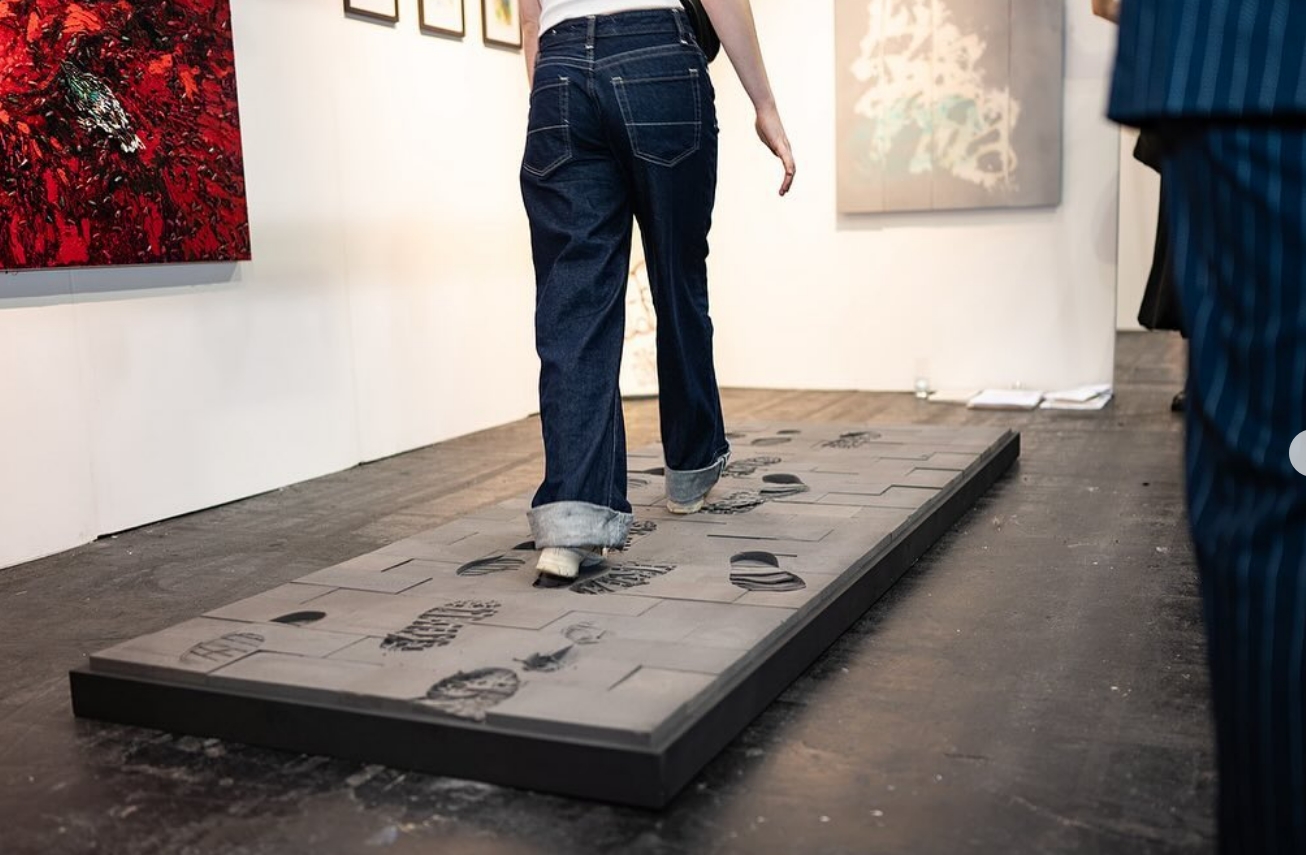
A temporary pathway made from dozens of blocks of dark green florists’ foam will be laid across the gallery floor. Visitors are going to be encouraged to step onto it, travel across it and leave something of themselves behind.
Shoes will press into the spongy material. Individual footprints will become trails; trails will overlap; clean edges will soften and the work will gradually acquire the evidence of everybody who's crossed it.
Without those marks, the artwork is incomplete.
Put Your Foot Down II, by Salford artist Maisie Pritchard, is the centrepiece of Walk in My Shoes, a free participatory event taking place at Salford Museum & Art Gallery on 19 and 20 September.
There's an immediate, almost childlike pleasure in being given permission to do something galleries usually forbid. But underneath that invitation there is a more serious proposition.
The path's intended to speak about recovery from substance use - not as a clean, solitary journey between two fixed points, but as something changed by detours, repetition, relationships and the presence of other people.
Recovery is often described through the language of forward movement.
People take steps, reach milestones, follow programmes and get their lives “back on track”. The metaphors are well intentioned, but they can create an expectation that recovery should be direct, measurable and always heading in the correct direction.
That neatness isn't always a factor in our real lives.
Put Your Foot Down II begins as an ordered pathway, but separate journeys are going to merge. Some marks will be deeper than others; some might barely remain visible.
What emerges isn't a record of people moving tidily in single file. It's a landscape made through collective movement.
“This artwork is activated through participation,” explains Mark Prest, founder and director of Portraits of Recovery, which commissioned the installation.
“Each step leaves a mark and helps make the work, contributing to a collective portrait of everyone who takes part.
“Recovery is often imagined as something straightforward, a journey from one place to another. Walk in My Shoes offers a different perspective: a process shaped by detours and mutual support.”
For Prest, the resulting work also asks us to reconsider what a portrait can be. There are no individual faces, formal poses or framed biographies. Instead, people are represented by the traces of their movement alongside the traces of others.
Individual journeys become part of something bigger: “an accumulation of shared experiences, movements and connections”.

The public installation is the culmination of several months of work led by Pritchard alongside people from Salford who identify as Recoverists - people in recovery from substance use.
Participants, their families and others close to them were invited to join a series of walks, gallery visits and practical workshops. Materials encountered along the way were collected and repurposed: twigs, leaves and discarded food packaging became improvised tools for drawing and mark-making.
The process couldn't be more important.
Projects concerned with addiction and recovery can sometimes turn lived experience into material to be interpreted by somebody else. Walk in My Shoes has instead been built through walking, collecting, talking and making together.
Pritchard describes it as a genuinely collaborative work, developed through time spent with people, rather than an artwork created in isolation and subsequently placed infront of them.
“Throughout the workshops, we’ve explored recovery as something that isn’t linear or fixed,” she says, “but something lived through everyday actions, relationships and shared experiences.”
Visitors to the September event will be able to explore the sculptural tools created during the workshops, learn about the collaborative process and then contribute directly to the final installation.
“Through participation, people become part of the artwork itself,” says Pritchard. “I hope the event encourages people to reflect on community and connection, and how the experiences of different people can exist alongside each other.”
Pritchard, who has a studio at Salford’s Paradise Works, makes interactive sculptures and art objects grounded in materials and practical processes.
Her wider practice repeatedly questions who is entitled to make art, what materials might be used and how an audience can move from observing a work to becoming part of it.
That openness is important within Walk in My Shoes. No artistic experience is needed. There's no correct way to make a mark, and nobody’s footprint is treated as more accomplished than anybody else’s.
Pritchard hopes visitors will leave understanding creativity as something accessible and embedded in ordinary life.
“Many of the activities throughout the project have centred around simple acts of walking, noticing and making together,” she explains.
Art, in this understanding, doesn't require specialist language, expensive materials or permission from an established cultural institution. It can emerge through attention, conversation and a shared willingness to try.
The same might be said of community.
Walk in My Shoes forms part of Recoverist Month 2026, an annual Greater Manchester programme placing contemporary art at the centre of conversations about substance use and recovery.
Now in its fourth year, the programme includes exhibitions, performances, films, walking trails and workshops. Its organisers describe it as the UK’s only arts-based awareness event led by and centred upon people and communities in recovery.
That public visibility has a purpose.
Stories about substance use are still frequently reduced to crisis, crime, failure or individual redemption. The slower work of recovery - rebuilding relationships, finding routine, developing confidence and belonging somewhere again - receives far less attention.
Portraits of Recovery argues that culture can help change the terms of that conversation. People in recovery aren't simply patients, service users or subjects of concern. They're artists, collaborators, audiences, neighbours and cultural citizens.
The workshops behind Walk in My Shoes were designed not only to produce an installation, but to offer connection, routine, creative skills and opportunities for participants to see their experiences reflected in a public artwork.
When the gallery doors open, the distinction between participant and audience will narrow again. That is a brilliant thing.
Each new visitor will be asked to walk the same vulnerable surface. Each will alter what earlier visitors left behind. Nobody will cross without becoming implicated in the finished work.
And perhaps that's the installation’s most important suggestion.
We don't move through life without marking one another. Recovery doesn't take place at a safe distance from everybody else, and its path can't be kept pristine.
It is made - and remade - by walking together.
Walk in My Shoes, part of Recoverist Month, is at Salford Museum & Art Gallery, Crescent, Salford M5 4WU, on 19 and 20 September 2026.
Entry is free. Further information and event details HERE
The project is a Portraits of Recovery commission, developed with Salford Museum & Art Gallery and Paradise Works, and funded by Achieve Recovery Asset Fund.





