



There is a question rarely asked when we talk about the future of the North. Who gets to describe it?
Who decides which of its communities matter, which difficulties deserve investigation, which cultural achievements are worthy of attention and which voices will be heard beyond the places where they live?
And who is it who has the time, money and security to keep doing that work?
A new YouGov survey commissioned by the Media Sovereignty Act Campaign suggests the British public is increasingly uneasy about the answers.
The poll of 2,097 adults found that 63 per cent would support banning UK national media organisations from being owned by foreign-based individuals or foreign-owned companies. The same proportion would support preventing one company from owning more than one national newspaper or broadcasting corporation.
Support crosses familiar political divisions. According to the campaign, more than six in ten voters from each of the main political parties favour ending foreign ownership, including 67 per cent of Reform voters. Similar levels of support were recorded among people who voted Leave and Remain.
There was even stronger backing for greater transparency and accountability. Seventy-two per cent supported requiring national newspaper groups to belong to a recognised independent regulator. More than three-quarters thought policy think tanks should disclose who funds them and how much those donors provide.
Perhaps most significant for organisations such as MagNorth, 62 per cent supported a levy on large social-media corporations to fund independent and local journalism.
That proposal takes the argument beyond a row about newspaper proprietors. It asks whether the organisations that have absorbed so much advertising income - while distributing, ranking and profiting from journalism produced by others - should contribute towards the reporting ecosystem upon which they depend.
The Media Sovereignty Act Campaign wants to prohibit foreign and offshore ownership of Britain’s national media and large regional groups. It also proposes limits on concentrated domestic ownership, including a maximum 20 per cent individual or family stake in a major national media organisation.
Its targets are clear. The measures would affect the Murdoch family’s control of The Sun and The Times, as well as the Rothermere interests behind the Daily Mail, Mail on Sunday, Metro and The i.
Campaign director Caspar Hughes argues that concentrated ownership has given an extraordinarily small number of people influence over how Britain understands issues including Brexit, climate change and Gaza.
“For a free and fair democracy, media ownership must be spread across all sections of society, not just the 0.0001%,” he says.
It is an unapologetically campaigning position. But the concentration it identifies is not imagined.
The Media Reform Coalition’s 2025 ownership report warned of declining plurality across national and local newspapers, broadcasting and online platforms. It also found that 143 of the 165 reporters funded through the BBC’s Local Democracy Reporting Service had been allocated to Reach, Newsquest and National World — three of the largest corporate publishers in the country. The coalition argued that public money intended to support local reporting remained overwhelmingly concentrated within established commercial groups.
Ownership does not dictate every article or invalidate the work of dedicated journalists employed by large organisations. There are exceptional reporters working throughout Britain’s national and regional press, often under immense pressure and with dwindling resources.
But ownership establishes priorities. It determines budgets, staffing, geographical reach, editorial risk and the amount of time a journalist is allowed to spend with a story. It decides whether an office stays open, whether a specialist correspondent is retained and whether reporting from a northern community is undertaken on the ground or assembled remotely from a press release and a handful of social-media posts.
Ownership is not separate from editorial culture. It creates the conditions in which editorial choices are made.
At MagNorth, this is not an academic debate. We know what it means to believe that a story matters and then have to find the time, travel costs and publishing resources to tell it. We know that serious journalism may begin with a press release, but cannot end there. It requires turning up.
It means listening to people whose names may never appear in the national press. It means allowing a conversation to develop rather than arriving with the conclusion already written. It means understanding that culture is not decoration added to a prosperous place, but part of the infrastructure through which communities understand themselves.
Over recent months, our work has taken us into community organisations, museums, theatres, galleries, former workhouses, industrial spaces and landscapes across the North. We have written about migration, poverty, conservation, childhood, identity, democratic anger and the value of culture.
Many of those stories were not commercially obvious. Some required considerable time. Few arrived with advertising budgets attached. That is precisely why independent journalism matters.
A publication rooted in a region sees things differently from one looking towards it from London. It notices the connections between a theatre in Leeds and the political story of a former mining community; between a museum in Ripon and the language Britain uses about poverty; between an environmental scheme in the Yorkshire Dales and a much larger national failure of policy.
This is not because independent publishers possess some unique moral purity. We have our own assumptions, limitations and blind spots. The difference is proximity, curiosity and the freedom to decide that a story deserves space even when an algorithm, shareholder or distant editor might disagree.
But freedom without financial sustainability is fragile. Independent journalism cannot survive indefinitely on goodwill, unpaid hours and the determination of individuals who believe the work is too important to abandon.
The erosion of local journalism affects the whole country, but its consequences are particularly acute across the North.
Large geographical areas are increasingly reported by fewer journalists, sometimes working across multiple titles. Newspapers that retain historic local names may contain substantial amounts of shared or centrally produced material. Council meetings, court proceedings, planning decisions and changes to public services can pass with little sustained scrutiny.
At the same time, northern life is too often interpreted nationally through crisis.
A place becomes visible when there is a riot, an election upset, a hospital failure, a factory closure or a particularly photogenic flood. The slow work of community-building, artistic creation, environmental repair and civic imagination struggles to command the same attention.
When local reporting retreats, the gap is not left empty. It is filled by rumour, partisan social-media pages, official communications and material designed primarily to provoke a response.
Research published by the Public Interest News Foundation estimates that 4.4 million people in the UK live in local news deserts. Its work argues that areas without reliable local reporting are increasingly vulnerable to misinformation and a diminished sense of civic connection. The organisation’s research forms part of a growing case for treating public-interest journalism as essential democratic infrastructure.
A democracy cannot function properly if citizens know more about the daily outrage selected for them by a distant proprietor or technology platform than they do about the decisions being made in their own town.
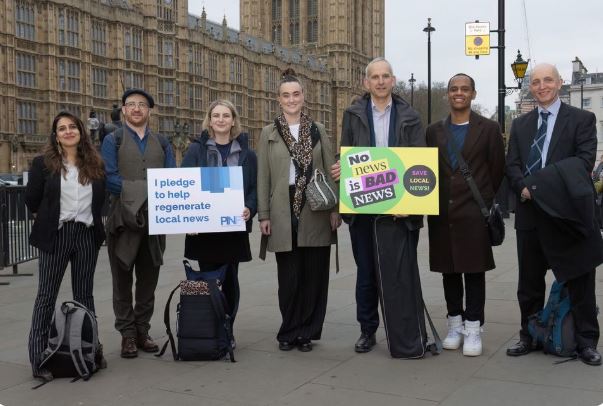
The proposed Media Sovereignty Act would introduce a levy on large social-media businesses and use the proceeds to support independent, local and cooperatively owned journalism.
There is public support for the principle. But the detail would matter enormously.
Who would distribute the money? Which publishers would qualify? How would genuinely independent journalism be distinguished from partisan campaigning, content aggregation or corporate publications presenting themselves as local outlets?
Any funding body would need to be structurally independent of ministers, political parties, major publishers and the platforms paying the levy. Decisions would need to be transparent, with safeguards preventing funding from becoming either a reward for favourable coverage or a mechanism for disciplining difficult journalism.
There is also a danger that public support intended to create greater plurality simply returns to the largest companies because they possess the teams, experience and administrative capacity to win competitive funding. That has to change.
The previous government’s response to the campaign’s parliamentary petition rejected a social-media levy and said it had no plans to introduce a statutory press regulator. It pointed instead to a Local News Fund worth up to £12 million over two years. That fund is intended to support digital innovation and address closures, redundancies and local news deserts.
It is welcome. But temporary innovation funding is not the same thing as a durable settlement for public-interest journalism.
Small publishers do not only need help purchasing software or experimenting with a new product. They need journalists. They need editors, photographers, filmmakers and the ability to spend a day - sometimes several days - properly understanding a story. They need time.
The arrival of Andy Burnham in Downing Street gives this debate particular resonance.
Britain’s new Prime Minister built much of his recent political identity in Greater Manchester, frequently arguing that power, investment and attention should be moved away from the centre. In his first days in office, he has promised growth “in every postcode” and a politics grounded in collaboration with Britain’s nations and regions. Andy Burnham became Prime Minister on 20 July 2026.
Media policy offers an early test of that instinct. Devolution cannot only mean relocating administrative responsibility. It must also mean strengthening the institutions through which places speak for themselves, interrogate power and participate in the national conversation.
A country remains heavily centralised if its regions gain elected mayors and new funding arrangements but continue to depend upon a small group of national proprietors and global technology companies to decide how they are seen.
If every place matters, the journalism emerging from those places must matter too.
The campaign is right to force the question of ownership into public debate. Yet foreign ownership is only part of the problem.
A British billionaire can exercise as much unaccountable power as an overseas billionaire. A domestically owned newspaper can neglect northern communities, distort public debate or place commercial and political interests above public service.
Nor would dispersing shares automatically create editorial diversity. Different titles can reproduce the same assumptions. Nominally local publications can remain remote from the people whose names they carry.
The deeper principle must therefore be plurality: more owners, more editorial centres, more community and cooperative models, stronger independent publications and a fairer distribution of the resources required to produce journalism.
Regulation must protect people from abuse without giving governments control over the press. Transparency rules should apply consistently. Public funding must be independently administered. And any social-media levy should create new reporting capacity rather than subsidise consolidation that has already weakened it.
These are difficult questions. They are not arguments for doing nothing.

At MagNorth, we do not pretend to be neutral about the value of independent journalism.
We believe the North deserves more than occasional attention from institutions based elsewhere. We believe its communities should not appear only as scenery, statistics or symbols in somebody else’s political argument.
We believe there is value in being informed and interested: in arriving without contempt, staying long enough to listen and resisting the pressure to turn every complicated story into a simple battle between heroes and villains.
But belief does not pay a contributor, buy a train ticket or create another working day.
If Britain wants a genuinely plural media, it must build conditions in which independent journalism can become more than an act of endurance.
The YouGov findings suggest the public understands that something is wrong. Nearly two-thirds want ownership dispersed. Nearly three-quarters want independent regulation. A clear majority would ask the technology companies profiting from our attention to contribute towards the reporting they have helped destabilise.
That does not settle the argument. It begins one.
The question is bigger than who owns The Sun, The Times or the Daily Mail. It reaches every town whose newspaper has become a shell, every council operating with little scrutiny, every community discussed but rarely heard and every small publisher attempting to tell stories that would otherwise go untold.
Who owns the media matters.
But so does who gets to make it, who can afford to remain independent - and who is allowed to tell the North’s story.
Header image: Matthew Ashmore





