



.jpg)
There is always a risk, when we mark something like World Press Freedom Day, that it feels distant: a concern for reporters in conflict zones, dissidents in prison, or correspondents working under regimes where censorship is open and brutal.
Those realities matter. They matter profoundly. But press freedom is not only lost in dramatic moments, and it is not only threatened somewhere else.
It can also be weakened quietly: by legal intimidation, by online abuse, by the hollowing out of local newsrooms, by the disappearance of reporters from council chambers and courts, and by communities gradually losing the means to tell their own stories.
That is why World Press Freedom Day matters to MagNorth.
The theme for World Press Freedom Day 2026 is “Shaping a Future at Peace”. UNESCO frames the day as a reminder of the relationship between free expression, reliable information, human rights, development and security. The NUJ, marking the day, makes the same connection: strong, independent journalism helps promote peace and social cohesion by giving people access to reliable information, scrutinising power, and creating the conditions for public dialogue.
The global picture is sobering. Reporters Without Borders’ 2026 World Press Freedom Index says press freedom has reached its lowest level in 25 years. For the first time in the Index’s history, more than half of countries and territories are now classed as having a “difficult” or “very serious” press freedom situation. Less than 1% of the world’s population lives in a country where press freedom is categorised as “good”; in 2002, that figure was 20%.
Free Press Unlimited, in its World Press Freedom Day message, highlights the same trend: journalism is increasingly being restricted through national security laws, legal threats, limits on access to information, and inadequate protections for journalists. Its message is global, but its implications are not remote.
The NUJ’s 2026 message brings that reality closer to home. This week it published findings from the first year of its Safety Tracker, reporting death and rape threats, racism, physical attacks and intimidation directed at journalists in the UK and Ireland. It also identified a worrying pattern of violent, graphic abuse towards women journalists, and cases involving discrimination on the basis of protected characteristics. The NUJ noted that relatively few respondents had reported incidents to police, employers or MPs - suggesting that abuse may be becoming normalised as “part and parcel” of journalistic work.
That should concern all of us.
Because when journalists are threatened, harassed, sued into silence, or simply priced out of doing public-interest work, the loss is not just professional. It is civic. It affects what the public gets to know.
The same is true of Strategic Lawsuits Against Public Participation - SLAPPs - a growing concern identified by the NUJ and others. These are abusive legal threats or claims designed to silence critical reporting. Even when claims lack merit, the threat of legal costs can drain small newsrooms and freelance journalists of time, money and confidence. For national newspapers with large legal departments, the risk may be manageable. For local, regional and independent publishers, it can be existential.
This is where the Northern context matters.
MagNorth has written before about the hollowing out of regional media and the urgent need for independent platforms rooted in people and place. Since 2009, more than 320 local newspaper titles have closed across the UK, leaving many communities without a dedicated local voice. In the North, this has been especially visible: papers closed or reduced, reporters stretched thin, and whole areas left dependent on fragments of coverage.
Yet the need for local journalism has not gone away. Councils still make decisions about housing, transport, social care, planning and public money. Courts still shape lives. Cultural institutions still need scrutiny as well as celebration. Communities still need to see themselves reflected with accuracy, dignity and depth.
As MagNorth has put it before: the North is not short of stories - it is short of storytellers. Without independent media, from investigative reporters to cultural magazine publishers, those stories risk being missed, flattened, or told from elsewhere.
That is why press freedom is not a specialist concern. It is not only about foreign correspondents, although we honour them. It is also about whether a freelance reporter can ask difficult questions without being threatened. Whether a local journalist can attend a meeting and be treated as part of democratic life, not as an inconvenience. Whether an editor can publish in the public interest without fearing a ruinous legal letter. Whether a young journalist from a working-class background can afford to enter the profession at all.
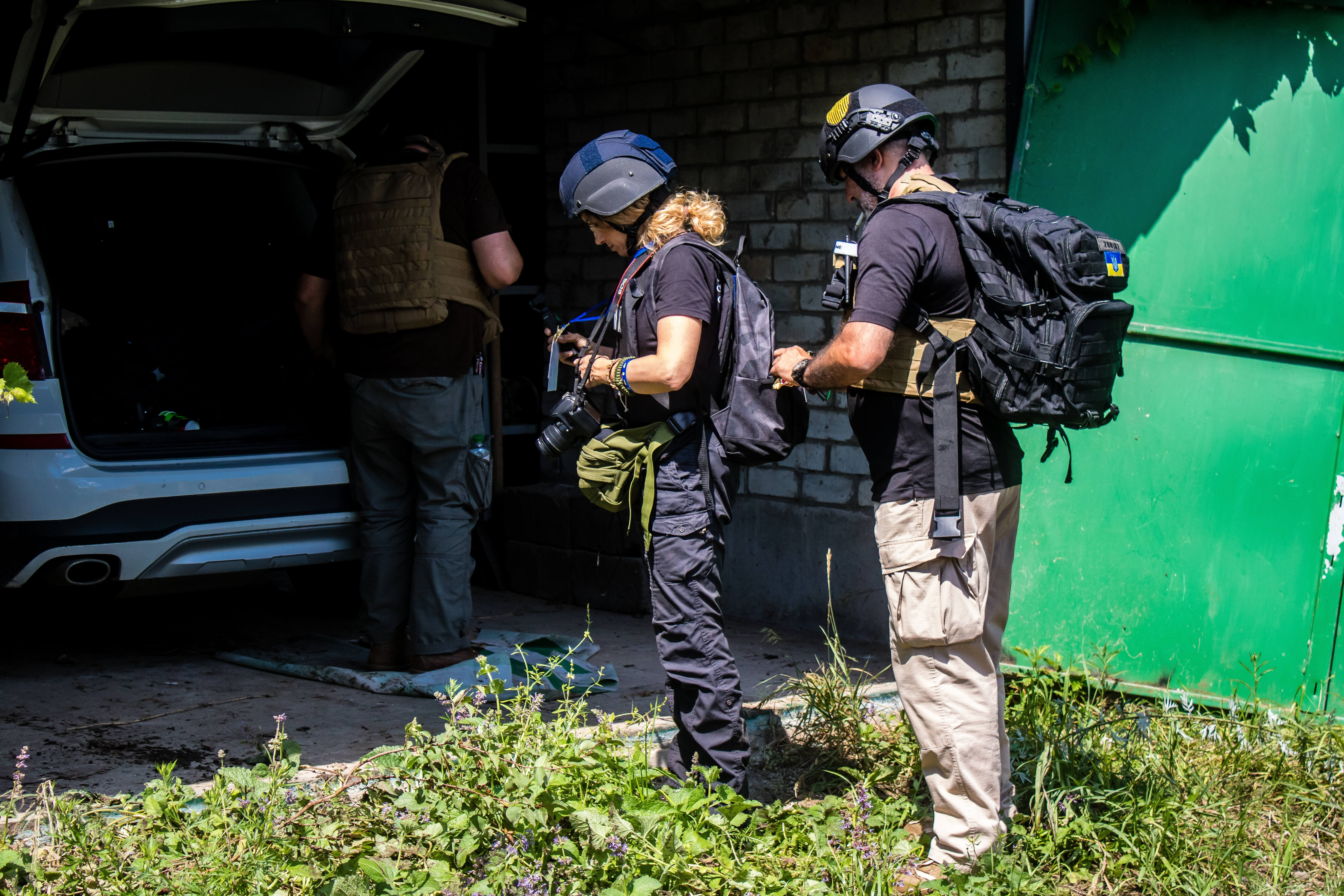
And it is about whether communities in the North get to speak for themselves.
Earlier this year, MagNorth published Lines You Must Cross, looking ahead to our work with communities and trainee journalists in the West Bank. That piece made clear that Colin’s planned visit is not about parachute reporting. It is about capacity-building: supporting emerging journalists to tell their own stories, in their own voices, with the skills to do so safely and effectively.
The West Bank is a very different reporting environment from the North of England. The risks are not equivalent. We should be careful, always, not to collapse distinct experiences into easy comparisons.
But there is a connecting principle: people need the means to describe the conditions of their own lives.
In high-risk environments, that may mean training, protective equipment, digital safety and legal support. In Northern communities, it may mean sustainable independent publishing, space for long-form storytelling, investment in local reporting, and a refusal to let national narratives be the only narratives that count.
MagNorth’s own cultural narrative has always been rooted in that idea: inclusion, equality of opportunity, and the amplification of voices that might not otherwise feel heard. The magazine’s mission is not only to celebrate the North, but to help sustain a media ecosystem in which Northern lives are reported with care, context and independence.
So today, World Press Freedom Day is a moment for solidarity - with journalists killed, jailed, threatened or censored around the world - but also for attention closer to home.
Press freedom is not simply the right of journalists to publish. It is the right of communities to know. It is the right of readers to receive information that has not been distorted by power, fear, money or silence. It is the right of places like ours to be more than a footnote in someone else’s story.
That matters in Gaza, Ukraine, Sudan, Syria and the West Bank. It matters in Westminster and Whitehall. And it matters in Bradford, Carlisle, Hull, Leeds, Liverpool, Manchester, Newcastle, Sheffield, York and every town whose future is shaped by decisions that deserve scrutiny.
A free press is not a luxury for stable times. It is one of the things that helps keep societies stable.
For MagNorth, that means continuing to make space for independent, thoughtful, rigorously researched journalism; continuing to support those who tell stories from within their own communities; and continuing to insist that Northern voices are not peripheral.
They are central.
Today, on World Press Freedom Day, that feels worth saying plainly.
Sources and suggested further reading: National Union of Journalists, Free Press Unlimited, UNESCO, Reporters Without Borders





