



The desire is painfully small. Razieh wants a plump goldfish for the Iranian New Year.
Not one of the skinny creatures already swimming in the pond at home, but the beautiful fish she has seen in a shop: white, dancing fins; a body seemingly made of light.
Her mother eventually gives her the money. Somewhere between home and the shop, Razieh loses it.
That is the slender premise of Jafar Panahi’s The White Balloon. A little girl walks through Tehran trying to recover a banknote and buy a fish before the shops close for Nowruz. Yet the film, written by Abbas Kiarostami and released in 1995, gradually opens an entire city around her: distracted adults, shopkeepers, soldiers, strangers, opportunists and other children, each carrying needs of their own.
Nothing momentous appears to happen. To Razieh, everything does.
This autumn, The White Balloon opens Between Innocence and Reality: Iranian Cinema and Childhood, a season of five films at Leeds’ Hyde Park Picture House exploring one of the most distinctive traditions in Iranian filmmaking.
The programme moves from Amir Naderi’s The Runner and Pouran Derakhshandeh’s Little Bird of Happiness to Kiarostami’s unsettling documentary Homework, Panahi’s The White Balloon and Majid Majidi’s Oscar-nominated Children of Heaven.
They are films separated by style, subject and sensibility. What connects them is a refusal to treat childhood as a decorative condition: a realm of uncomplicated innocence placed safely beyond politics or hardship.
Here, children are not protected from the world adults have made. They must learn how to move through it.
The season has been developed by Hyde Park Picture House in partnership with Dr Maryam Ghorbankarimi, Senior Lecturer in Film Practice at Lancaster University.
In an essay accompanying the programme, Ghorbankarimi begins with the modest desires around which some of Iranian cinema’s most enduring stories are constructed: a pair of shoes, a red goldfish, the urgent need to return a school notebook.
Through these apparently simple concerns, she argues, filmmakers have found ways to examine much larger questions: family, education, poverty, power and the expectations imposed upon children by adults.
The child’s perspective changes the scale of things.
A lost banknote can become a crisis. A teacher’s question can expose a system built upon fear. One missing shoe can reveal the precarious finances of an entire household.
In Children of Heaven, Ali loses the shoes belonging to his younger sister, Zahra. Knowing their parents cannot afford to replace them, the siblings conceal what has happened and devise a system for sharing Ali’s trainers. Zahra wears them to school in the morning before racing back so that Ali can use them for his afternoon lessons.
Their predicament is intimate, even tender. It is also an account of economic hardship told without statistics, speeches or political instruction.
The children already understand the pressure upon their family. Their secrecy is an act of protection. They do not need an adult to explain poverty to them; they have learnt its rules through experience.
That capacity to reveal a social structure through the immediate life of a child became one of the defining qualities of internationally celebrated Iranian cinema. It produced films of apparent simplicity whose moral and political implications continued expanding long after their stories had ended.
But the tradition did not begin with Iran’s emergence on the international festival circuit.
Its roots run through an institution established decades earlier.
Founded during the 1960s, the Institute for the Intellectual Development of Children and Young Adults - widely known as Kanoon - produced books, films, animation and other cultural and educational material for young people.
Its influence upon Iranian cinema was extraordinary.
Operating beyond some of the immediate demands of the commercial film industry, Kanoon gave artists room to experiment. Abbas Kiarostami and Naser Taghvai began their filmmaking careers there. Directors including Bahram Beyzaie and Masud Kimiai also produced short works within its creative environment.
Kanoon developed animation, assembled an important archive and helped establish a filmmaking culture in which children and their experiences could be approached with seriousness, formal curiosity and respect.
The institution survived the 1979 Revolution and resumed its work. Some of the most significant films of the emerging post-Revolutionary cinema grew from the world it had helped create, including The Runner, Kiarostami’s Where Is the Friend’s House? and Beyzaie’s Bashu, the Little Stranger.
Children also offered filmmakers a particular freedom after the Revolution.
New restrictions governing the representation of adult bodies, intimacy and relationships made certain aspects of adult life increasingly difficult to place directly upon the screen. A child could move between homes, streets, classrooms and communities in ways an adult character sometimes could not. Childhood became a route through which filmmakers could approach a much wider social reality.
Yet it would be reductive to regard these young characters merely as devices created to outmanoeuvre censorship.
The richness of the films comes from the attention they pay to children themselves: their intelligence, confusion, resilience, fear, humour and ability to read the emotional weather around them. The films do not simply use childhood to say something about adults. They ask audiences to recognise the child as a person whose reality matters.
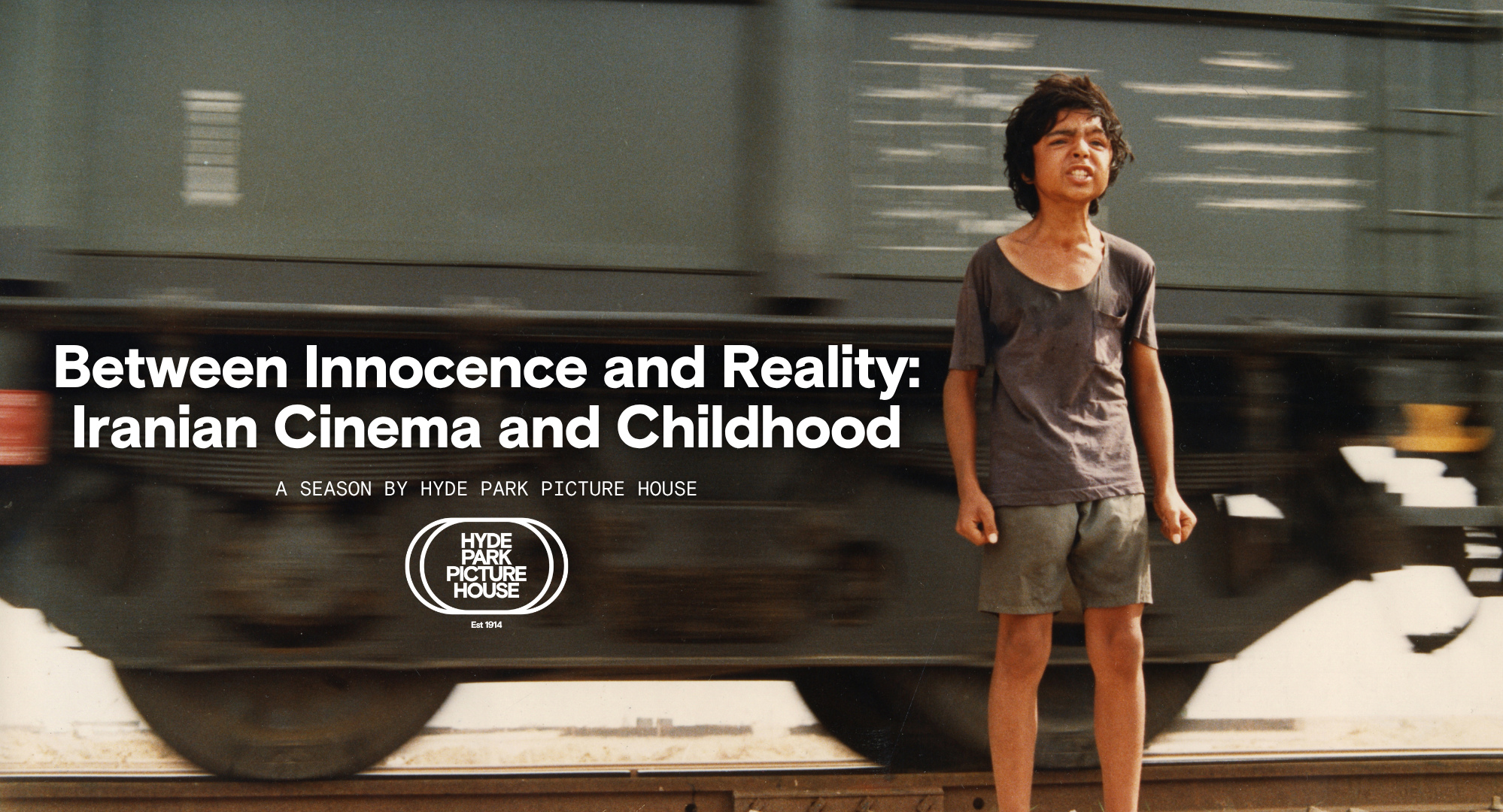
In Amir Naderi’s The Runner, released in 1984, the orphaned Amiro survives by gathering bottles, collecting scrap and selling ice water to passengers arriving at the port. He lives at the margins of southern Iran, looking towards ships and aeroplanes that suggest other lives and distant possibilities.
Running becomes both a physical act and a declaration of will. Amiro races other boys. He chases moving trains. He pursues the things he needs to live while reaching towards a future that remains barely visible.
Made close to the continuing Iran–Iraq War, the film refuses to turn its young protagonist into a passive symbol of deprivation. Amiro is irrepressibly alive. His hunger for knowledge is as urgent as his need for food and shelter.
That distinction is stark. There is a danger, especially when films travel internationally, that children living through poverty or conflict are viewed only as objects of pity. Naderi gives Amiro agency, appetite and imagination. His circumstances have shaped him, but they do not contain the whole of him.
Kiarostami’s Homework, released in 1989, turns from the street to the classroom.
The filmmaker speaks directly to primary-school pupils about their homework, punishments and lives at home. What begins as a deceptively straightforward series of interviews develops into a troubling examination of education, discipline and fear.
The boys know the answers authority expects from them. They have learnt when to repeat, when to hesitate and when silence may be safest. Their words expose the distance between the declared purpose of an educational system and the experience of those required to live within it.
Once again, the children do not deliver an argument prepared by adults. The structure reveals itself through their attempts to answer ordinary questions.
Any account of Iranian childhood cinema focused solely upon its internationally canonised male directors would remain incomplete.
A particularly important element of the Hyde Park Picture House season is its inclusion of Pouran Derakhshandeh, one of the first women to direct feature films in post-Revolutionary Iran.
Her work does not fit neatly inside the Western understanding of Iranian art cinema as restrained, poetic and realist. Derakhshandeh has frequently used melodrama, professional performers and emotionally direct storytelling to reach broad audiences.
Across four decades, her films have returned to children and young people whose experiences are ignored, misunderstood or considered too difficult to discuss. Her work has addressed disability, communication, adolescence, caring responsibilities, Down syndrome and childhood sexual abuse.
Little Bird of Happiness, made in 1987, centres upon a deaf girl who has ceased speaking following the death of her mother. Derakhshandeh cast deaf children as deaf characters, rather than asking hearing performers to imitate their experiences.
That choice brings an essential authenticity to the film, but it also raises a wider question: who is permitted to appear, communicate and be recognised on screen?
Derakhshandeh’s emotional directness is not separate from the social purpose of her cinema. It is part of it. Melodrama can move a private or unspoken experience into public view, asking an audience not simply to observe another life but to feel implicated in it.
Placed beside The Runner, Homework, The White Balloon and Children of Heaven, her work also unsettles the idea that there is one recognisable form of Iranian cinema — or one way of representing childhood.
[MARYAM COMMENT TO ADD: Why it was important to include Derakhshandeh in the season, and why these films should be encountered by audiences in Leeds now.]
There is particular value in bringing these films together in Leeds now.
Public understanding of Iran in Britain is frequently constructed through geopolitics, conflict, repression and diplomatic crisis. Those realities cannot be ignored. But when a country is encountered only through the vocabulary of the news bulletin, its people can disappear behind the politics conducted in their name.
Cinema offers no uncomplicated corrective. These films should not be asked to represent an entire nation, still less explain it. What they can do is return specificity to lives too often flattened by distance.
A child wants a goldfish. A brother and sister share a pair of shoes. A boy runs beside a train. School pupils struggle to describe the fear surrounding their homework. A deaf girl tries to find a means of being heard.
These are culturally and historically particular stories. They are also immediately human ones.
Hyde Park Picture House says it is working with Iranian communities and academics in developing and presenting the programme. That local relationship is significant. The season is not simply importing a prestigious body of international cinema into Leeds; it has the potential to create a place in which films, scholarship, memory and lived experience meet.
[OPTIONAL COMMUNITY COMMENT: Detail from Kelly about the contribution made by local Iranian communities.]
The Picture House itself feels an appropriate home for such an encounter. The independent cinema has survived for more than a century because people have continued to believe that watching together matters — and that the films shown in a city should extend rather than narrow its field of vision.
Between Innocence and Reality asks its audience to look carefully.
Not down at children as emblems of vulnerability, nor backwards at a supposedly simpler age, but outwards from the child’s position into the systems, hierarchies and compromises of adult society.
The five films do not present a single idea of childhood or a single cinematic Iran. They move between documentary inquiry, poetic realism, melodrama and popular storytelling. Their children can be mischievous, frightened, tenacious, watchful and wiser than the adults around them.
What they share is an understanding that no desire is small to the person who carries it.
And that sometimes the clearest way to see the world is to stand, for a little while, at a child’s height.
Between Innocence and Reality: Iranian Cinema and Childhood
The White Balloon — Sunday 20 September, 2pm
Children of Heaven — Saturday 3 and Sunday 4 October, with Pay What You Can screenings
Little Bird of Happiness — Sunday 11 October, 2pm
Homework — Tuesday 13 October, 6pm
The Runner — Sunday 25 October, 2.20pm
The season takes place at Hyde Park Picture House, 73 Brudenell Road, Leeds. Programme information and tickets are available from Hyde Park Picture House.





