



Pocklington’s historical significance cannot be understated. In the past decade, housing projects have uncovered dozens of Iron Age burials, Anglo-Saxon settlements, and Roman remains, not to mention the countless artefacts that give a significant insight into ancient life in East Yorkshire.
The Iron Age chariot burial from The Mile for example, has ‘no British parallel’, according to archaeologists on the site. The area has even been involved in the COMMIOS Project at the University of York, an endeavour seeking to transform our notions of ‘diversity, mobility and social dynamics’ in the past, especially the Iron Age.
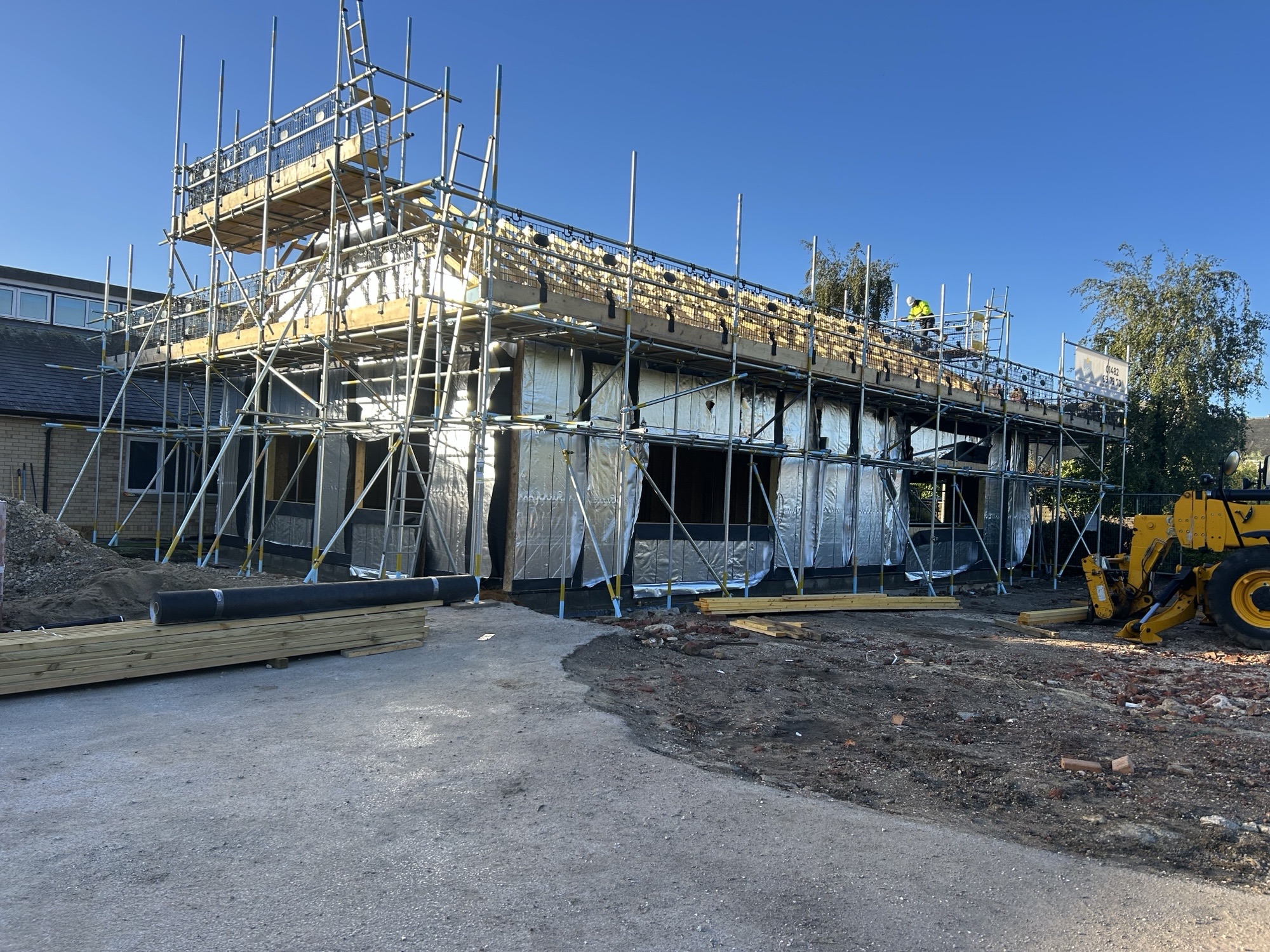
The newest find, however, has been long-since hypothesised by much more amateur archaeologists - namely, the children of Pocklington Junior School, whose ‘archaeology pit’ is almost exactly on the site of an Iron Age burial discovered when the school underwent renovations in December '25.
As a child, when I attended the school, my friends and I had a ‘pit’ in which we’d play archaeologists, carefully scraping back the dirt and looking for remains that weren’t just stones and water bottles. We would proudly proclaim that we’d found Roman pottery, or a bone fragment, holding up a slightly oddly shaped rock that we wholeheartedly believed was an earth-shattering discovery.
Now, I wonder how close we were to unearthing actual human remains. It wouldn’t have been our first experience with it, mind - around that time, the Iron Age artefacts and bones found nearby were brought into the school for us to look at, as a significant local find. Only upon reading about the discovery years later did I realise why they had been brought in - at the time, ten years old and not really paying attention to my surroundings, I assumed that it was a random visit from a museum.
Kelly Foxton, headteacher of Pocklington Junior School, said that the discovery was a "truly remarkable moment for the school community". Indeed, it must have been exciting for teachers and students alike - the rumours of ghosts that circulated while I was there will certainly have increased tenfold. Mrs Foxton described the discovery as "highlighting Pocklington’s historical roots" - which, in a town that is aiming for the title Town of Culture, is a significant boost to the relevance both modern and ancient of the town.
The discovery was made in late December, right before the Christmas holidays, which is terrible timing for teacher’s stress levels. The police were initially called - probably after a sheepish, ‘have any staff members disappeared lately?’ - but the bones, a head and torso with no attached limbs, were quickly deemed to be ancient. They possibly evidence extensive habitation of the area in ancient times, given the distance between this burial and the other significant findings on Yapham Road, Burnby Lane and The Mile.
Late local historian Robert Bellingham theorised that the site of the school may have been of historical significance - this find would appear to support his theory. In any case, it validates Pocklington’s already strong claim to fame in the ancient world.
.jpg)
As a historical market town situated between Hull and York, Pocklington’s significance historically cannot be overstated. For a town that annually celebrates the time a performer fell off the top of the church, it may be surprising how rich its history really is.
From the Bronze Age to WWII, the town has played its part in shaping the history of Britain, and in turn shaping our understanding of it, such as the discovery of the Mile charioteer’s IronAge bronze shield, decorated with Celtic art and a scalloped border, found in 2017, alongside a chariot burial with horses still in harness: an extremely rare find.
Though the Romans dismissed Pocklington (and possibly literally named it ‘Backwater’), there are plenty of Anglo-Saxon, Iron Age, and Medieval finds and stories to make up for it. The Battle of Stamford Bridge, for example, took place just four miles away, and William Wilberforce, who famously fought for the abolition of slavery, attended Pocklington School in the 1700s. Even the church, where my parents married and I and my siblings were baptised,dates back to both the Norman and Anglo-Saxon era. It is truly a town steepedin history, impossible to go anywhere where ghosts have not paced formillennia.
Professor Melanie Giles of the University of Manchester, who specialises in Iron Age Britain, has extensively studied the East Yorkshire area. The ‘Arras Culture’ around here, she told me, differs from the rest of Britain in this time in many important ways. "Around the middle Iron Age", she said, "many people lived in hillforts, with a lot of fortifications and evidence of a lot of violence. East Yorkshire in particular is interesting because there appears to be little of that. There was of course violence, but a lot of it appears to have been individual violence rather than warfare, and most injuries were survivable."

Speaking about the location of the finds, Professor Giles went on, "Pocklington is perfectly positioned for an Iron Age settlement. It is next to wetlands and the Wolds, with good agricultural land and downland for sheep - there are rivers, springs and brooks nearby", [where many prehistoric settlements tended to be found] "and it’s close to the Humber, too, so there would have been a lot of boats like the Hasholme Boat that was found nearby - there would have been a lot of trade, and the evidence shows us that it would have been, as it is today, a much sought-after place to live."
She also discussed how archaeologists are now able to trace the movements of individual people from the Continent during the Middle Iron Age, around 400-300 BCE, perhaps traders and artisans bringing with them new ideas such as Celtic art and chariot technology, which local communities quickly embraced.
Recent isotope studies from Pocklington also show some people moving out of their area for periods of their life, some of whom returned in old age, or were brought back to be buried in their ‘home’ cemetery. Others arrived from neighbouring regions, and seem to have been made welcome, marrying into local families.
One of the most interesting things about the finds in Pocklington, however, are the artefacts found in burials. Professor Giles’ personal favourite was at the chariot burial on The Mile, where a brooch resembling a dragonfly was found with the body, alongside a beautifully intricate shield. "It speaks so much of the person". she said. "These people were very skilled artisans. Their work, thousands of years on, gives a touching insight into the personalities anddaily lives of the people who created and loved them."
While the genetic and isotope analysis of the remains found under the school is likely to take years rather than months, such a find is still genuinely amazing and I hope the children of Pocklington can be involved in telling this individual’s story.
Whilst the burial is fragmentary, due to local soil conditions and thousands of years of building and disturbance, we are lucky that this much has survived. Who knows what else lies under the soil - what evidence of the ancient history of Pocklington that we are still yet to find?
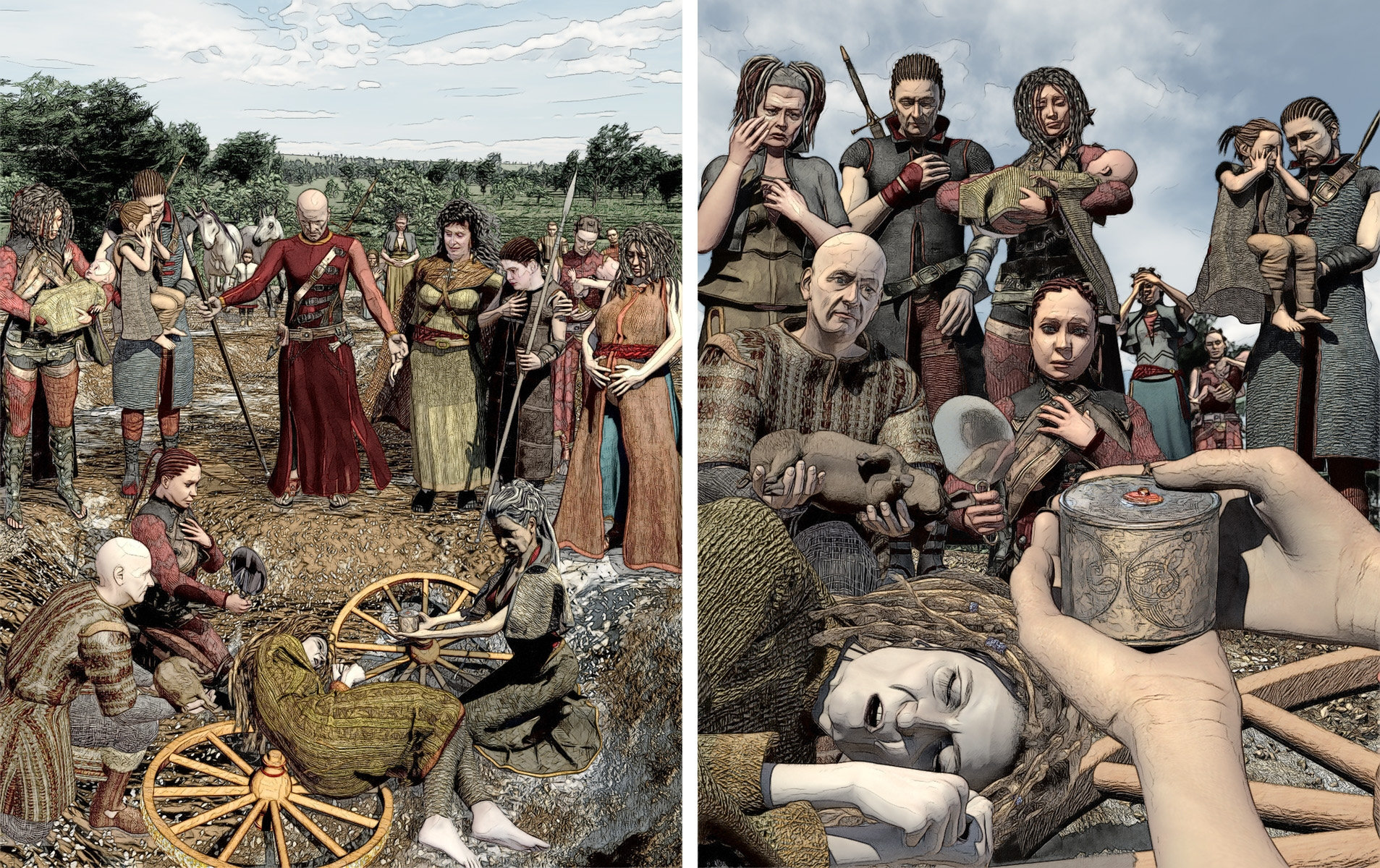
Header Image: ‘A visualisation of the Iron Age Wetwang Slack female chariot burial by Aaron Watson, courtesy of Melanie Giles’.





