



.jpg)
Far below the waves of the North Sea, layers of ancient rock may hold one of Britain’s most powerful tools for tackling climate change.
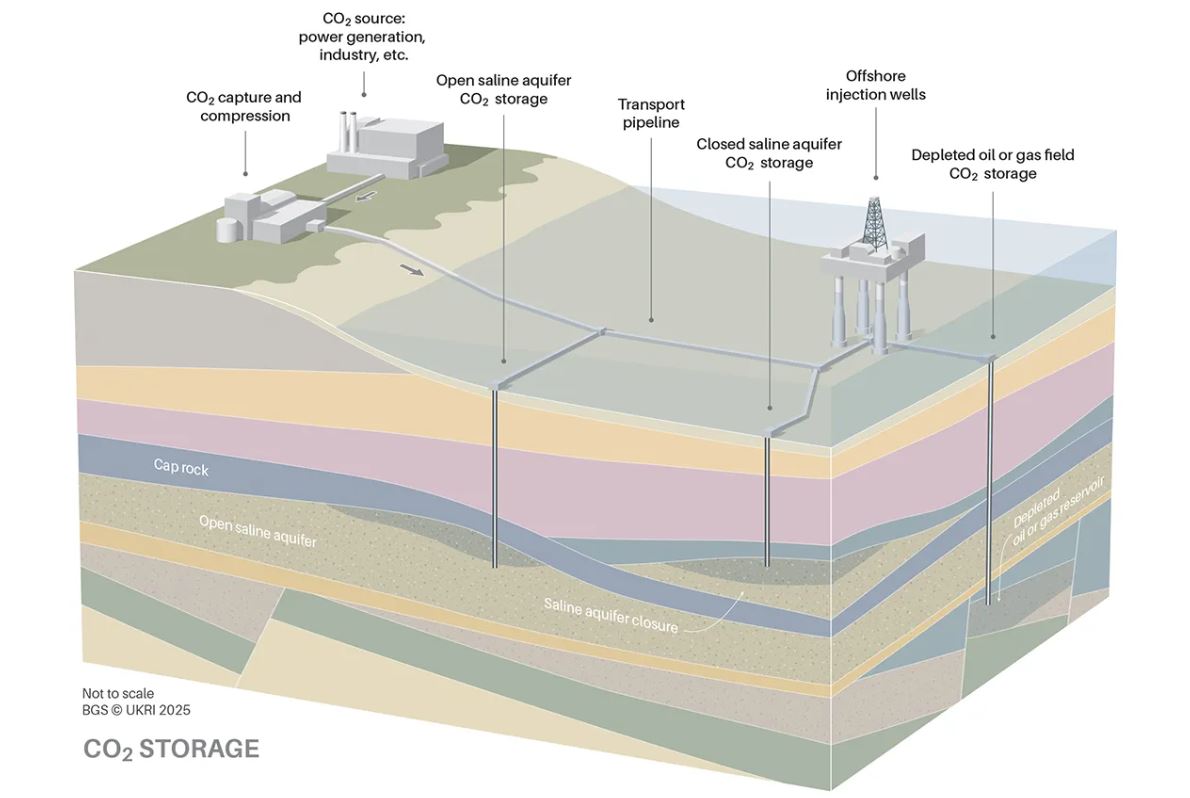
Carbon capture and storage (CCS) works by capturing carbon dioxide produced by major industrial sources - including power stations, cement plants and steelworks - before it reaches the atmosphere. The gas is compressed, transported through pipelines and injected deep underground into porous rock formations, typically more than 800 metres beneath the seabed.
Once underground, the CO₂ becomes trapped within tiny spaces in the rock and sealed beneath impermeable layers known as cap rock.
The UK government sees the technology as a key pillar of its net-zero strategy. Current ambitions aim to store 50 million tonnes of CO₂ every year by 2030, rising to around 170 million tonnes annually by 2050.
Achieving that will require enormous underground storage capacity - and the British Geological Survey (BGS) are clear the North Sea may be a major resource.
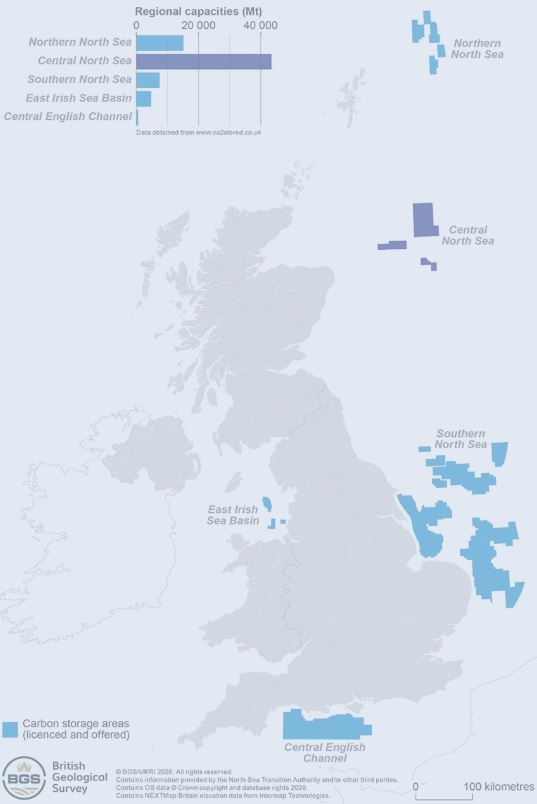
Scientists estimate that offshore geological formations around the UK could theoretically store more than 70 billion tonnes of carbon dioxide.
While early CCS development has focused on the Southern North Sea and other well-studied areas, attention is increasingly turning to the Central North Sea, where geologists believe one of the basin’s largest untapped storage resources lies.
Here, extensive sandstone layers formed between 40 and 65 million years ago, deposited by deep-water marine sediment flows. These rocks are naturally porous and permeable, meaning they can act like enormous sponges for carbon dioxide.
Above them lie thick sealing layers of rock capable of trapping the injected gas underground for thousands of years.
Researchers at the British Geological Survey are now studying these formations to better understand their structure and storage potential.
Although the storage sites themselves lie offshore, the capture of carbon will largely happen on land - and that is where Yorkshire could play a pivotal role.
The Humber Estuary is the UK’s largest industrial cluster and produces roughly a third of the country’s industrial emissions. Refineries, chemical plants, power stations and manufacturing sites along the estuary generate millions of tonnes of CO₂ every year.
Because of its coastal location and extensive energy infrastructure, the region is ideally placed to connect industry with offshore storage sites.
Major initiatives such as the Northern Endurance Partnership and Humber Zero are already exploring how captured carbon from the Humber’s industries could be transported through pipelines beneath the seabed and stored deep in the North Sea.
If successful, the Yorkshire coast could become a key gateway linking British industry to offshore carbon storage.
Despite its enormous potential, the Central North Sea remains relatively under-studied from a carbon storage perspective.
The region contains complex stacks of sandstone formations, and scientists must answer several important questions before large-scale storage begins. Researchers are investigating how these sandstone layers connect, how pressure might behave during CO₂ injection and whether historic oil and gas wells could create potential leakage pathways.
Fortunately, decades of offshore oil and gas exploration have produced a huge archive of geological data. Drill cores stored in the UK’s National Geological Repository allow scientists to analyse the rocks without the need for costly new drilling.
Offshore boreholes can cost £20–30 million each, making these archived samples invaluable for understanding the geology beneath the seabed.
If the Central North Sea’s storage capacity can be fully unlocked, it could potentially hold more than 10 billion tonnes of carbon dioxide - around a quarter of the basin’s regional storage potential.
Despite growing government investment, carbon capture and storage remains the subject of debate among environmental groups.
Greenpeace and other campaigners argue that CCS risks becoming a distraction from the urgent need to phase out fossil fuels, warning that the technology should not be used to justify continued oil and gas production. Critics also question whether CCS can scale quickly enough to make a significant impact on global emissions.
Supporters, however, argue that carbon capture will be essential for industries such as cement, steel and chemicals where emissions are difficult to eliminate entirely.
In these sectors, CCS may provide one of the few realistic pathways to deep emissions reductions.
For more than half a century, the North Sea has been central to Britain’s energy story.
First it powered the country through oil and gas. Now, the same geology that once supplied fossil fuels may help store their emissions.
If the technology delivers on its promise, the waters off the Yorkshire coast could become one of the UK’s most important assets in the transition to a low-carbon future.
Header Image: Flamborough Head, East Yorkshire. (Richard Allaway)





