




For a fortnight this autumn, the workers walking onto the stage of Theatre Royal Drury Lane won't be chorus girls, aristocrats or creatures from some conveniently enchanted kingdom.
They'll be shipbuilders.
The language will come from Tyneside. The great structure dominating their lives will be a shipyard. Their crisis won't be mythical, but painfully familiar: the threatened closure of the workplace around which generations of families and an entire community have organised their lives.
From 22 September until 3 October, Sting’s musical The Last Ship will arrive in the West End for a strictly limited run of 16 performances. Sting will appear in every one of them, playing Jackie White, an ailing yard foreman forced to lead his community at the moment it needs him most.
It's a newly adapted and expanded version of the show Sting first began developing in 2011, now with a new book by acclaimed playwright and novelist Barney Norris, and new songs and direction by Leo Warner. The production has already travelled through Amsterdam, Paris, Brisbane and New York, including nine performances at the Metropolitan Opera House.
But wherever it travels, its emotional geography remains fixed firmly on the banks of the Tyne. This is a story born in Wallsend.
Sting grew up Gordon Sumner, close enough to the Swan Hunter shipyard to watch thousands of men walking through its gates each morning.
Wallsend had developed around shipbuilding during the 19th century. Swan Hunter was established there in 1874 and became not simply a large employer, but a force which helped determine the shape, rhythms and identity of the town. Historic England records that Wallsend expanded dramatically as a centre of shipbuilding; the yard and the community surrounding it became almost impossible to separate.
A shipyard did more than pay wages. It trained apprentices, passed skills between generations and provided the common subject of conversation in houses, clubs and pubs. Its shifts regulated family life. Its orders affected the confidence of an entire place.
It also asked a great deal of the people who worked there.
Shipbuilding was noisy, punishing and dangerous. It could narrow a young person’s choices as well as provide them with a future. The belonging created by industrial work was real, but so were its hierarchies and exclusions. Women worked in North East shipyards too - taking on skilled engineering roles at Swan Hunter, Palmers in Hebburn and elsewhere during the First World War - although much of their contribution was subsequently pushed from the accepted story. Historic England’s continuing research describes that history as still “deeply hidden”.
Sting’s own relationship with this world was complicated from the beginning.
“I grew up in the shadow of the shipyard,” he says. “I’d watch thousands of men walk to work each morning, but I dreamed of something else. I dreamed of escaping, and I did everything in my power to get away from that life.
“But the farther I got, the more I realised I needed to understand where I came from and felt I had to give something back. The Last Ship is my tribute to the people and the place that shaped me.”
That contradiction - the desire to escape home followed by the need to comprehend it - gives the musical its power.
It's not unusual for young northerners to be told that success requires departure. Leave the town. Leave the accent behind. Go south. Make something of yourself.
Yet leaving rarely produces the clean break imagined by the person standing on the platform. Home travels with us. Its cadences remain in the voice; its humour and suspicion become part of our instincts. Distance can sometimes sharpen an attachment rather than diminish it.
Sting travelled from Wallsend to the world. The Last Ship represents the return journey.
The musical tells the story of a community confronting the closure of its yard: not only the removal of jobs, but the threatened destruction of a shared identity.
When Swan Hunter faced collapse in 1993, the consequences reached far beyond the men directly employed there. Parliament heard warnings about the loss of thousands of jobs and the effect on suppliers, families and communities already experiencing the simultaneous contraction of coal mining, fishing and other heavy industries.
The debate was economic, but the language used by Tyneside’s representatives revealed the emotional scale of the event. There was talk of despair, betrayal and bitterness - and of losing some of the most highly skilled industrial workers in Europe. One MP recalled that when he entered Parliament in 1974, six separate yards had still been building ships on the Tyne. The 1993 Commons debate now reads as a record of a community watching the infrastructure of its life being dismantled.
This is the territory occupied by The Last Ship.
The danger with any artistic treatment of heavy industry is nostalgia: turning the shipyard into a picturesque collection of sparks, flat caps and hearty male voices, while forgetting the injuries, industrial conflict and limited choices.
But there's an equal danger in dismissing what was lost.
The destruction of an industry doesn't only remove difficult or physically demanding employment. It can break the chain through which knowledge is handed from one person to another. It can erase pride, solidarity and a sense of usefulness. It can leave communities being told to reinvent themselves by people who will not have to live through the reinvention.
Theatre can't rebuild a yard. It can, however, insist that what happened there deserves to be remembered as human experience rather than reduced to a line on an economic graph.
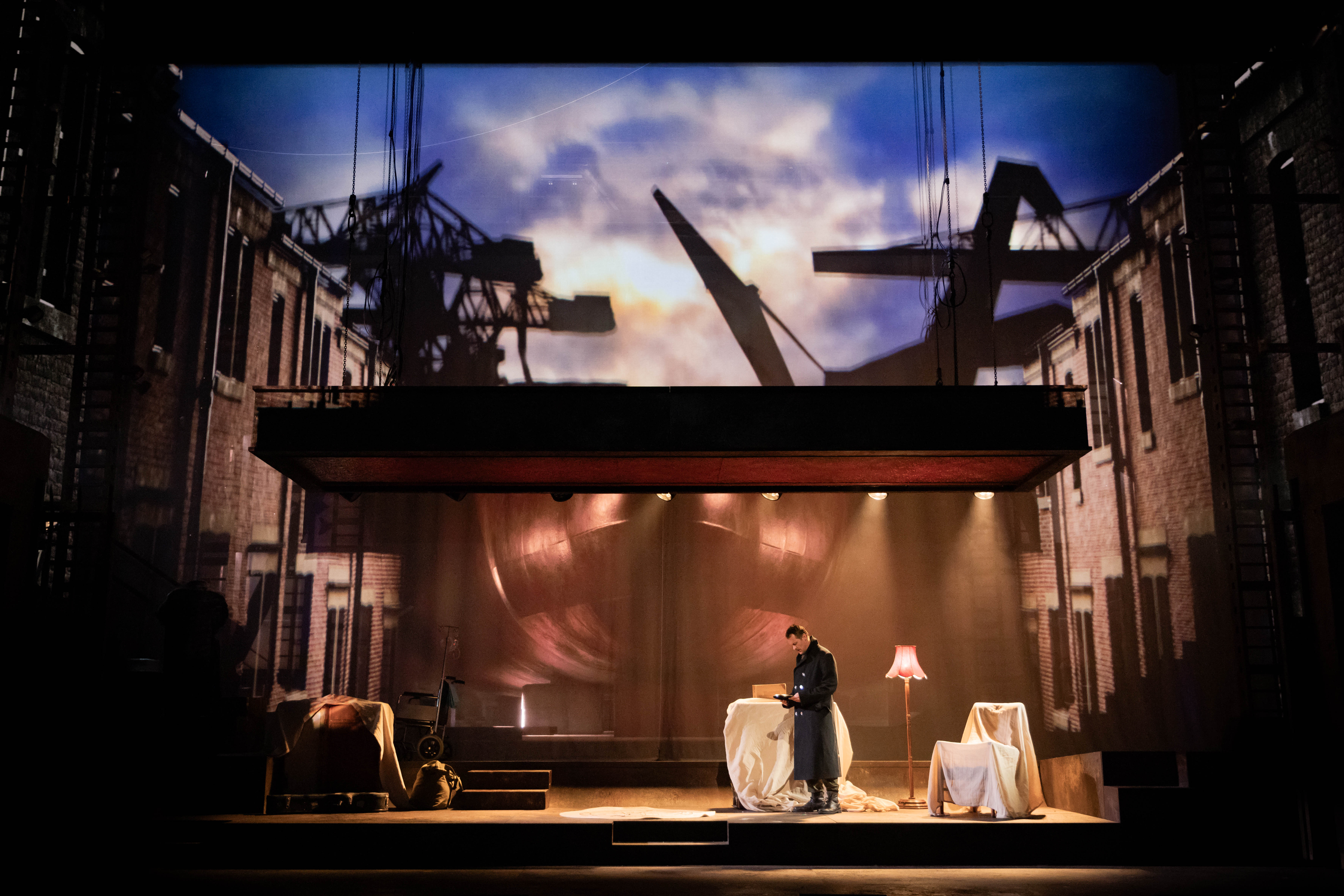
There's something both thrilling and quietly subversive about seeing this story occupy Theatre Royal Drury Lane.
The Last Ship is not coming to London to be authenticated by London. Tyneside doesn't require metropolitan approval of its own history.
What matters is that, for 16 performances, a West End stage will be required to take the life of a northern industrial community seriously - not as comic relief, gritty background texture or a convenient source of regional colour, but as the centre of the world.
A company of more than 50 will bring that world to the stage. Declan Bennett returns as Gideon, with Frances McNamee as Meg, Jackie Morrison as Peggy White, Cassiopeia Berkeley-Agyepong as Baroness Tynesdale, Matt Beveridge as Freddy Newlands and Tyneside actor Joe Caffrey as Billy Thompson.
Lejaun Sheppard will play the Wallsend Ferryman from 24 September until the end of the run. For the first two performances only, the role will be taken by Sting’s friend and collaborator Shaggy, adding an unexpected Caribbean presence to the Tyne.
The score includes songs such as Island of Souls, All This Time and When We Dance, alongside new material written for this latest staging. Sting’s music moves between folk song, intimate ballad and the kind of communal chorus that seems constructed to be sung by people standing shoulder to shoulder.
This isn't a Sting concert carrying a little theatrical scenery. It's a large-scale musical in which Sting has placed himself inside the community that made him - no longer the boy looking out at the yard, but Jackie White, the older man trying to hold its people together.

There are perfectly sensible objections to encouraging northerners to travel to London to see a story about their own lives. The North has extraordinary theatres, writers, actors and audiences. Northern work shouldn't have to migrate before it's regarded as important.
But that's also why this particular journey feels worthwhile.
Northern audiences won't be travelling merely to consume a West End spectacle. They'll be going as witnesses - people capable of recognising what the show gets right, what it simplifies and whether the humanity beneath the industrial mythology rings true.
There has also got to be some pleasure in the reversal.
For generations, people were expected to leave places such as Wallsend to pursue opportunity in London. This September, it is the people, music and memories of Wallsend that will take possession of one of London’s most celebrated stages.
A direct train south, in other words, doesn't always have to represent escape. Sometimes it can be an act of return.
Several performances are afternoon matinees, making a same-day rail journey possible from parts of the North, while an overnight visit would allow audiences to treat the production as something more significant than another West End show.
Because this one carries Tyneside history with it.
The yards at Wallsend might no longer command the landscape as they once did, but the people who worked there haven't vanished. Their labour remains in family stories, archives, bodies, buildings and the vessels they sent out into the world.
For two weeks this autumn, it will also be heard in song beneath the chandeliers of Drury Lane.
The Tyne is heading for London.
Perhaps some of us should go with it.





